The Indian Town: An Ecosystem Without an Architect
Guwahati's apparent urban chaos sustains commerce, mobility and close-knit communities. Yet its infrastructure gaps show where coordinated urban governance becomes indispensable.

- Oct 30, 2026,
- Updated Oct 30, 2026, 11:15 AM IST

- Roads attract tea stalls, shops, workshops and vendors without subsidies
- Families build comforting social worlds despite inadequate shared physical surroundings
- Private tanks, septic systems and transport services fill infrastructure gaps
Why our seemingly chaotic towns work—and what urban planners might learn from them
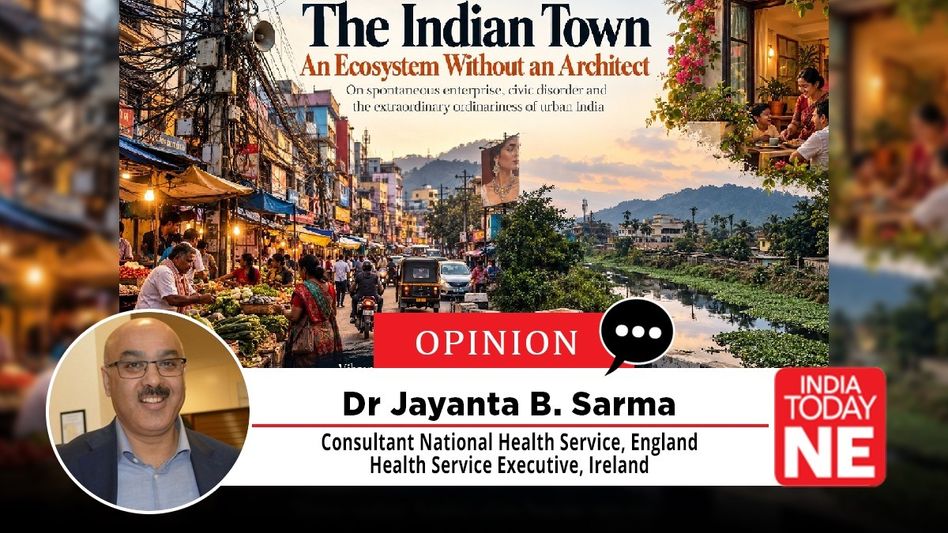
Stand at a busy intersection in Guwahati and look around. Electrical cables hang in extraordinary tangles. A single utility pole may support loudspeakers, traffic signals and an assortment of equipment installed at different times. Shops spill onto pavements, vehicles negotiate their own passage, and roadside vendors conduct brisk business amid the apparent confusion.
A little farther away, a watercourse lies stagnant. Seasonal waterlogging is familiar enough to surprise nobody. Comprehensive underground sewerage remains absent in many neighbourhoods.
Yet the town works.
Shops open, markets flourish, goods arrive, people travel, children attend school, and businesses multiply. More remarkably, people seem genuinely happy with their lives, notwithstanding their dissatisfaction with any number of things.
How does this apparently chaotic urban organism sustain itself?
An economy nobody designed
Consider a simple experiment. Build a road.
Before long, a tea stall appears. Someone opens a grocery shop. A mechanic establishes a workshop. Vegetable vendors occupy convenient positions. Other businesses follow, responding to the movement of people and the opportunities it creates.
No government employment-generation scheme necessarily preceded these developments. No subsidy was required to persuade the tea seller that travellers might want tea.
The road provided access. Enterprise did the rest.
This spontaneous mobilisation of labour, small capital and commercial ingenuity is among the least appreciated characteristics of Indian urban development.
Not every enterprise prospers, and many support only modest livelihoods. Nevertheless, an astonishing amount of economic organisation emerges without anyone designing the whole.
A forest without an architect
Travel through smaller towns in Assam and elsewhere in India, and remarkably similar patterns appear. Roads attract commerce, commerce attracts settlement, and settlement generates demand for further services.
The towns seem to follow an unwritten template.
Who designed it?
Perhaps nobody did.
A forest grows without an architect deciding where every tree should stand. Its structure emerges from countless interactions among organisms and their environment.
Indian towns display something similar. Thousands of independent decisions create recognisable patterns of economic and social life.
The analogy has limits. Towns are shaped by laws, politics, land ownership and public investment. But their everyday functioning owes much to spontaneous organisation.
The town is not simply an unfinished planning project. It is a living ecosystem.
A thousand little oases
Perhaps the most fascinating aspect is the happiness of its inhabitants.
Everywhere, people create their own little মৰুদ্যান—oases of comfort, companionship and aspiration.
A family maintains a pleasant home. A shopkeeper takes pride in a flourishing business. Neighbours socialise, festivals are celebrated, friendships develop, and children grow up within familiar communities.
These are not necessarily unhappy people enduring an unhappy environment. Their happiness can be entirely genuine.
Of course, they may complain about traffic, drains, electricity, public services or a hundred other matters. Happiness does not imply satisfaction with everything.
Nor are these oases isolated. They connect through families, markets, workplaces and neighbourhood relationships, producing a vibrant collective existence.
Here lies the paradox: a town can be physically disordered without being socially dysfunctional.
Its inhabitants may enjoy rich and fulfilling lives even while the shared physical environment remains remarkably inadequate.
Where individual ingenuity reaches its limits
Much of the town's infrastructure is also privately improvised.
Households install water tanks, pumps and septic tanks. Small workshops maintain vehicles and machinery. Informal recycling networks recover valuable materials. Local transport operators fill gaps in mobility.
Taken together, these represent enormous investments of individual effort and resources.
But private solutions have limits. Septic tanks require proper maintenance and safe sludge disposal; their mere presence does not guarantee environmental sanitation.
And consider water.
A shopkeeper can open a business independently. A household can construct a septic tank. But nobody can independently maintain an entire drainage catchment.
Water crosses property boundaries. Obstructions upstream create consequences downstream. Natural channels require coordinated protection and maintenance.
The town can spontaneously organise a marketplace, but it cannot necessarily organise the movement of water.
Similarly, each new cable attached to a utility pole may solve an immediate problem. Collectively, the additions can produce an extraordinary accumulation for which responsibility becomes unclear.
Individually sensible decisions do not always produce collectively sensible outcomes.
That is where urban governance becomes indispensable.
Consumer modernity, civic inadequacy
Another contradiction is impossible to miss.
Expensive cars navigate damaged roads. Sophisticated advertisements promote premium lifestyles above crowded pavements. Modern shopping facilities coexist with inadequate drainage.
Consumer modernity has advanced much faster than civic modernity.
The explanation is not particularly mysterious. Individuals and businesses can purchase improvements when they have the resources. A drainage network, safe pavement or coordinated utility system requires collective decisions, public investment and continuing maintenance.
Private aspirations can therefore flourish while public infrastructure stagnates.
But does this mean we should attempt to rebuild Indian towns in the image of Western cities?
Not necessarily.
An Indian model of urbanism
Imagine a planner with unlimited resources attempting to reconstruct an Indian town according to an ideal master plan.
The engineering problems could be addressed. But every pavement, roadside market and commercial frontage already supports economic and social relationships.
Wholesale reconstruction might eliminate disorder while destroying livelihoods and disrupting established networks.
And unless the institutions governing subsequent development change, the familiar patterns could gradually reappear.
Perhaps we are asking the wrong question.
Rather than wondering how to make an Indian town resemble a Western city, we should ask how to make an Indian town a better Indian town.
Build roads with drainage, pedestrian access, utility corridors and provision for the commerce that will inevitably emerge. Improve informal markets rather than simply displacing them. Integrate existing household sanitation into safe, organised systems. Protect natural waterways. Establish clear responsibility for shared infrastructure.
Allow enterprise to flourish, but prevent the accumulated consequences of individual decisions from degrading the collective environment.
This approach could have significance well beyond India, particularly for developing countries where urban growth frequently outpaces the capacity to build comprehensive infrastructure.
The objective should not be to suppress spontaneous organisation. It should be to create the conditions in which it produces better outcomes.
The Indian town is neither a failed Western city nor a model of perfection. It is an extraordinary social and economic organism inhabiting an imperfect physical environment.
Its people have already demonstrated how much they can create without an architect.
The next challenge is to understand what they cannot create independently.
If society can spontaneously generate so much enterprise, vitality and happiness, what precisely must the state provide—and what should it leave society to create for itself?
That may be the starting point for a genuinely Indian model of urban development.
(The views expressed in this article are those of the author and do not necessarily reflect the views of India Today NE or its affiliates)