The Manufactured Scarecrow: How Delimitation, Demography, and State Bias Fuel Ethnic Cleansing in Manipur
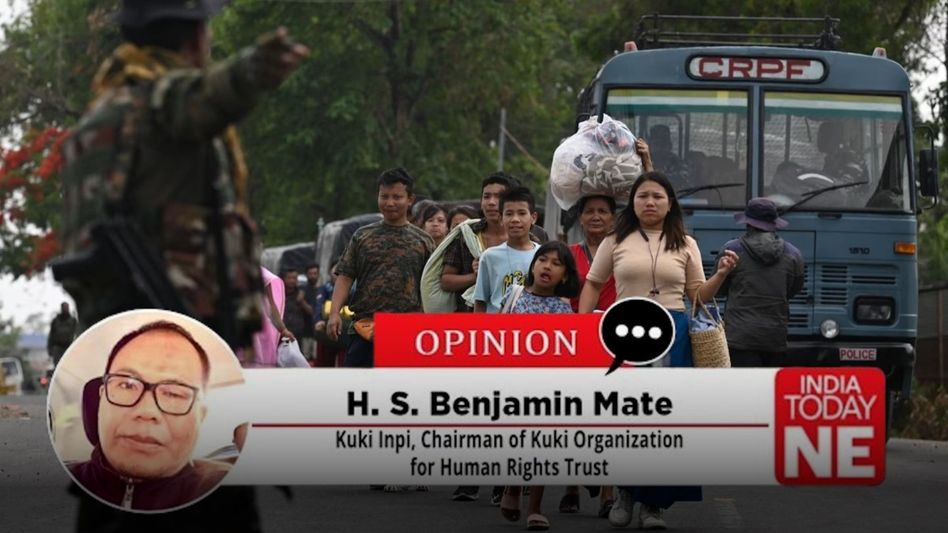
Since May 3, 2023, Manipur has been the stage for what analysts from the London School of Economics have termed a campaign of "ethnic cleansing."

- Dec 08, 2025,
- Updated Dec 08, 2025, 9:13 AM IST

Since May 3, 2023, Manipur has been the stage for what analysts from the London School of Economics have termed a campaign of "ethnic cleansing."
The numbers are numbing but essential: over 260 lives lost, more than 60,000 people displaced into squalid camps, and over 400 churches torched. This is not a spontaneous "clash."
It is the violent culmination of a decades-long political project to disenfranchise the hill tribes of Manipur—first through legal and demographic manipulation, and now, as that system frays, through state-tolerated terror. At its heart lies a rigged electoral map and the cynical weaponization of the "illegal immigrant" slur against the Kuki-Zo people.
A Democracy Rigged at its Foundation: The 1972 Map
To understand the present inferno, one must start with a map drawn in 1972. Manipur's first post-statehood delimitation, based on the 1971 census, was rigged from inception. The Meitei-majority leadership, dominating the new assembly, carved 40 assembly seats for the valley against a mere 20 for the hill tribes. This was despite near-parallel populations and the tribal communities being the stewards of over 90% of the state's land area. This "ill-gotten" edge gifted the valley perpetual control over budgets, land policy, and executive power, rendering constitutional safeguards like Article 371C's Hill Areas Committee ineffective.
The first crack in this edifice appeared with the 2001 Census.
Provisional data signaled a democratic correction: it projected five additional Scheduled Tribe (ST) seats for the hills, which would trim the valley's excessive representation.
The Meitei political establishment's response was revealing. They did not engage in debate; they went to court, alleging "fraudulent" population spikes in tribal areas. While a Gauhati High Court order for recounts was boycotted by distrustful tribal communities, officials arbitrarily slashed 90,000 tribal residents from the rolls. As the petitioner in the subsequent Supreme Court case, I witnessed our legal victory—a July 2007 stay that upheld the sanctity of census data—be overridden by backroom politics. A Meitei-lobbied 2008 ordinance deferred all delimitation in Manipur indefinitely on vague "security" grounds, freezing the unjust map.
Also Read: Manipur is not an “Ethnic Conflict” — It is a test of India’s Democracy
The 2011 Census became an exercise in perpetuating this deceit through hill undercounts and the bureaucratic "tagging" of tribal villages to valley districts. The goal was singular: preserve the 40:20 seat ratio at any cost.
From Data Manipulation to Violent Erasure
The fuse for the current violence was lit on March 27, 2023, when the Manipur High Court directed the state to consider the Meitei community's demand for Scheduled Tribe (ST) status. For Kuki and Naga tribes, this was not an issue of identity but of existential threat—a legal gambit seen as a prelude to Meiteis buying land in their protected ancestral hill areas. Protests began, and on May 3, violence erupted.
What followed was not a chaotic riot but a one-sided pogrom, enabled by state machinery. Human Rights Watch has documented a "pro-Meitei bias" in the state government's conduct, noting that "Meitei vigilante groups have operated with the support of the state government" while "law enforcement has often stood by or even joined in the violence." Mobs, patronized by this environment, have committed atrocities documented globally: the parading and sexual assault of Kuki-Zo women, beheadings, and the systematic burning of villages. Former Chief Minister Biren Singh fueled the flames, publicly accusing the Kuki-Zo of being "narco-terrorists" and "illegal immigrants" from Myanmar—a narrative that weaponized the arrival of 5,000+ refugees fleeing the Myanmar coup to tar an entire indigenous community.
The Looming Reckoning and a Blueprint for Justice
The Meitei elite's terror is, at its core, a desperate pre-emptive strike. Articles 82 and 170 of the Indian Constitution mandate a delimitation exercise after the next census, due in 2026. A fair count and redraw risk finally rolling back the 1972 gerrymander, restoring political weight to the hills. Having exhausted legal delays, the playbook has shifted to a brutal, demographic one: if you cannot win votes, erase the voters.
This is the shadow of Nuremberg—not in scale, but in method. The bureaucratic denial of personhood (querying origins, conditional citizenship) precedes and enables physical horror. When a people are first made "illegal" in the ledgers, violence against them becomes legitimized.
Justice, therefore, must begin with restoring truth to the ledger and accountability to the state:
1. An independent, third-party audit of hill population data.
2. A judicially monitored delimitation exercise.
3. The release of all disaggregated census data and anti-"tagging" safeguards.
4. Unfettered FIRs against all perpetrators, with witness protection.
5. A truth commission to document the state's role.
As I argued in 2007: "No delimitation, no elections." The principle holds. To hold an election on a map born of manipulation and maintained by ethnic cleansing is to sanctify the crime. The Kuki-Zo are not intruders; they are guardians of their land and rightful citizens. India must choose: will it uphold a republic defined by constitutional fidelity for all, or allow a falsified tally to forge its ruin?
Sidebar: Census-Delimitation Timeline & Key Facts
· 1972: The first delimitation rigs the system: 40 valley seats vs. 20 hill seats, despite tribal stewardship of 90% of the land.
· 2001: Census projects hill gains; data is contested in court. The Supreme Court stays re-verification in 2007.
· 2008: Parliament amends the Delimitation Act, singling out Manipur for an indefinite freeze.
· March 2023: Manipur High Court's order on Meitei ST status acts as a immediate trigger for protests.
· May 3, 2023: State-tolerated violence begins, escalating into what the LSE describes as "ethnic cleansing."
· 2026 Onwards: The next census and the constitutionally mandated delimitation loom, creating the political pressure fueling the crisis.
The Stakes of Delimitation: Delimitation redraws electoral seats and reserves. It dictates budgets, land laws, and political power. In Manipur, a manipulated population count equates to stolen sovereignty.