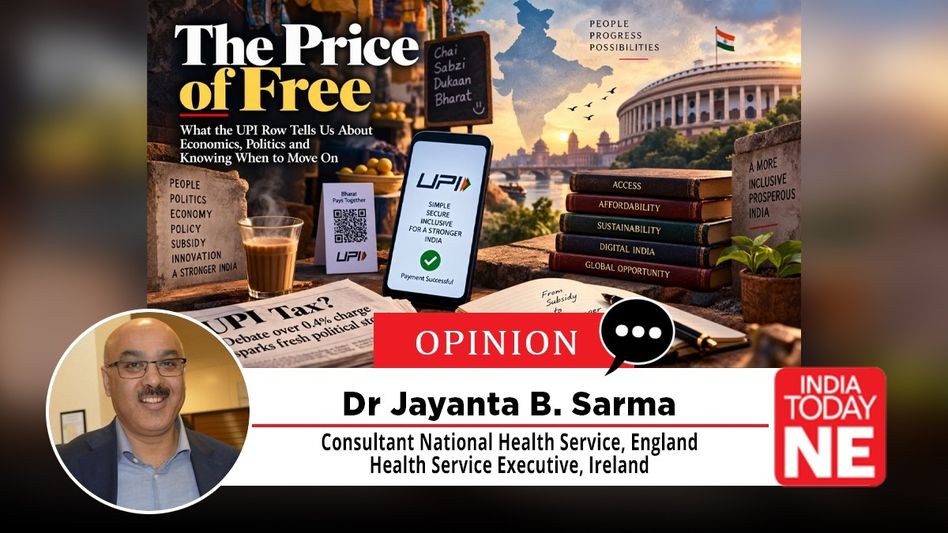
The Price of Free: What the UPI row tells us about economics, politics and knowing when to move on
The Unified Payments Interface turned ten in August. In that decade it went from 1.78 crore transactions in its first financial year to 24,162 crore in 2025–26. It now accounts for about 84 per cent of India's digital payments by volume. In August 2026 alone, Indians made about 24.5 billion UPI transactions worth nearly ₹30 lakh crore.

- Sep 19, 2026,
- Updated Sep 19, 2026, 12:19 PM IST

India has spent a decade teaching us that moving money can feel almost costless. It may now have to teach us the much harder lesson that almost nothing actually is.
The Unified Payments Interface turned ten in August. In that decade it went from 1.78 crore transactions in its first financial year to 24,162 crore in 2025–26. It now accounts for about 84 per cent of India's digital payments by volume. In August 2026 alone, Indians made about 24.5 billion UPI transactions worth nearly ₹30 lakh crore.
For millions of Indians, these statistics are almost beside the point. UPI's achievement is better understood at the tea stall, vegetable cart or autorickshaw.
Scan. Enter. Pay.
Something that once required cash, change, a card terminal or a visit to a bank became an almost unconscious gesture.
Then came 0.4 per cent.
From October 15, a Merchant Discount Rate of 0.4 per cent will apply to specified merchant transactions above ₹2,000. Person-to-person transfers remain free. Payments up to ₹2,000 remain free, as do qualifying small merchants. There are concessions for specified sectors, and the charge is capped at ₹300 for larger transactions. The government estimates that about 96 per cent of merchant transactions by number will remain unaffected.
And suddenly an economic question became a political one.
When zero becomes an entitlement
Congress leader Rahul Gandhi has called the new MDR a “UPI tax”, demanded its withdrawal and accused Prime Minister Narendra Modi of yielding to American pressure. Congress leaders have specifically asked whether the change benefits American payment companies such as Visa and Mastercard. The government rejects that account and insists that MDR is neither a government tax nor a charge upon the consumer.
The politics is easy to understand.
UPI was free. Now somebody is being charged.
Everything after that requires explanation, and explanations rarely defeat slogans in the first round.
Yet the economics deserves examination before we decide what the politics means.
UPI was never actually free.
Computers processed the transactions. Banks maintained systems. Networks carried data. Payment applications were developed and maintained. Fraud had to be detected. Disputes had to be resolved. Cybersecurity had to be strengthened. Servers, engineers and customer-service operations had to be paid for.
Zero was the price presented at the point of transaction. It was not the cost of producing the transaction.
A parliamentary committee recently estimated the annual operating cost of the UPI ecosystem at about ₹20,700 crore, while the government's allocation was ₹2,000 crore. It warned that the gap could eventually affect investment in cybersecurity, fraud prevention and network infrastructure and recommended exploring a self-reliant, tiered revenue model.
That changes the question.
It is no longer simply: should Indians have free UPI?
It is: who should pay for UPI?
What exactly did India invent?
There is a temptation to think that UPI's great innovation was free payment.
I suspect that understates what India accomplished.
Visa and Mastercard could process digital payments long before UPI existed. They operate formidable global networks. India did not invent electronic money.
What UPI did was alter its architecture and economics.
A conventional card ecosystem contains several layers and, particularly for credit cards, pays for considerably more than the transportation of money: acquiring, issuing, network services, fraud risk, credit, rewards and other costs. Merchant charges of roughly 1.5 to 3 per cent are consequently familiar in card economies.
UPI asked a simpler question.
If I already have ₹10,000 sitting in my bank account and merely want to move it into yours, why should transferring those deposits necessarily carry the economics of a credit-card transaction?
India effectively separated payment from credit.
It also created an interoperable rail upon which competing banks and applications could operate. A merchant did not necessarily need an expensive terminal. A printed QR code could be sufficient.
That mattered enormously in an economy containing millions of tiny merchants.
The relevant comparison now is therefore not merely:
0 per cent versus 0.4 per cent.
It is also:
0.4 per cent versus perhaps 2 or 3 per cent.
On a ₹10,000 purchase, 0.4 per cent is ₹40. Two per cent is ₹200. Three per cent is ₹300.
There are differences between the services, particularly where credit cards provide actual credit and rewards, so this is not a perfect like-for-like comparison. But it reveals something important.
Perhaps India's achievement was never discovering how to make payments free.
Perhaps it was discovering how to make them extraordinarily cheap.
That distinction matters enormously for what should happen next.
The economics of knowing when you have succeeded
There was a strong argument for subsidising UPI when India was trying to establish it.
Payment systems exhibit network effects. A payment system used by ten thousand people is not very useful. Every additional consumer makes the network more attractive to merchants; every additional merchant makes it more useful to consumers.
Government intervention can accelerate that process.
But successful intervention eventually creates its own paradox.
It works.
UPI today connects hundreds of banks and hundreds of millions of users. It is not an infant technology pleading for acceptance. It is India's dominant digital-payment rail.
The policy question must therefore change.
The economic justification for spending the first ₹1,000 crore helping create a national payment network may have been overwhelming. That tells us surprisingly little about whether spending the next ₹1,000 crore subsidising transactions on an already dominant network is equally worthwhile.
Economists call the missing alternative the opportunity cost.
That ₹1,000 crore could support UPI.
Or healthcare.
Schools.
Rural broadband.
Water.
Cybersecurity.
Or India's next piece of digital public infrastructure.
The correct comparison is not UPI versus nothing.
It is the next rupee spent on UPI versus the next rupee spent somewhere else.
And here politics encounters a serious disadvantage.
Opportunity cost is invisible.
Nobody receives a message saying:“Your share of the public money used to subsidise this payment was ₹1.63.”
Nor does anyone see the clinic, road, broadband connection or laboratory that was not funded because the money was spent elsewhere.
But the merchant can see ₹40 disappearing from a ₹10,000 transaction.
The visible ₹40 will almost always defeat the invisible alternative in political theatre.
A curious parliamentary complication
This is where the present Congress attack becomes interesting.
Five Congress MPs—including P. Chidambaram, Manish Tewari and Gaurav Gogoi—were members of the parliamentary committee when its report addressing UPI's funding problem was adopted. The published minutes recorded no formal dissent. The committee argued for a sustainable, tiered revenue framework rather than perpetual dependence upon government subsidy.
Congress has subsequently objected to the suggestion that this means its MPs endorsed the government's present policy.
That qualification is legitimate.
Manish Tewari has pointed out that the specific 0.4 per cent rate, thresholds, ceilings and exemptions subsequently announced by the government were never placed before the committee. He and Gaurav Gogoi also say members had raised concerns about MDR during committee deliberations.
Both propositions can therefore coexist.
Congress members did not record formal dissent from a committee report recognising the need for a sustainable revenue model.
That does not prove that they approved this particular 0.4 per cent scheme.
But the episode illuminates something more interesting than partisan inconsistency.
Inside a parliamentary committee, politicians encounter costs, infrastructure, cybersecurity, revenue models and sustainability.
Outside Parliament, they encounter voters.
The incentives are not the same.
The race to the bottom
Economics provides a useful metaphor: the price war.
One company cuts its price to attract customers. Its competitor responds. The first company cuts again. Each decision can be individually rational because refusing to respond means losing customers.
Collectively, however, competition can drive both towards an outcome neither originally desired.
A race to the bottom.
Politics can develop a remarkably similar structure.
One government subsidises something.
Its opponent promises more.
Eventually the price presented to the citizen reaches zero.
At that moment something psychologically important happens. The subsidy ceases to feel like a subsidy.
It becomes an entitlement.
Any attempt to restore even a modest price can then be described not as reducing a subsidy but as taking something away.
And political price wars possess one advantage unavailable to commercial ones.
A company selling permanently below cost eventually goes bankrupt.
A government can send the bill to the taxpayer.
Zero therefore acquires a strange political meaning. It no longer means that something costs nothing. It means that somebody other than the immediate beneficiary pays.
The electorate is not necessarily foolish for responding to this.
Human beings naturally respond more strongly to visible losses than dispersed hypothetical gains. Politicians understand that instinct because they share it.
The opposition therefore has a powerful incentive to call 0.4 per cent a “tax”.
The government has an equally powerful incentive to describe anyone questioning its policy as defending an unsustainable subsidy.
Soon the economic question disappears beneath point-scoring.
That too is a race to the bottom—this time in explanation.
Governments create these traps too
It would nevertheless be convenient, and wrong, to blame only opposition politics or the electorate.
Governments create expectations.
For years, zero-MDR UPI was celebrated as a feature of India's digital revolution. If governments repeatedly advertise something as free without explaining who is actually paying for it, they should hardly be surprised when citizens eventually believe that zero is its natural price.
Nor are merchant objections frivolous.
Retail organisations have warned that additional costs could encourage some businesses to prefer cash or incorporate payment costs indirectly into prices. A legal challenge has also reached the Supreme Court. These are legitimate consequences to investigate rather than dismiss.
The economically interesting question is therefore not whether 0.4 per cent is obviously right.
Perhaps it is too high. Perhaps it is too low.
We now have an opportunity to find out.
Watch whether merchants abandon UPI. Watch cash usage. Watch payment failures and fraud. Watch investment in infrastructure. Watch whether competition drives payment costs down. Watch whether the subsidy requirement declines without damaging inclusion.
Good public policy should be capable of changing when evidence changes.
India's next opportunity may be outside India
There is another reason not to reduce the future of UPI to an argument about forty paise per hundred rupees.
India may have created an exportable piece of digital infrastructure.
UPI is now operational in some form—acceptance and/or cross-border remittances—in 11 foreign countries. India has established or developed connections stretching from Singapore and the UAE to France, Nepal, Mauritius, Cambodia, Greece and the Maldives. The government says UPI accounted for about 49 per cent of global real-time payment transaction volume in 2025.
That raises a much more ambitious question:
Can India capitalise on what it has built?
Not necessarily by turning UPI into another Visa or Mastercard and extracting the highest possible fee from every transaction. Doing so could destroy precisely what makes the Indian architecture attractive.
The opportunity may instead be in exporting standards, interoperability, engineering expertise and infrastructure.
Countries with large unbanked or underbanked populations may find India's account-to-account model more attractive than reproducing the entire historical journey through cards and terminals.
Cross-border UPI connections could lower remittance costs.
Indian fintech firms could build services around foreign implementations.
Indian travellers could increasingly pay abroad directly from Indian accounts.
Foreign payment systems could connect to India's.
UPI could become not merely an Indian convenience but an Indian technological standard.
If so, perhaps that is where the next public rupee should go.
Not towards permanently subsidising every large domestic purchase, but towards making UPI more resilient, secure, interoperable and internationally useful.
The difficult art of declaring victory
Public policy is surprisingly bad at recognising success.
Failed programmes develop institutions that resist abolition.
Successful programmes develop beneficiaries who resist change.
UPI presents India with the much happier second problem.
Government and the banking ecosystem helped build something. Public policy encouraged its adoption. Merchants joined. Consumers joined. Private applications flourished. Network effects took over.
UPI became ordinary.
That is an extraordinary achievement.
But successful policy does not necessarily mean continuing forever with precisely the policy that produced the success.
The support required by a sapling is not necessarily required by the mature tree.
There remain powerful reasons for protecting tiny transactions and small merchants, expanding access among people still excluded from digital finance, and investing publicly in cybersecurity, fraud prevention and resilience.
There is a much less obvious reason why taxpayers should indefinitely subsidise every economically capable participant in an already dominant payment network.
And there lies the dilemma.
Economics asks whether the next rupee could produce more somewhere else.
Government worries about the political cost of saying so.
Opposition discovers that yesterday's subsidy makes an excellent weapon against today's reform.
The voter sees the ₹40 but cannot see the opportunity cost.
And everyone begins racing towards the politically irresistible price:
zero.
UPI's greatest achievement may ultimately help India escape that trap.
It has demonstrated that the alternative to an expensive commercial payment network need not be a permanently taxpayer-funded payment network.
There is a third possibility:
a mature, interoperable Indian payment infrastructure that is extraordinarily inexpensive, commercially sustainable, protective of small users—and increasingly valuable to the rest of the world.
If India can make that transition, charging something where once it charged nothing need not mean that the UPI experiment has failed.
It may mean that the experiment has succeeded enough for India to move on to the next one