The Question Behind Vijay’s Promise
Tamil Nadu’s new political moment raises a deeper democratic question: is personal honesty enough to reform a system that reproduces corruption structurally?
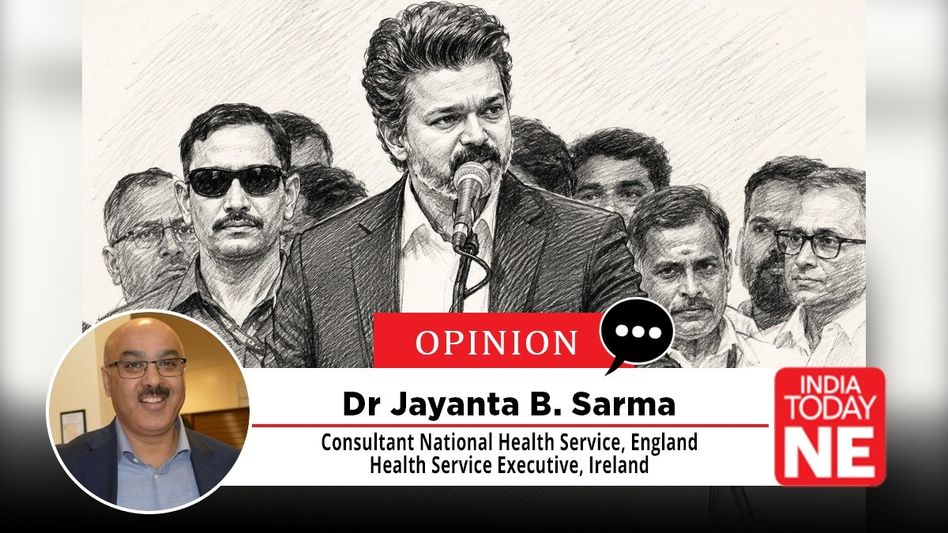

- May 11, 2026,
- Updated May 11, 2026, 2:38 PM IST

When Vijay declared that he was not in politics for money and would not indulge in corruption, the statement resonated powerfully across Tamil Nadu. In a country weary of scandals, patronage, and opaque political financing, such a declaration was naturally reassuring. Yet the very obviousness of the statement also invites a more uncomfortable question.
Who exactly believed that Vijay entered politics to personally steal money?
He is not a conventional politician emerging from the shadows of business contracts, local patronage networks, or dynastic political structures. He is already among the wealthiest and most culturally influential public figures in southern India. His wealth was accumulated long before he sought formal political office. His fame predates his power.
That distinction matters.
The scepticism surrounding celebrity politicians is therefore rarely about direct personal corruption. The deeper concern is whether personal wealth, mass popularity, and moral signalling automatically translate into an understanding of how political systems actually function.
This is a far more sophisticated democratic question than the simplistic binary of “honest versus corrupt.”
Modern political discourse often treats corruption primarily as a moral failing of individuals. The assumption is straightforward: elect a personally clean leader and governance will improve automatically. History, however, repeatedly demonstrates that this is not necessarily true.
Corruption in democracies is rarely sustained merely by greedy individuals. It survives through systems — election financing structures, bureaucratic incentives, contractor ecosystems, party machinery, welfare-distribution leakages, informal networks of influence, and institutional cultures that gradually normalise transactional behaviour.
A personally honest leader entering such an ecosystem does not automatically dismantle it. Sometimes the system absorbs the leader faster than the leader reforms the system.
This is why Vijay’s statement, while politically understandable, also felt incomplete to some observers.
One expected not merely a moral assurance but perhaps a systems diagnosis.
Not:
“I will not be corrupt.”
But:
“I understand why corruption reproduces itself even under personally honest governments.”
That would have been a far more radical political statement.
Yet politicians rarely speak in such terms because the moment corruption is openly described as systemic, difficult questions immediately follow. Which institutions are compromised? Which political practices enable it? Which financiers shape power? Which entrenched interests will be confronted? Which networks will lose access?
Such clarity creates adversaries before governance even begins.
Therefore, most political communication remains safely moral rather than structurally analytical. Individual virtue is easier to communicate than institutional redesign.
Still, public scepticism remains legitimate.
If a person possesses extraordinary wealth, influence, and public devotion for decades before entering politics, citizens are entitled to ask what evidence exists of prior societal transformation.
Did the individual build enduring educational institutions? Public-health systems? Civic platforms? Governance models? Administrative innovations? Did he articulate a coherent philosophy of statecraft before seeking office? Or did politics emerge only after cultural dominance had already been achieved?
This is not cynicism. It is democratic maturity.
Because public service and political power are not identical things.
There is, of course, a counterargument. One may reasonably argue that philanthropy alone cannot alter structural realities in a country like India. A celebrity may fund hospitals, schools, scholarships, or charities, but cannot fundamentally redesign policing, bureaucracy, welfare delivery, or governance architecture without political authority. Many successful individuals eventually conclude that charity treats symptoms while political power controls systems.
That logic is not irrational.
Yet the question persists because societies instinctively search for continuity between private success and public vision. Citizens wish to know whether politics is the culmination of an already demonstrated civic imagination or merely the next arena of influence.
Tamil Nadu’s political culture adds another layer to this phenomenon. Cinema there has historically functioned not merely as entertainment but as political mythology. Figures such as M. G. Ramachandran and J. Jayalalithaa transformed cinematic familiarity into emotional political legitimacy. Voters often feel they already “know” such personalities intimately through decades of symbolic exposure.
That emotional trust is politically powerful. But emotional familiarity is not the same thing as demonstrated administrative philosophy.
The extraordinary rise of Vijay’s movement reflects genuine public exhaustion with established political arrangements. Voters clearly desired disruption. But disruption and transformation are not always the same phenomenon.
Indeed, the fractured mandate itself may become Vijay’s first real encounter with systemic politics. Moral clarity is easiest before negotiation begins. Governance, however, is the management of competing interests, institutional inertia, bureaucratic realities, and political compromise.
That is where celebrity politics meets administrative reality.
Ultimately, the most important democratic question is not whether Vijay is personally corrupt. Few serious observers appear to believe that. The more profound question is whether he possesses a sufficiently deep understanding of how power reproduces itself inside the state.
Because systems do not change merely because good people arrive at the top.
They change only when someone understands why the system behaves as it does in the first place.
(Author’s Note: Dr Jayanta Biswa Sarma writes on politics, institutions, and society through the lenses of history, philosophy, and systems thinking, drawing on both Indian and Western intellectual traditions. Artificial intelligence tools may be used in preparing this article as research and editorial aids. All arguments, interpretations, and final editorial judgement remain the author’s responsibility)