The RSS and the Northeast’s Search for Common Ground
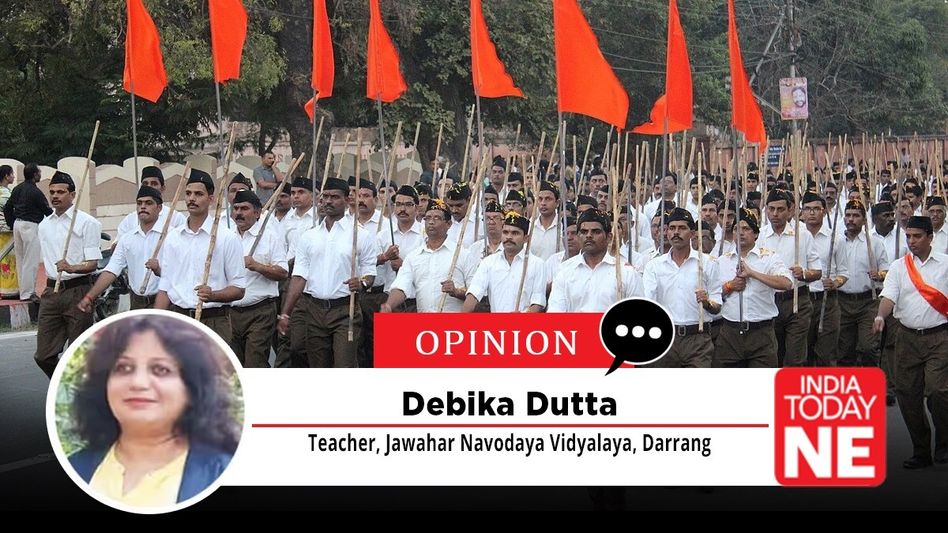
The centenary of the Rashtriya Swayamsevak Sangh (RSS), founded in Nagpur in 1925, offers an occasion to reflect not only on the organisation’s long journey but also on a question central to India’s national life: how can a diverse society strengthen its common civic identity without diminishing the distinct cultures that give its regions their character? In the Northeast, where language, ethnicity, faith and historical experience shape public life in distinctive ways, this question deserves particular care.

- Oct 20, 2026,
- Updated Oct 20, 2026, 1:41 PM IST

The centenary of the Rashtriya Swayamsevak Sangh (RSS), founded in Nagpur in 1925, offers an occasion to reflect not only on the organisation’s long journey but also on a question central to India’s national life: how can a diverse society strengthen its common civic identity without diminishing the distinct cultures that give its regions their character? In the Northeast, where language, ethnicity, faith and historical experience shape public life in distinctive ways, this question deserves particular care.
The Northeast is not a single cultural or political landscape. It is a mosaic of communities, languages, customary institutions and religious traditions. Its people have contributed richly to India’s literature, sports, public service, armed forces, scholarship and economic life. Yet the region’s relationship with the national mainstream has at times been affected by geographical distance, inadequate understanding and stereotypes. Any organisation that seeks to promote national integration must therefore approach the region with humility, patience and a genuine appreciation of its social complexity.
The RSS’s engagement with Assam and the wider Northeast has a history that reaches back several decades. Accounts of its early expansion record the arrival of pracharaks Dadarao Parmarth, Vasantrao Oak and Krishna Paranjpe in Assam in October 1946. Organisational activities subsequently developed in places including Guwahati, Shillong and Dibrugarh. These beginnings took place in a period of profound political change, when questions of identity, belonging and the future of the region were becoming increasingly significant. The historical record is a starting point, however, not a substitute for examining how relationships with communities have evolved over time.
For the Northeast, national integration cannot mean cultural uniformity. The region’s indigenous traditions, customary laws, community institutions and languages are not obstacles to national unity; they are part of India’s civilisational richness. A meaningful idea of unity must make room for this diversity and recognise that people can maintain a strong sense of local identity while participating fully in the life of the Republic. The test of any social or cultural movement is whether its work strengthens mutual respect and enables communities to feel that their identity is understood rather than merely accommodated.
Education and youth engagement can help build such understanding. The Vivekananda Kendra Vidyalaya network, which began its work in Arunachal Pradesh in 1977, is one example of an educational initiative associated with the wider family of organisations influenced by national cultural ideas. Similarly, the Akhil Bharatiya Vidyarthi Parishad’s Students’ Experience in Interstate Living programme, initiated in 1965, has sought to familiarise students with the lives and cultures of people in other parts of the country. Such initiatives can create lasting friendships when they encourage genuine exchange rather than a one-way lesson in national identity.
The most meaningful form of integration is often achieved through ordinary acts of service. Relief work during disasters, support for education, health-related initiatives and assistance to communities facing hardship can establish trust where speeches and slogans cannot. Volunteers associated with the RSS took part in relief efforts following the Assam earthquake of 1950, an episode that forms part of the broader history of voluntary service in the region. Service earns public confidence only when it is responsive to local needs, transparent in purpose and offered without discrimination. The dignity of the recipient must remain central.
At the same time, the Northeast’s social realities call for sensitivity. Communities have legitimate concerns about the preservation of indigenous languages, land and customary practices, as well as religious freedom and the protection of minority rights. These concerns should not be dismissed as signs of distance from the national mainstream. They are part of the democratic conversation through which citizens seek security, dignity and a fair place in the Republic. Any movement operating in this setting must demonstrate through its conduct that national belonging does not require people to abandon their heritage or surrender their constitutional rights.
Public perceptions of the RSS are diverse, and no single description can capture the views of all communities across the region. The organisation’s supporters point to discipline, voluntary service and cultural awareness; critics raise questions about majoritarianism, social pluralism and the place of minority identities. A mature assessment should neither substitute praise for evidence nor allow suspicion to foreclose dialogue. It should consider specific activities, listen to the people affected by them and judge outcomes by whether they promote social trust, equal citizenship and peaceful coexistence.
For the RSS, the centenary is therefore an opportunity not merely to look back but to listen more closely. The Northeast’s young people are negotiating rapid social change, migration, digital transformation, educational aspirations and new economic possibilities. They need institutions that help them develop confidence, opportunity and civic responsibility while respecting the languages and traditions inherited from their families and communities. Dialogue with students, educators, tribal bodies, women’s groups, religious leaders and local civil society can make engagement more credible and grounded in lived experience.
The region also needs stronger connections with the rest of India that go beyond ceremonial visits or occasional cultural events. Student exchanges, shared research, sports, literature, entrepreneurship and collaborative environmental work can help citizens understand one another through sustained contact. The Northeast’s ecological knowledge, artistic traditions and community-centred practices have much to contribute to national debates on sustainable development and social cohesion. Integration should be a two-way process: the region should be better understood by India, and its own insights should help shape India’s future.
Ultimately, national unity is strongest when it rests on trust rather than compulsion. The Constitution provides the framework: equal citizenship, freedom of conscience, cultural and educational rights, and the rule of law. These principles are not barriers to social cohesion; they are its foundation. Organisations with a national presence can contribute positively when they work within this constitutional framework, respect the plural character of society and recognise that public confidence must be earned continuously.
The RSS’s centenary invites a larger reflection on the meaning of belonging in a country as varied as India. The Northeast should not be approached as a distant frontier that needs to be brought closer to the nation, but as an integral and influential part of the nation whose people have their own histories, aspirations and contributions. The real measure of national integration will be found not in uniformity of thought or culture, but in the ability of different communities to work together without fear or erasure. India’s unity will be strongest when no community feels compelled to choose between its cultural inheritance and its national belonging.