The silent mystic of Dhubri: Lessons beyond the floods
Olok Saha’s devotion during Dhubri floods inspires hope and unity. Government and volunteers join hands in rescue and relief efforts, embodying true spirituality.

- Aug 01, 2026,
- Updated Aug 01, 2026, 7:08 PM IST

The world sees what the eyes can see. Faith sees what the soul alone can understand.
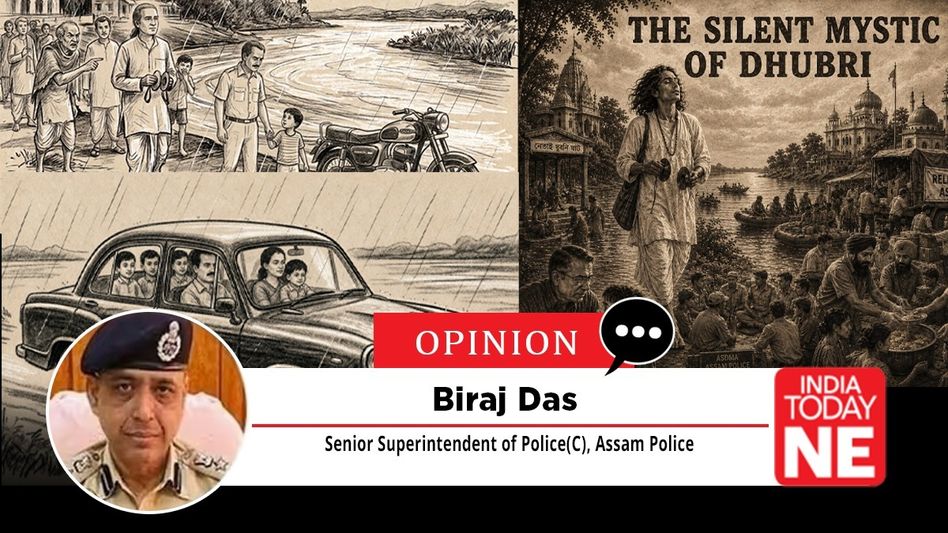
Every monsoon, as the mighty Brahmaputra swelled into a restless ocean and the skies above Dhubri turned grey with rain-laden clouds, a solitary figure in a simple white dhoti and kurta walked slowly along the riverbank near the SP and DC Bungalows and the old Circuit House. In his hands he held a pair of khutitaal. Its rhythmic clatter blended with soft devotional Bengali songs that rose above the roar of the river. Children laughed at him. Young boys mocked him. Many adults dismissed him as a pagol or a bhondo. Yet he never reacted. He simply continued walking, singing and praying in the spirit of the wandering Bauls of Bengal.
Nearly half a century has passed. The Brahmaputra continues its journey to the sea. The man in white is no more, and my father too has left this world for a heavenly abode. But whenever I think of Dhubri, I first remember that lonely devotee by the river and the priceless lesson my father taught me one monsoon evening.
In the mid to late 1970s the happiest years of my childhood unfolded here while my father was posted at Dhubri, then the headquarters of undivided Goalpara. To a child, Dhubri felt magical. The broad Brahmaputra seemed endless. Ferries carried people, cattle and goods. The smell of wet earth after the first rains still lingers in my memory.
Dhubri was far more than a border town. It was a meeting place of cultures and faiths. My mother became our first teacher. He took us to Madhupur Satra, situated in Kochbihar about 80 kilometres from Dhubri town, and Mother used to narrate the story of Mahapurush Srimanta Sankardev. She also shared the timeless tale of Behula and Lakhindar, the central legendary couple of a major medieval genre of Bengali folklore. After a serpent bite took Lakhindar’s life, Behula, through her deep devotion and pure love, reached the sacred ghat on the Brahmaputra where Netai Dhubuni, the divine washerwoman who washed the clothes of the gods, lived and worked. Netai Dhubuni helped Behula access the heavenly realm. Through her guidance the soul of Lakhindar was restored to life. Local tradition holds that the name Dhubri itself is derived from Netai Dhubuni. This story of boundless devotion left a lasting imprint on me.
My father explained about the Maa Mahamaya Temple that faith was never about fear but about quiet inner alignment. Dhubri itself became our greatest teacher. The Gurudwara Sri Guru Tegh Bahadur Sahib, Netai Dhubuni Ghat, Panch Peer Dargah together created a landscape where diversity felt natural.
Yet the greatest lesson came from the man society called mad. His name was Olok Saha. He lived in Shanti Nagar near the old Bishnu Cinema Hall. Every monsoon he walked along the Brahmaputra playing his khutitaal and singing, undeterred by rain or ridicule. Once, when challenged about a gold chain he wore, he removed it without hesitation and cast it into the Brahmaputra, reflecting a deeply non-materialistic spirit.
One evening, walking with my father beside the raging monsoon river, I asked innocently, “Is he mad, or is he pretending to be a holy man?”
My father looked at me with unusual seriousness. “He is praying,” he said gently. “Not for himself. He is praying for the people of Dhubri.” He then shared what Olok Saha had once told him. "দেখেন না স্যার, এই মানুষগুলো আমাকে তিরস্কার করে। ওরা জানে না যে আমি ওদের জন্যই ঠাকুরকে প্রার্থনা করছি.", “You see, Sir, these people ridicule me. They do not know that I am praying to the Lord for their well-being.”
Those words transformed everything. Here was a man insulted daily by the very people for whom he prayed, yet he never complained or sought recognition. That evening my father gave me one of life’s greatest lessons. Never judge spirituality by outward form, never mistake silence for weakness, and never assume the loudest voices carry the deepest faith. The image of Olok Saha never left me.
Today, as the Brahmaputra once again rises and floods test Assam, that same spirit of quiet service shines across the land. The state and central governments have stood firmly with the people. The ASDMA has coordinated rescue and relief with dedication. The NDRF, SDRF, Indian Army and Air Force have been deployed. The Assam Police has maintained law and order so that relief work proceeds smoothly. The Assam Police Radio Organisation has ensured uninterrupted communication, interoperability and timely information sharing among all agencies. Relief camps have been opened and essential supplies distributed.
From different districts of Assam, truckloads of rice, pulses, drinking water, clothes, medicines, sanitary napkins, books, school bags and other essentials have reached the affected areas. NGOs, local volunteers, student groups and ordinary citizens have worked tirelessly. Even from Punjab, more than 2,000 kilometres away, Sikh volunteers and youth groups have arrived carrying rations and the spirit of langar, serving food to all without distinction. In Sivasagar and other districts, gurdwaras have sheltered hundreds of families and served thousands of meals daily.
In all this we see the living continuation of the lesson my father taught me. True spirituality is found in hands that reach out without asking for thanks and in hearts that serve those who may never know the giver’s name, just as Olok Saha once did.
My elder brother Dhiraj, whom people affectionately called Kaju, also shaped my understanding of compassion. I still remember how he voluntarily carried relief to flood victims sheltering at Dolijoliag Gaon in Dergaon, offering comfort without seeking recognition. His simple acts continue to guide me.
Olok Saha founded no institution and sought no followers. His name appears in no history book. Yet he illuminated my life, revealing that true spirituality is the quiet courage to connect with higher dimensions of compassion, especially for those who misunderstand you.
Whenever I visit Dhubri, I bow before its sacred places, the Maa Mahamaya Temple, Guru Tegh Bahadur Sahib Gurudwara, Netai Dhubuni Ghat and Panch Peer Dargah. I also remember Madhupur Satra in Kochbihar. But above all I bow before an invisible shrine in my heart. A humble man in white walking alone beside the Brahmaputra, his khutitaal keeping time with steadfast faith.
And today I also bow before every helping hand, the workers of ASDMA, Assam Police and APRO, NGO volunteers, local youth and the Punjabi brothers and sisters who travelled so far to stand with Assam. The world may still call some people mad for their quiet faith. My father taught me to recognise the saint in them. That recognition continues to bring hope.
In the end, it was my father’s gentle guidance that turned a simple riverside encounter into a lifelong compass for the soul, pointing always toward compassion, unity and the silent mystic heart of Dhubri.
“They alone live who live for others.” — Swami Vivekananda