The Thadou Gal (Thadou War) of 1917–1919: Reclaiming a Misrepresented Chapter of Manipur’s History and India’s Freedom Struggle
History is not merely a record of the past; it is the preservation of identity, sacrifice and collective memory. Distorting Manipur’s history and misrepresenting the identities of historical figures not only misrepresent their contributions but also erase the history and heritage of the people to whom they belonged.

- Nov 19, 2026,
- Updated Nov 19, 2026, 12:02 PM IST

History is not merely a record of the past; it is the preservation of identity, sacrifice and collective memory. Distorting Manipur’s history and misrepresenting the identities of historical figures not only misrepresent their contributions but also erase the history and heritage of the people to whom they belonged. This is precisely why the Thadou Gal (Thadou War) of 1917–1919 deserves accurate and rightful recognition, particularly in the face of continuing attempts to portray its Thadou leaders and freedom fighters as Kuki. Their identities must not be rewritten, their sacrifices must not be appropriated, and their history must not be erased.
Significantly, and in defence of historical accuracy, Thadou Inpi Manipur (TIM), the apex organisation representing the Thadou people, issued a media release on 16 November 2026, firmly rejecting the portrayal of Thadou War heroes as Kuki. The statement also objected to media descriptions of historically recognised Thadou chiefs as “Thadou-Kuki” or “Kuki” chiefs in reports covering a function held in Kangpokpi on 15 November, which was attended by Deputy Chief Minister Nemcha Kipgen as part of the observance of Janjatiya Gaurav Divas, commemorating tribal freedom fighters.
The Thadou War was a significant resistance against British colonial rule in Manipur, organised and led by Thadou chiefs and warriors from different parts of the hills. Their struggle was for freedom, self-determination and the defence of their land, people and indigenous identity. On 17 March 1917, Thadou chiefs assembled at Jampi village and declared war against British colonial authority.
Yet, for decades, the uprising has been wrongfully described as the “Kuki Rebellion” or “Kuki Rising” instead of its historically appropriate indigenous name, Thadou Gal (Thadou War). This terminology has obscured the identities of its leaders, misrepresented Thadou historical figures as Kuki or “Thadou-Kuki”, and falsely portrayed a resistance organised and led by Thadou chiefs and warriors as a Kuki uprising.
Indigenous accounts, memorial inscriptions, colonial publications and academic research provide substantial grounds for recognising the uprising by its historical name: Thadou Gal (Thadou War). This is not an attempt to appropriate another community’s history or diminish anyone else’s contribution. It is a call for historical accuracy and rightful recognition of the Thadou chiefs and warriors who fought for freedom.
The Jampi Meeting and the Declaration of War, 17 March 1917
A defining moment in the Thadou resistance occurred on 17 March 1917, when prominent Thadou chiefs assembled at Jampi village under the leadership of Pu Khotinthang Sitlhou, alias Kilkhong Sitlhou, chief of Jampi. The meeting brought together 13 prominent Thadou leaders and chiefs who resolved to resist British colonial authority (Haokip, 2015, pp. 64–65).
The participants were Khotinthang Sitlhou, alias Kilkhong Sitlhou, chief of Jampi; Khupkhotintong, alias Tintong Haokip, chief of Laijang, Tamenglong; Songchung Sitlhou, chief of Sangnao; Lunkholal Sitlhou, chief of Chongjang; Vumngul Kipgen, chief of Tujang; Lhunjangul Kipgen, son of Vumngul Kipgen; Enjakhup Kholhou, chief of Thenjol; Leothang Haokip, chief of Goboh; Mangkho-on Haokip, chief of Tingkhai; Heljashon Haokip, chief of Loibol; Onpilen Haokip, chief of Joupi; Onpilal Haokip, chief of Santing; and Jamkhokhup Haokip, chief of Boljang.
The meeting was convened by a Thadou chief, attended by Thadou leaders and organised around a collective decision to declare war against the British rule. Its participants and purpose establish its distinct Thadou character.
Khotinthang Sitlhou’s Declaration: Freedom or Death
The political resolve behind the Jampi meeting is reflected in the declaration of Pu Khotinthang Sitlhou, who expressed an uncompromising determination to drive British imperial forces out of Manipur and restore freedom (Haokip, 2015, p. 70):
“We will, therefore, fight and chase the imperial forces through all the jungles, wood-lands, over the cliffs or crags of the rocky mountains and rills or hills and dales, until they are slaughtered or driven out of Manipur hills and our complete freedom restored. In course of this war of life and death, all of our villages or houses may be burnt down, our granaries gutted, our women ravished, our children butchered or flayed alive but still we will fight to the end. Now freedom or death is before us; if we perish, we perish for preservation our freedom. This day, I, Khotinthang Sitlhou chief of Jampi on behalf of the Thadou chiefs declare the war of independence on the British imperial government.”
Khotinthang Sitlhou is also remembered for declaring: “We are not born slave to serve the white people. We are born to rule. We must crush or thrust them out of Manipur.” These declarations demonstrate the determination of the Thadou chiefs to resist colonial domination and defend their freedom.
Indian Prime Minister Narendra Modi publicly recognised Pu Khotinthang Sitlhou (Kilkhong) as one of Manipur’s heroes in his addresses on 4 January and 22 February 2022. Union Home Minister Amit Shah also acknowledged him as a freedom fighter and war hero during his programme at Moirang on 6 January 2023. These acknowledgements further underscore Sitlhou’s contribution to the resistance against British colonial rule.
Tintong Haokip and the Resolve of the Thadou Chiefs
The determination expressed at Jampi was shared by other chiefs. The declaration of Tintong Haokip, also known as Khupkhotintong, chief of Laijang, is documented in Margaret Haokip’s doctoral thesis (Haokip, 2015, p. 74):
“Am I not the brave and fearless son of Thadou (Tak chapa, Thadou chapa). This war is for enslavement or freedom. I will never allow myself and my people to be the bond slaves of the white people, who have no power to rule over us. I will fight them to the end until my bullets and gun-powder exhausted and slaughter them or drive them out of our land.”
He then fired his gun into the air while chanting the names of his forefathers. The expression “Tak chapa, Thadou chapa” directly invokes Thadou identity in the declaration of resistance. His words reinforce the determination of the chiefs to defend their people, indigenous Thadou idnetity and land against British colonial rule.
Thadou Gal and Zou Gaal: Two Distinct Resistance Movements
An important historical distinction must be maintained between Thadou Gal and Zou Gaal. Although both involved resistance against British colonial rule during the same period and shared a common enemy, they were distinct movements with different community leadership and organisational contexts. Thadou Gal refers to the resistance organised and led by Thadou chiefs in different parts of Manipur, with the Jampi meeting of 17 March 1917 as its defining event. Zou Gaal refers to the resistance by the Zou community in Zou-inhabited areas of Manipur.
This distinction is supported by the research of Khaikhotinthang (Athang) Kipgen, MA, whose 1976 research work was titled The Thadou War of 1917–19. Kipgen examined the relationship between the two resistance movements and stated:
“It is a fact that the Zous also fought against the British in the same year but there was no link between the Thadous and Zous in men and materials except in having a common enemy. Over and above this, the Zous kept aloof from the Jampi Meeting and at the same time the distribution of 'Sajam' and circulation of Thingkho (half-burnt firewood) and Malchapom (red chilli) only to the Thadou chiefs and not to any other rulers whatsoever.”
Kipgen concluded that the uprising organised through the Jampi meeting was purely “Thadou Gaal”, the name by which it was known to those who fought it. His account distinguishes the movements in terms of their participants, organisation and leadership. Their shared opposition to British colonialism does not make them a single uprising. Both deserve recognition according to their respective historical identities and circumstances.
The Immediate Circumstances and Wider Objectives of the War
The immediate circumstances surrounding the 1917 uprising included British attempts to recruit Thadou people as labourers for deployment to France during the First World War. However, the resistance cannot be reduced to opposition to labour recruitment alone. The memorial of Pu Khotinthang Sitlhou at Taloulong records that leading Thadou chiefs pledged to fight British hegemony for Manipur’s independence, indicating a broader political objective of resisting colonial domination.
A reported response by Pu Ngulkhup Haokip to Mrs Cole in 1917 further illustrates this determination. When the British sought Thadou participation in their military campaign against the Sapkangte, he declared: “We Thadous will not work as coolies. We will do what the British want us to do. Let us fight.”
This response captures the resolve of the Thadou chiefs to resist colonial demands and assert their right to defend their land and freedom.
The Thadou War Heroes and Their Historical Identities
The leaders and warriors of Thadou Gal must be remembered according to their own identities and the historical evidence documenting their contributions.
Pu Khotinthang Sitlhou, alias Kilkhong, chief of Jampi, was the principal convenor and leader of the historic meeting of 17 March 1917. His memorial at Taloulong, erected on 9 January 2013, identifies him as the chief convenor of the Thadou War of 1917–1919. It records that he hosted the traditional Sajam Lhah feast at Jampi, where leading Thadou chiefs pledged to fight British hegemony for Manipur’s independence. The inscription also commemorates his arrest and imprisonment at Sadia, Assam, and Cellular Jail in the Andaman and Nicobar Islands. It records that the war was declared closed by Lt Gen Sir H. H. Keary on 20 May 1919.
Pu Tintong Haokip, also known as Khupkhotintong, chief of Laijang, was a prominent participant in the Jampi meeting and a leading voice in the declaration of resistance. His declaration, particularly the words “Tak chapa, Thadou chapa”, explicitly affirms the Thadou identity he invoked while pledging to fight British rule (Haokip, 2015, p. 74).
The memorial of Pu Pasut Singson at Gopibung village in Kangpokpi district, erected on 14 March 2023, explicitly commemorates the “Thadou War (Thadou Gal), 1917–1919”. The inscription records that he performed the traditional Thadou war ritual at Jampi on 17 March 1917. He planted a mithun’s horns in the ground with a spear and cut off its tail to declare war against the British Empire. The memorial provides important indigenous commemorative evidence of the uprising and Pasut Singson’s role in it.
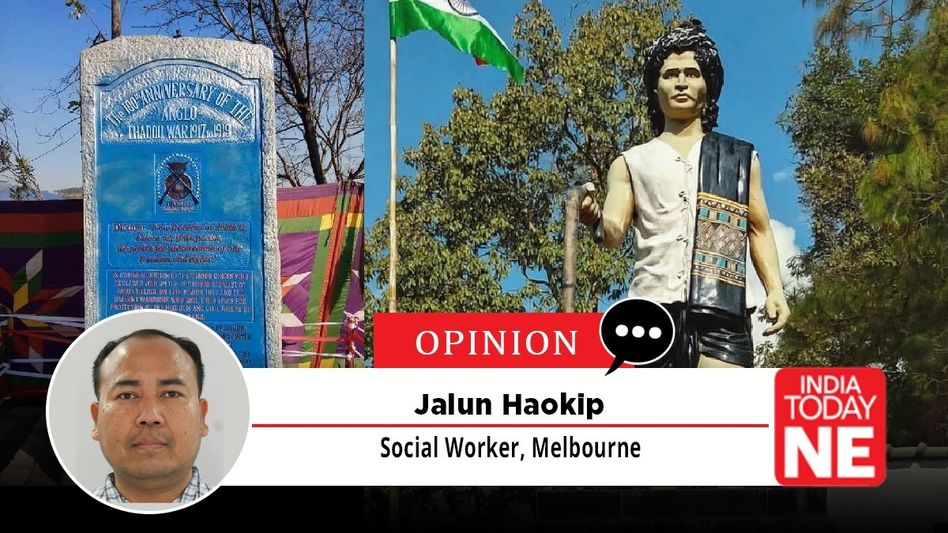
Further commemorative evidence is provided by a memorial inscription marking the centenary of the Anglo-Thadou War (1917–1919) on 17 March 2017. It explicitly commemorates the Thadou chiefs who declared war against British imperialism at Jampui village on 17 March 1917, as well as the warriors who sacrificed their lives to protect the freedom and rights of the Thadou people.
Pu Ngulkhup Haokip, chief of Lonpi, also known as Mombee, was another important Thadou leader associated with the resistance. Thadou historical accounts identify him with Nulshun Haokip, whom British colonial publications describe as a Thado chief. His reported response to Mrs Cole in 1917, quoted above, also explicitly identifies the people concerned as Thadous.
Pu Ngulbul Haokip, a prominent Thadou chief of Longya (also spelt Longja) and head of the Mangvung clan, stood at the forefront of the resistance against British colonial rule. According to Thadou historical accounts, he and both his sons were killed by British gunfire while defending their positions. His family lineage, including the present chief of Longya and head of the Mangvung clan, has strongly maintained its Thadou identity across generations.
Other historical figures associated with the period include Pu Lhukhomang Haokip, alias Pache Haokip, chief of Chassad, Pu Chengjapao Doungel and many others. Their histories and contributions form part of the wider record of Thadou resistance and sacrifice during 1917–1919.
British Colonial Records and Academic Evidence
Colonial-era publications provide important documentary evidence concerning Thadou identity, family lineages and traditional leadership. In their 1896 publication, The Chin Hills: A History of the People, Our Dealings with Them, Their Customs and Manners, and a Gazetteer of Their Country, B. S. Carey and H. N. Tuck state on page 4:
“The Chassads belong to the Thado tribe” and “The Haokips are merely a family of the Thado tribe.” The same publication identifies Nulshun Haokip, chief of Mombee (Lonpi), as a “Thado Chief” on page 17 and refers to him as a “Thadou chief” on page 119 (Carey & Tuck, 1896, pp. 4, 17, 119).
Additional evidence appears in J. Shakespear’s The Lushei Kuki Clans, particularly the section titled “The Thadou” on page 190. Shakespear identifies four principal families:
“The four main families are the Dongel, Shit-hloh, Haukip, and Kipgen.” These names correspond to the Doungel, Sitlhou, Haokip and Kipgen families (Shakespear, p. 190).
Academic research further supports the historical distinction of the Thadou War. Margaret Haokip’s doctoral thesis, The Thadou War and Its Impact on Society, 1917–1919 (2015), documents the Jampi meeting, the declarations of Khotinthang Sitlhou and Tintong Haokip, and the wider impact of the uprising. Khaikhotinthang (Athang) Kipgen’s 1976 research work, The Thadou War of 1917–19, provides further evidence distinguishing Thadou Gal from Zou Gaal.
Together, these academic works, colonial publications, memorial inscriptions and indigenous historical accounts provide a substantial basis for recognising the uprising as Thadou Gal. Historical identity must be assessed through the available evidence rather than imposed through later political classifications.
Historical Misrepresentation and the Need for Recognition
The repeated description of the 1917–1919 uprising as the “Kuki Rebellion” or “Kuki Rising” is not simply a disagreement over terminology. Historical names carry the identity, agency and memory of the people who made history. When a movement organised by Thadou chiefs is retrospectively labelled otherwise, the distinct historical identity of its participants is displaced.
Thadou Inpi Manipur maintains that the community is Thadou, without any prefix or suffix. There is no distinct ethnic or tribal community called “Thadou-Kuki”. The category “Any Kuki Tribes” (AKT), introduced as an administrative classification, cannot by itself establish a separate ethnic identity or retrospectively determine the identity of historical figures. The identities of historical chiefs and participants must be understood through documentary evidence, indigenous accounts, memorial inscriptions, genealogies and academic research.
The misrepresentation of Thadou leaders and freedom fighters under a Kuki identity also has contemporary implications. Thadou Inpi has expressed concern that Kuki militant organisations and radical elements have invoked false Kuki identity and historical narratives to advance separatist and political agendas, including territorial claims and assertions of Kuki supremacy over other indigenous communities, including the Thadou people. Such narratives must not be allowed to erase Thadou history or distort the historical record of Manipur.
The Manipur Government’s recognition of the uprising through a restricted holiday designated as “Kuki Rising” must therefore be reconsidered. The historic Jampi meeting was convened by a Thadou chief, its participants were Thadou leaders, memorial inscriptions commemorate the Thadou War, and academic research documents the uprising as Thadou Gal.
In light of this historical and commemorative evidence, the continued use of the term “Kuki” or “Kuki Rising” requires serious historical review and correction. The uprising should be recognised by its historically appropriate name: Thadou Gal (Thadou War), reflecting the identity of the chiefs and warriors who organised and led the resistance.
Thadou Inpi Manipur calls for official recognition of the uprising as Thadou Gal or Thadou War (1917–1919) in government records, historical publications and educational materials. The restricted holiday designation should be reconsidered and corrected accordingly. Media reports and historical accounts that misrepresent Thadou chiefs and freedom fighters as Kuki or “Thadou-Kuki” should also be corrected. Preserving Thadou memorials, historical records, oral histories and genealogies is essential to safeguarding this history for future generations.
Conclusion: Our History Must Be Recognised as It Was
The Thadou War of 1917–1919 was a defining chapter in Manipur’s resistance against British colonial rule. The historic Jampi meeting of 17 March 1917; the declarations made by Khotinthang Sitlhou, Ngulkhup Haokip and Tintong Haokip; the courage and sacrifices of these and other Thadou chiefs and warriors; and the evidence preserved in memorial inscriptions, indigenous historical traditions, colonial records and academic research provide a compelling historical basis for recognising the uprising by its rightful indigenous name: Thadou Gal (Thadou War).
The Thadou people are not seeking to appropriate another community’s history or diminish anyone else’s contribution to India’s freedom struggle. They are demanding what every people deserve: the truthful recognition of their own history, identity, heroes and sacrifices. No historical narrative, political agenda or imposed label should be permitted to erase the identity of those who fought for their freedom. History must be recorded according to evidence and historical truth, not distorted or reshaped to serve political convenience.
Our history is not for appropriation, our identity is not for redefinition, and our sacrifices are not for erasure. Thadou heroes must be remembered as Thadou, and the Thadou War must be recognised as the Thadou War.