How RCB solved a culture crisis to become back-to-back IPL champions
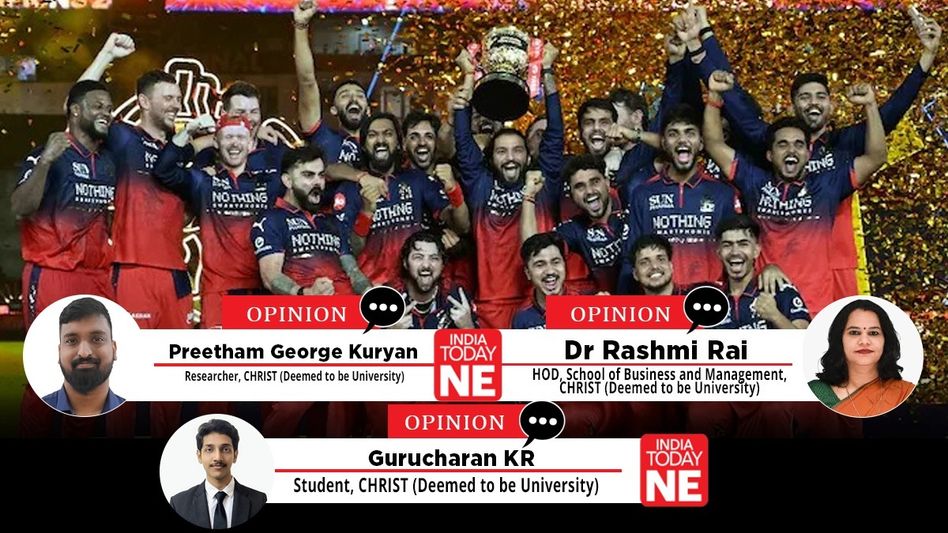
Royal Challengers Bengaluru's back-to-back IPL titles followed a shift from star dependence to collective belief. The change turned a long-running story of near-misses into a case study in leadership and team culture.

- Jun 08, 2026,
- Updated Jun 08, 2026, 2:51 PM IST

- For years, elite individual talent masked deeper structural and cultural weaknesses
- Kohli's 973-run 2016 season still ended in a final defeat
- Repeated near-misses hardened self-doubt and shaped pressure moments across campaigns
Royal Challengers Bengaluru's transformation from perennial underachievers to back-to-back IPL champions is about far more than cricket. It offers one of the most compelling recent case studies in organisational behaviour within Indian sport.
For eighteen years, Royal Challengers Bengaluru assembled some of the most gifted cricketers on earth. They had Virat Kohli, one of the defining cricketers of his generation. They reached three IPL finals and lost all three. When they finally lifted the trophy in 2025, winning 11 of 16 matches, and defended it in 2026, the cricket world reached for familiar explanations: form, luck, or the circumstances finally converging. Yet those explanations capture only part of the story.
RCB did not solve the cricket problem. It solved a human behaviour problem.
The Talent Paradox
There is an enduring myth in business that assembling the best individuals is the same as building the best team. RCB lived this assumption for two decades. In 2016, Kohli scored 973 IPL runs in a single season, a record that still stands, and carried RCB to the final almost by individual will. They lost.
The lesson took years to absorb: elite talent cannot substitute for organisational health. Talent was never the problem. The system surrounding it was.
Exceptional performers can compensate for a weak culture for a surprisingly long time. What they cannot do is manufacture the collective belief, role clarity, and psychological safety that allow teams to execute when it matters most. Eventually, organisations must move beyond asking whether they have the right people and begin asking whether they have created the conditions for those people to succeed.
The Weight of a Story
Before any tactical fix, RCB had to confront something deeper. Organisational psychologists might describe the phenomenon as a form of learned helplessness: repeated failure producing a resignation so ingrained it becomes identity.
Every near-miss added to the weight. The 2016 final was not merely a defeat. It became the franchise's deeply embedded narrative, the story that shaped how players thought, how pressure was absorbed, and how belief contracted at the moments it was needed most.
The antidote is not a motivational speech. It is the deliberate construction of collective efficacy: the shared conviction that this group, as a unit, can execute under pressure.
Under Andy Flower, RCB became increasingly focused on building precisely this form of collective belief. Cohesion first. Role clarity first. Stars were still welcome, but within a system, not above it.
A Team That Captained Itself
Captain Rajat Patidar described the shift plainly: the coaching staff began treating every player equally. This is a statement about psychological safety, a factor highlighted by Google's Project Aristotle as critical to high-performing teams. When a culture treats some members as peripheral, it weakens the collective capability it relies on under pressure.
Flower made the leadership philosophy explicit: Hazlewood, Bhuvneshwar, and Krunal would be "almost captaining themselves."
In any organisation, this is the difference between a leader who hoards authority and one who builds a team capable of deciding well in their absence. The former limits organisational capacity. The latter expands it. The latter is how organisations scale.
Patidar won 19 of 27 matches as captain. While a single factor never drives results in sport, such consistency often reflects the strength of the environment surrounding a team.
The Danger of Winning Once
The most instructive chapter in RCB's story is not 2025. It is 2026.
The success trap is real: having achieved a goal, teams unconsciously shift from pursuing what is next to protecting what they have. The challenger's urgency evolves into the incumbent's caution. Many organisations struggle with this transition. RCB appears to have navigated it effectively.
Flower described the 2026 campaign as defined not by relief or nostalgia, but by a deeper level of confidence, the quiet assurance of a team that had internalised its own capability.
This is possible only when a belief system is organised around the quality of process rather than the achievement of the trophy. The trophy may have been the outcome, but culture appears to have been a significant driver.
Talent attracts attention. Culture creates performance. Systems sustain success.
RCB did not win because it finally found better players. It had extraordinary players for nearly two decades. Its breakthrough appears to have come when leadership focused less on acquiring talent and more on creating the conditions for that talent to thrive.
They rebuilt belief before they rebuilt batting orders.
This transcends the boundary ropes of cricket; it is a profound blueprint for modern leadership. It serves as a challenge to any organisation courageous enough to trade the easy comfort of execution for the uncomfortable friction of introspection.
Ultimately, sustainable excellence is not achieved by merely rearranging what you do on the surface, but by fundamentally transforming how you think at the core. It is a demanding shift, but it is precisely where a temporary strategy ends and a permanent legacy begins.