
The UAE-OPEC Split and the Emerging Dynamics of Global Crude Oil Trade
A decision made quietly in Abu Dhabi may end up reshaping fuel prices, trade routes and geopolitical equations far beyond the Gulf. As OPEC loses one of its biggest producers, the real question is not why the UAE walked away, but who stands to gain most from the collapse of old oil loyalties.
Advertisement

Dr Arjun BS
- May 25, 2026,
- Updated May 25, 2026, 4:03 PM IST
Story highlights
- Abu Dhabi cited strategic priorities and an evolving energy profile
- Years of quota curbs had constrained the UAE's higher production capacity
- Iran-linked attacks and Hormuz disruption sharpened tensions inside the producers' group
A Six-Decade Alliance, Broken in a Statement
The United Arab Emirates is not merely an oil-producing country. It is, or rather was, the third pillar of the most powerful energy cartel the world has ever known. On April 28, 2026, the UAE announced its decision to quit OPEC, citing its "long-term strategic and economic vision and evolving energy profile", with the exit taking effect on May 1. After nearly six decades of membership, the UAE did not call a summit. It did not convene a committee. It issued a statement and walked out the door.
That is not the behaviour of a country making a routine policy adjustment. That is the behaviour of a nation that has made a fundamental, irreversible decision about its own sovereignty over its oil, its strategy, and its future.
The Frustration That Was Always There
To truly understand this departure, one must understand the quiet, accumulating frustration that has been building inside the UAE’s energy ministries for years. The UAE did not leave because it was weak. It left because it had become too strong for OPEC's cage to hold.
Before the start of the Iran conflict, the UAE's production capacity had grown to 4.8 million barrels per day. Yet under its OPEC agreement, it was only permitted to produce 3.2 million barrels per day. That is a country that built an expressway and was handed a permit for a dirt track. Every barrel above 3.2 million, every barrel that could have funded schools, infrastructure, and sovereign ambition, was left in the ground, not because the ground would not yield it, but because a cartel vote said so.
The UAE has the ambition to reach 5 million barrels per day of capacity by 2027, and wants the freedom of action to pursue that goal. This is not recklessness. This is a nation refusing to have its economic destiny decided in Vienna by a committee that includes the same country that has spent recent months bombing its ports.
The announcement came after the UAE was the target of weeks of missile and drone attacks by fellow OPEC member Iran, while Tehran's disruption of the Strait of Hormuz severely constrained the UAE's ability to export oil, threatening the very foundation of its economy. There is something deeply, almost absurdly contradictory about sharing an oil quota table with a country that is simultaneously trying to shut down your shipping lanes. The UAE finally said what any sovereign nation in its position should have said long ago: enough.
What the Numbers Tell Us
Behind every geopolitical shift, there are numbers. And these numbers demand our full attention.
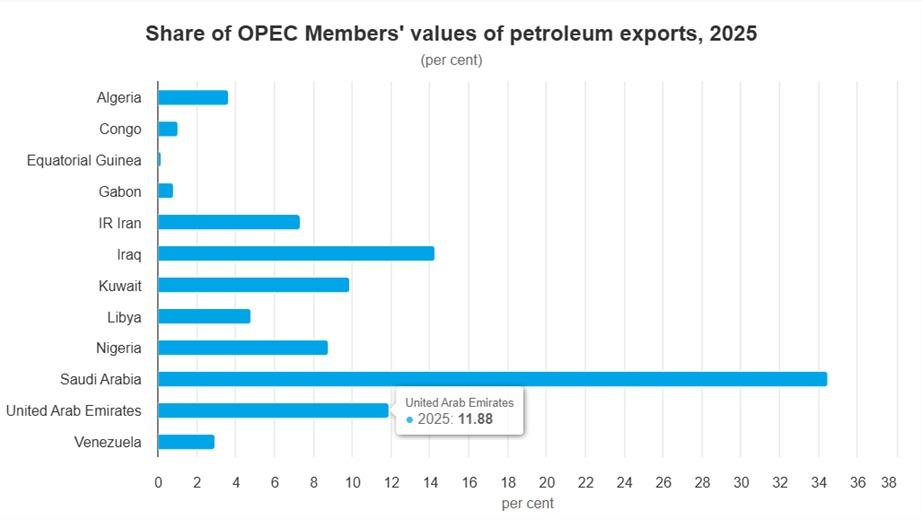
Total world crude oil production in 2025 averaged 74.85 million barrels per day, with OPEC member countries exporting an average of 19.85 million barrels per day, up 0.85 million barrels per day from 2024. Within that cartel, the UAE was the third-largest producer, behind only Saudi Arabia and Iraq. Losing it is not a footnote. It is a structural amputation.
In March 2026, the UAE was pumping roughly 2.37 million barrels per day, well below its sustainable capacity of approximately 4.3 million barrels per day, according to IEA data. That gap, nearly 2 million barrels per day of untapped, suppressed production, is now the UAE's to unleash on its own terms, on its own timeline, for its own national interest.
India's Moment If It Has the Clarity to See It
India does not have the luxury of watching this as a distant geopolitical spectacle playing out in the deserts of the Gulf. It is among the most oil-dependent large economies on earth, and every tremor in global crude supply sends shockwaves through its inflation figures, trade balances, and household budgets.
India imports around 4.7 to 5 million barrels per day, meeting more than 85% of its total oil needs, with Iraq, Russia, Saudi Arabia, and the UAE as its key suppliers. The UAE accounts for approximately 8% to 10% of India's crude imports, a smaller share than Russia's or Iraq's, but a critical one given shorter shipping distances and the particular needs of India's west coast refineries.
Russia has been India's dominant supplier since the Ukraine war shifted the equations in 2022. Russian crude's market share in India's import basket rose from just 1% in 2017 to 36% in 2024, while Persian Gulf crude's share declined from 63% to 46% over the same period. This dependence on discounted Russian crude has served India economically, but it also leaves India politically vulnerable, subject to Western sanctions pressure, and dependent on a geopolitical arrangement that could shift without warning.
A UAE freed from OPEC's production ceilings and eager to rapidly expand its market share is not a problem for India. It is a partner in waiting. New Delhi can use this moment to negotiate long-term supply agreements, lock in preferential pricing on UAE grades before others do, and meaningfully reduce the concentration risk of over-reliance on any one corridor. India's refining capacity reached 5.17 million barrels per day as of 2024, the fourth-highest in the world, giving it the processing muscle to handle diverse crude grades with ease. The infrastructure for this partnership already exists. What is needed now is the diplomatic intent to act on it.
The UAE has also been actively using its Fujairah terminal on the Gulf of Oman to bypass the Strait of Hormuz entirely, exporting around 1.7 million barrels per day of crude and refined fuels through that route, which naturally connects to India's west coast. This is not a future possibility. The corridor is already functioning, has been tested, and is ready to be deepened.
POST A COMMENT