
The Wider Lens: The City That Outran Memory
A returning alumnus, a daughter, and the long future of Manchester.

- Feb 22, 2026,
- Updated Feb 22, 2026, 3:25 PM IST

There is a particular kind of disorientation that comes only with return.
Cities change gradually for those who stay. They change all at once for those who leave.
When I left Manchester in the mid-1990s, it was a city still carrying the weight of its industrial past, practical, serious, sometimes rough at the edges, intellectually alive but physically modest. Oxford Road felt like a working corridor of institutions rather than a polished urban statement. Buses ruled the landscape. The university and hospital zones felt slightly detached from the commercial core.
I believed I knew the city well enough that it would remain recognisable forever.
I was wrong.
A Photograph That No Longer Exists
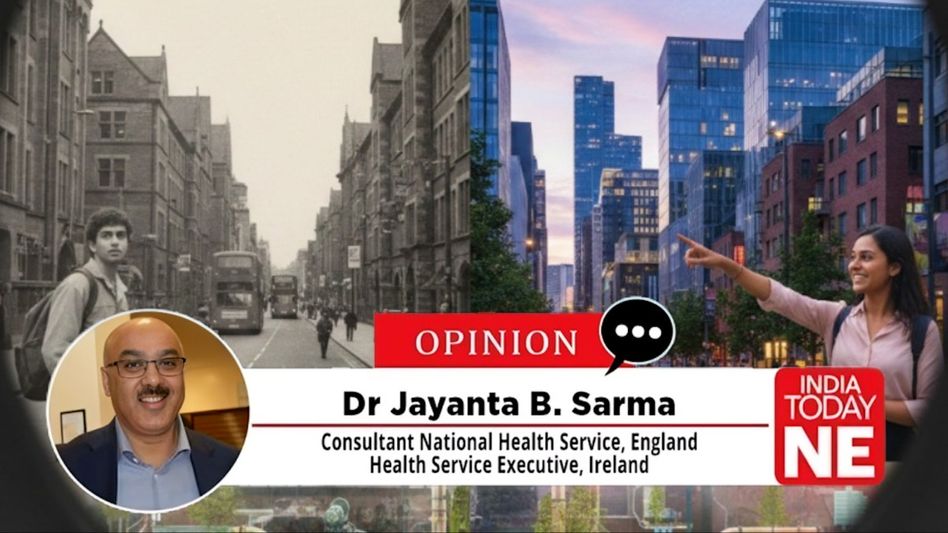
When I first arrived in Manchester in 1994, the very first thing I did was symbolic.
Before finding my bearings as a student, before understanding the rhythm of the city, I went to the university and took a photograph in front of the building associated with Ernest Rutherford, the place where the atom was split and where modern physics crossed an irreversible threshold.
I have lost that photograph.
At the time I did not think much of it. I was a young man fascinated by science, drawn to Manchester partly because of its intellectual heritage. Physics had long been my first language of wonder, even though life eventually carried me into medicine. The scientific imagination stayed with me, a way of seeing systems, uncertainty, and emergence.
Decades later, I returned to the same city.
This time my guide was my daughter.
She is now pursuing her PhD at University of Manchester, walking confidently through spaces that once felt immense and unfamiliar to me. As we moved along Oxford Road together, she pointed out buildings, ideas, and futures; I found myself narrating memories that no longer matched the landscape around us.
The photo may be gone, but the continuity remains.
The Shock of Recognition and Non-Recognition
The Manchester I returned to seemed almost impossible.
The skyline had risen vertically. The tram system, once a small novelty, had proliferated into a metropolitan network. Districts that felt peripheral in my memory now merged seamlessly into the centre.
The city had not simply improved; it had changed scale.
Behind that shock lies measurable transformation:
• A population that moved from decline to strong growth, surpassing half a million residents.
• A city-centre residential population rising from a small core in the early 2000s to nearly one hundred thousand today.
• An economy multiplying many times over in output, supported by universities, healthcare, research, and professional services.
The emotional experience of surprise was not nostalgia exaggerating reality. It was reality itself.
Cities as Experiments in Emergence
It is tempting to search for a master plan, a single vision that produced such change.
But the city tells a different story.
Manchester feels less like a designed project and more like a system that crossed a threshold.
A crisis created momentum. Institutions aligned. Transport expanded. Investment followed confidence, and confidence followed investment. Positive feedback loops reinforced one another until the city reached a new equilibrium.
In physics, we would call it a phase transition.
The city absorbed energy until it reorganised itself.
No single architect imagined the final form. The transformation emerged from interactions, between policy, capital, infrastructure, and human movement — too complex to fully predict.
Towers and the Quiet Disappearance of Scale
England’s heritage culture is famously protective. Yet Manchester’s skyline rose dramatically.
The secret lies in balance rather than permission or prohibition. Historic buildings remain; what changes is their setting, their scale relationship to the new city.
Walking through the centre now, I noticed that heritage had not vanished. It had become background.
Brick warehouses still stand. Civic architecture still anchors streets. But where once they defined the skyline, they now live beneath glass and steel.
This is not destruction.
It is reframing.
Whether one calls it progress or loss depends less on policy than on emotion, on how memory negotiates with the present.
Movement as Destiny
The towers draw attention, but the quieter revolution is movement.
Transport reshaped perception. The expansion of the tram system collapsed distance, drawing outer zones into the psychological core. Oxford Road itself transformed from a traffic corridor into something closer to a campus boulevard.
Urban form follows mobility.
Once movement changes, land values change. Once land values change, urban density follows.
The city’s new identity is built as much on movement patterns as on architecture.
Growth and Its Unequal Arithmetic
Urban success is never evenly distributed.
Those who owned property early benefited from rising values. Investors and developers captured momentum. Professionals found new opportunities.
Others experienced the transformation differently: rising rents, increased costs, and neighbourhood turnover.
Growth lifts a city, but it does not automatically distribute prosperity.
This is not uniquely Manchester. It is the structural consequence of growth-led urbanism everywhere.
The moral question remains unresolved:
Who has the right to the gains produced by collective transformation?
Beneath the Surface
While the city rises above ground, hidden systems strain below.
Much of Manchester still relies on Victorian-era sewer infrastructure, networks designed for a different climate and a different density. Extreme rainfall events expose the limitations of older combined systems, pushing planners toward new solutions: green infrastructure, flood-absorbing landscapes, sustainable drainage.
The modern urban park now serves a dual purpose — recreation above, hydraulic engineering below.
Cities increasingly depend on invisible adaptation rather than visible expansion.
Oxford Road, Then and Now
Of all places, Oxford Road carries the deepest emotional resonance.
In my memory it was practical, sometimes harsh, a corridor of work, study and movement. Today it feels greener, calmer, integrated.
But beneath the redesigned streetscape, the same intellectual engine remains.
Science still defines the area.
Hospitals, laboratories, lecture halls, the pursuit of knowledge continues uninterrupted.
Walking there with my daughter felt like witnessing continuity disguised as change.
The city had transformed, yet the reason I came to Manchester in the first place still persisted: the belief that knowledge matters.
Could It Have Been Different?
Of course.
Manchester might have grown more slowly, preserved lower scale, pursued more distributed development from the outset. It might have emphasised heritage or social balance differently.
But such alternatives would have produced a different city — perhaps gentler, perhaps less economically dynamic.
The city chose acceleration.
Now it faces the next challenge: how to convert momentum into resilience.
Toward the Future City
The model that drove Manchester’s reinvention may already be evolving.
Climate pressures, infrastructure constraints, affordability questions, and changing work patterns suggest a new phase ahead — one less dependent on concentration and more focused on distributed networks.
The future city may not be defined by taller towers but by deeper connectivity:
• multiple urban centres,
• integrated transport,
• ecological infrastructure,
• and systems designed for adaptability rather than spectacle.
Cities that survive longest are not those that grow fastest, but those that learn how to rebalance.
A Quiet Ending
As we finished our walk, I realised that the real story was not one of loss or triumph.
The city had not betrayed memory. It had simply continued evolving while I was away.
Manchester no longer resembles the place I knew in 1994. Yet the essence that drew me there — curiosity, science, intellectual ambition, remains.
Perhaps that is the real measure of a city’s success: not whether it preserves its appearance, but whether it preserves its capacity to inspire new generations.
Cities, like atoms, split and reorganise. Energy moves forward. Forms change.
And somewhere between memory and reinvention, the city endures, not as a fixed place, but as a living inheritance.
The views expressed in this article are those of the author and do not necessarily reflect the views of India Today NE or its affiliates.
MORE NEWS











Copyright©2026 Living Media India Limited. For reprint rights: Syndications Today
