Water Knows No Boundary: A Crisis Without Precedent
There is a particular kind of grief that comes not from loss alone, but from the loss of something you never thought could be taken. The farmer in Sivasagar who planted paddy in soil his grandfather tilled, the shopkeeper in Charaideo who opened the same shutter every morning for twenty years, the family in Jorhat who built their home on ground that had always held firm: none of them had a vocabulary for this. The water was supposed to go elsewhere. It always had.

- Jul 30, 2026,
- Updated Jul 30, 2026, 2:56 PM IST

There is a particular kind of grief that comes not from loss alone, but from the loss of something you never thought could be taken. The farmer in Sivasagar who planted paddy in soil his grandfather tilled, the shopkeeper in Charaideo who opened the same shutter every morning for twenty years, the family in Jorhat who built their home on ground that had always held firm: none of them had a vocabulary for this. The water was supposed to go elsewhere. It always had.
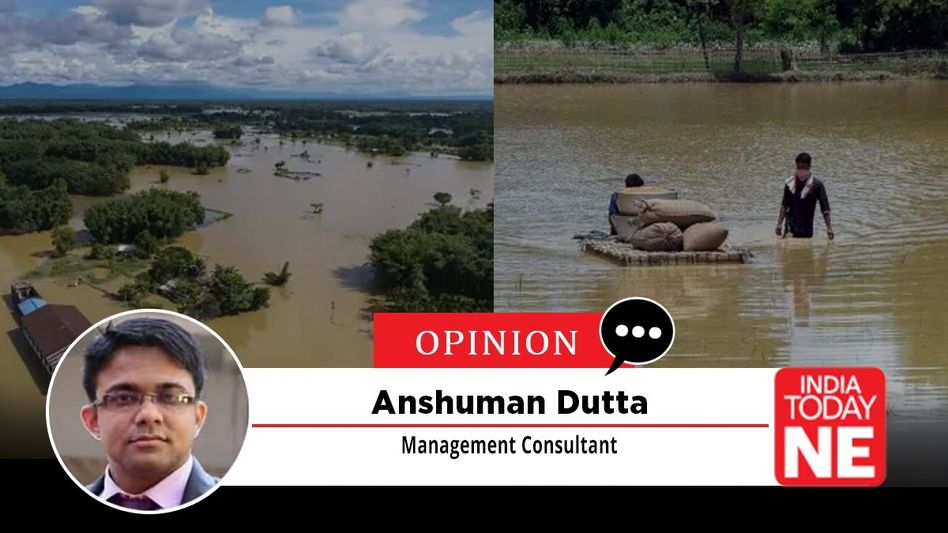
In July 2026, the Brahmaputra and its tributaries did not follow the script. The Dikhow and the Desang, swollen beyond any recorded measure, tore through Sivasagar town and the village of Nanglamoraghat with a force that left neighbors staring at each other in disbelief. The Dhansiri at Numaligarh reached what authorities called a "severe flood situation." The Buridihing at Khowang in Dibrugarh spilled beyond its banks. Many dead. More than 7.10 lakh remain affected across eleven districts. And somewhere in that number, buried beneath the language of disaster management and official statements, are hundreds of thousands of people experiencing something unprecedented in their lifetimes: a flood that was never supposed to come for them.
What makes this particular crisis distinct from the annual floods that Assam has long been forced to absorb is not simply the scale, though the scale is staggering. It is the geography of surprise. The areas now submerged in the upper reaches of the Brahmaputra valley are communities with no institutional memory of flood survival. When the NDRF arrives by boat, they are not meeting people who know how this works, who have a second home in mind to retreat to. They are meeting people whose sense of permanence has been obliterated without warning.
The Assam State Disaster Management Authority reported on Tuesday that 758 villages across Biswanath, Charaideo, Dhemaji, Dibrugarh, Golaghat, Jorhat, Kamrup, Karbi Anglong, Nagaon, Sivasagar and Tinsukia districts were inundated. Of the more than seven lakh affected, only 12,720 are sheltered in the 52 relief camps currently operational. That arithmetic carries weight. The remaining population, the vast majority, is dispersed across flooded villages, staying with relatives on slightly higher ground, waiting on rooftops, or simply hoping the water will recede before they have to make the choice of where to go.
More than 9,000 people have been evacuated by rescue agencies using boats. The Army, NDRF, SDRF and Fire and Emergency Services are all deployed. The Chief Minister has stationed cabinet ministers in each affected district, and MPs and MLAs have been asked to remain on the ground. The Northeast Frontier Railway has cancelled, short-terminated and diverted trains, and is running special services for stranded passengers after floodwaters submerged tracks near Simaluguri in Sivasagar district, suspending services on the Simaluguri-Namtiali and Simaluguri-Selenghat sections. The operational machinery is in motion. But machinery cannot hold a family together when the house is gone. It cannot restore the 14,411 hectares of crops now underwater, or give back the harvest that farmers were counting on for the next twelve months.
In every flood, there are two populations: those that the state can see, and those it cannot. The 12,720 in relief camps are counted, fed, and documented. The rest are not invisible by accident. They stay away from camps because of distance, because of fear, because of the social complexity of displacement, because they are holding out hope that this is temporary. Many are elderly people who refuse to leave homes they have spent their lives building. Many are women and children whose safety in crowded shelters is uncertain. Many are people from marginalized communities whose names have historically not appeared on the lists that determine who receives support.
The crop loss alone will send ripples through these communities for months after the headlines have moved on. Assam's agriculture is dominated by small and marginal farmers who operate without the buffer of savings or insurance. When 14,411 hectares go under, those families do not simply lose this season's income. They lose their seed stock, their soil's condition, their ability to plant in the next window. The debt cycle that follows a bad flood can outlast the flood by years.
The instinct in a crisis is to ask what can be sent. Food, clothes, medicine. These matter, and in the immediate term they are urgent. Relief camps need dry goods, clean water, hygiene supplies, and medical support for waterborne illness, which spreads quickly in flooded conditions. But anyone who has studied disaster recovery knows that the instinct to send things rather than money is often driven more by the donor's need to feel useful than by the recipient's actual need. Local organizations on the ground can procure what is needed, in the quantities needed, from suppliers who know the region. A digital transfer to a trusted Assam-based NGO will almost always do more than a truckload of donated clothing.
The organizations most likely to have genuine impact are those that were already present in these communities before the flood arrived. Large national disaster relief bodies have their role, but they tend to concentrate resources in visible, accessible locations. The harder-to-reach communities, now cut off by submerged roads and missing bridges, are reached by people who already knew how to get there. Local civil society, religious groups, village cooperatives, panchayat networks: these are the channels through which sustained support flows to the people least visible to the official record.
For those who want to help, the ASDMA maintains a list of approved relief organizations at asdma.assam.gov.in. Prioritize groups with an established Upper Assam presence, local language capacity, and transparent reporting on fund use. Before volunteering in person, coordinate with district administrations or NGO coordinators directly. Uncoordinated arrivals, however well-meaning, add to the logistical burden of operations already stretched thin. Share information responsibly: verified updates from ASDMA, the Northeast Frontier Railway, and credible regional journalism. Do not amplify unverified social media appeals for individual donations. And think beyond the immediate emergency. Livelihood restoration, seed support for farmers, small business recovery, and mental health resources for first-time flood survivors will be needed long after the water recedes.
Assam has a long relationship with flooding. The Brahmaputra is one of the most flood-prone rivers on earth, and the state has built, over generations, a culture of annual bracing. But that culture has its own geography. Communities in the lower floodplain know the rhythm. They store grain higher. They know which roads hold longest. They have relatives on higher ground. The communities now drowning in Upper Assam do not have that knowledge. For them, the culture of flood resilience was always something that happened somewhere else.
Climate change does not announce itself. It does not send a warning that the river systems your grandparents trusted are now operating under conditions no one has seen. It simply raises the water level, year by year, degree by degree, until one morning the Dikhow breaches Sivasagar town and everything a family owned is floating in the street. The people of Upper Assam are not experiencing an act of God. They are experiencing the accumulated consequence of decades of decisions made far from their fields and their homes.
That context does not make the immediate crisis more manageable. It makes it more urgent. Because if this is the new pattern, if rivers that once held firm are now part of the annual catastrophe, then the communities currently without flood memory will need to build it fast. They will need infrastructure investment, early warning systems, livelihood buffers, and a government that treats this not as a one-time anomaly to be managed but as a structural risk to be addressed. What happens in the next few weeks will determine not just how this particular crisis resolves, but whether Assam begins to treat the changing behavior of its rivers as a policy emergency.
Many dead and still counting. Over seven lakh are displaced, frightened, and in many cases facing this for the first time with no script to follow. The official machinery is deployed. But the official machinery has limits. It reaches the visible and the accessible. It operates on timelines and procedures. It cannot replicate the act of a neighbor bringing food to a family too proud to ask for help, or a local teacher organizing children in a relief camp so their parents can sleep, or a small organization that has been working in a community for years and knows exactly which households are most at risk and where the gaps in relief distribution fall.
What this crisis requires, alongside the boats and the camps and the government ministers stationed at district headquarters, is the older kind of solidarity. The kind that does not wait for instructions, that does not require a donor receipt, that moves because someone recognizes another person's suffering and understands, without being told, that the correct response is to help. Assam has shown that capacity before. The test now is whether it can extend it to communities that have not needed it before, that have no history of asking, and that are, right now, learning what it means to need.
The water will recede. It always does. What it leaves behind, and whether the people who were swept up in it find solid ground again, depends on what happens in the next few days, weeks, and months, and on how many people, in Assam and far beyond it, decide that this is their problem too.
The views expressed in this article are those of the author and do not represent the positions of any organization, employer, or publication with which the author is affiliated.
Anshuman Dutta is an analyst covering Northeast India politics, policy, and geopolitics. He is a member of the Forbes Communications Council and writes for The Assam Tribune, nenow.in, and Free Press Journal. He hosts The Meridian Dialogue, an independent leadership interview series published on nenow.in.