When a Number Plate Becomes an Identity
After violence during the KSU rally in Shillong, Meghalaya-registered vehicles were stopped in Assam. The fallout sharpened concerns over collective blame, transport safety and everyday interstate movement.

- Aug 21, 2026,
- Updated Aug 21, 2026, 8:45 PM IST

- Police recorded 31 damaged vehicles and two government vehicles set ablaze
- KSU leaders were arrested as the Meghalaya High Court took cognisance
- Transport blockades at Jorabat and Khanapara stranded passengers and goods carriers
The violence during the Khasi Students’ Union (KSU) rally in Shillong was serious. Vehicles were damaged, people were injured, and property was attacked. The anger that followed among Assam's transport operators and drivers is understandable. What happened next at Jorabat raised another concern.
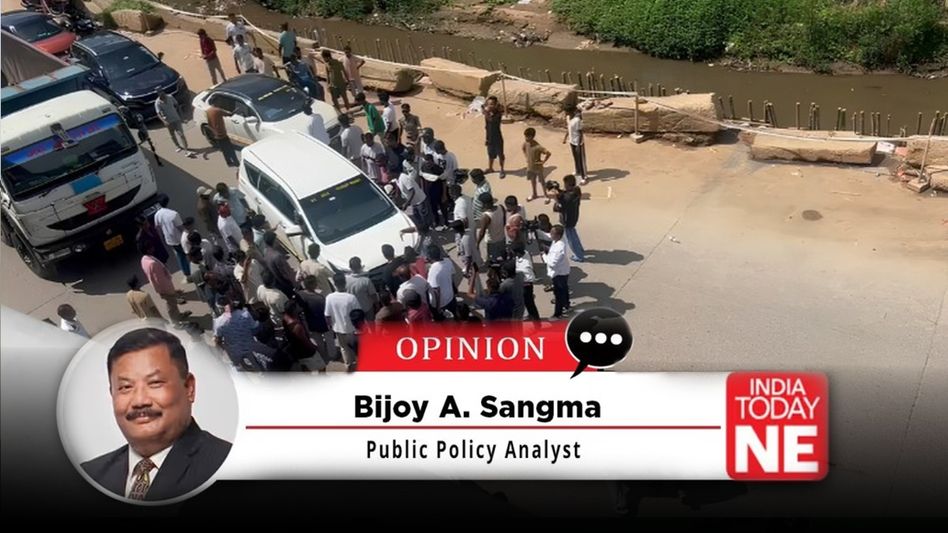
On August 20, a day after the violence in Shillong, Meghalaya-registered vehicles were being stopped at Jorabat and Khanapara. Passengers were asked to get down. Movement between Assam and Meghalaya was disrupted. Assam-based transport operators said they were responding to what they described as attacks on Assam vehicles and drivers in Meghalaya. The blockade continued on August 21, leaving passengers and goods vehicles stranded and forcing some travellers to change vehicles at the inter-state border.
For those who earn their living on the Guwahati-Shillong route, this is not an abstract dispute. A vehicle damaged on the road means a financial loss. A driver who feels unsafe worries about his livelihood and his family. These concerns deserve to be heard. But there is another question that deserves equal attention: when anger crosses a state boundary, who bears its consequences?
The immediate dispute began in Shillong. Its consequences travelled down the road.
I have travelled the Guwahati-Shillong road many times. I have used it for work and other journeys, as have thousands of people who move between the two states every day. For most of us, it is simply a road. Students use it to reach college, patients travel to hospitals, families visit relatives, and taxi drivers make their living on it. The state boundary is there, but ordinary life usually does not stop at it. That is why the present episode deserves careful thought.
The violence during the KSU rally is now before the appropriate authorities. Police said the rally resulted in damage to 31 vehicles, while two government vehicles were set on fire. There were also reports of assaults on pedestrians and damage to public property. Police arrested three KSU leaders and sent them to judicial custody, and the Meghalaya High Court has taken suo motu cognisance of the matter.
Whatever the competing accounts, individual responsibility has to be established through evidence. That is the proper way to deal with an incident in which people were injured, and property was damaged. If an Assam driver or vehicle was attacked in Shillong, the person responsible should answer for that act. Damage to a vehicle should not disappear simply because it occurred during a larger protest. Accountability should follow the individual act.
The same principle matters when the consequences move into Assam. People travelling through the state cannot reasonably be held responsible for what happened in Shillong simply because the vehicle carries a Meghalaya registration. A family making its way through Assam has no responsibility for violence at a rally. Nor does a driver from Assam have responsibility for the actions of protesters he does not know. Passengers should not be expected to answer for the registration number of the vehicle in which they happen to be travelling.
This may sound obvious. In moments of tension, obvious things can become surprisingly difficult to remember. A number plate identifies a vehicle. It does not identify the intentions or conduct of its passengers.
The KSU rally itself also had a context that should not be ignored. The organisation had given the Meghalaya Government a 15-day deadline over a five-point charter of demands. The issues included the proposed Shree Cement project in East Jaintia Hills, implementation of the Meghalaya Residents Safety and Security Act, recruitment, migrant workers and other concerns relating to indigenous interests. The rally followed the deadline's expiry.
Those concerns are part of Meghalaya's public debate. Land, employment, migration, environmental protection and the security of indigenous communities have been discussed in the state for many years. People have the right to raise such questions, organise, protest and disagree with decisions they consider harmful. There is also a responsibility that comes with protest. Violence cannot become the language through which a legitimate concern is pursued. The right to protest and the responsibility to avoid violence can exist together. A protest can have a legitimate subject and still cross a line when people are injured, or property is destroyed. Rejecting violence does not require rejecting the concern that brought people onto the street. The same principle applies to the anger that followed in Assam.
The concerns of Assam's taxi operators and drivers should not be dismissed. They have spoken about their safety, their vehicles and their livelihoods. Their response has a context, and their demand for assurances about the safety of Assam vehicles and drivers should be heard. But the people affected by a blockade are not necessarily the people responsible for what happened in Shillong.
Someone from Meghalaya travelling through Assam is not a participant in the Shillong violence. The driver carrying that passenger is not responsible for the actions of protesters he does not know. Once that distinction disappears, individual responsibility begins to give way to collective blame. That is where a local incident can become a much larger social problem.
The people of Assam have every reason to expect safety when they travel. People from Meghalaya have the same expectation when they travel through Assam. That should be the common ground.
Assam and Meghalaya have disagreed before. They have also negotiated before. In March 2022, the two states reached an agreement covering six of their 12 areas of boundary difference. The agreement did not settle every issue, but it showed that difficult questions can be moved through negotiation. Six areas remain to be resolved. That history is worth remembering at a time when emotions are high.
Disagreement between governments, organisations or communities does not have to become hostility between ordinary people. Most people have little interest in allowing it to become one. The Guwahati-Shillong road is a useful reminder of this. People cross it every day without asking themselves which state they are entering. A taxi driver sees a passenger, a shopkeeper sees a customer, a student sees a college, a patient sees a hospital, and a family sees a destination.
That is how interstate relations are actually lived, through ordinary encounters rather than official statements alone.
This is also why information matters during a tense situation. A video recorded in Shillong can reach Guwahati within minutes. A claim made in Assam can be circulating in Shillong before anyone has checked it. A photograph can be presented as current when it is not. A rumour can acquire the appearance of fact simply because enough people have forwarded it. Once that happens, correcting the record becomes much harder.
People therefore have a responsibility in what they share, particularly when emotions are running high. Public figures and organisations have an even greater responsibility because their words travel further. In a tense situation, restraint in public communication is not weakness. It is part of preventing a local dispute from acquiring a wider life of its own.
There is no need to pretend that Assam and Meghalaya have no differences. They do. Some of those differences are rooted in questions of land, identity, resources and political representation. There is also no need to turn every disagreement into a question of loyalty to one state or the other.
I have spent much of my life moving through this region. What has struck me repeatedly is how much everyday life crosses boundaries that politics sometimes treats as fixed. People study in one state, work in another and maintain family or business relationships across both. Those relationships rarely make headlines, but they are important.
The number of vehicles stopped and incidents reported tells only part of the story. There is another question worth asking: what will people remember when the immediate anger has passed? Will they remember that individuals committed acts of violence and that those responsible were dealt with through investigation and due process? Or will they remember that a vehicle from another state was enough to make its passengers suspect?
The first can be dealt with through investigation and due process. The second can settle quietly into everyday behaviour.
Perhaps the simplest principle is the one worth holding on to: a number plate should tell us where a vehicle is registered. It should never tell us how its passengers are to be treated.
(The views expressed in this article are those of the author and do not necessarily reflect the views of India Today NE or its affiliates.)