When a Politician Teaches Journalism
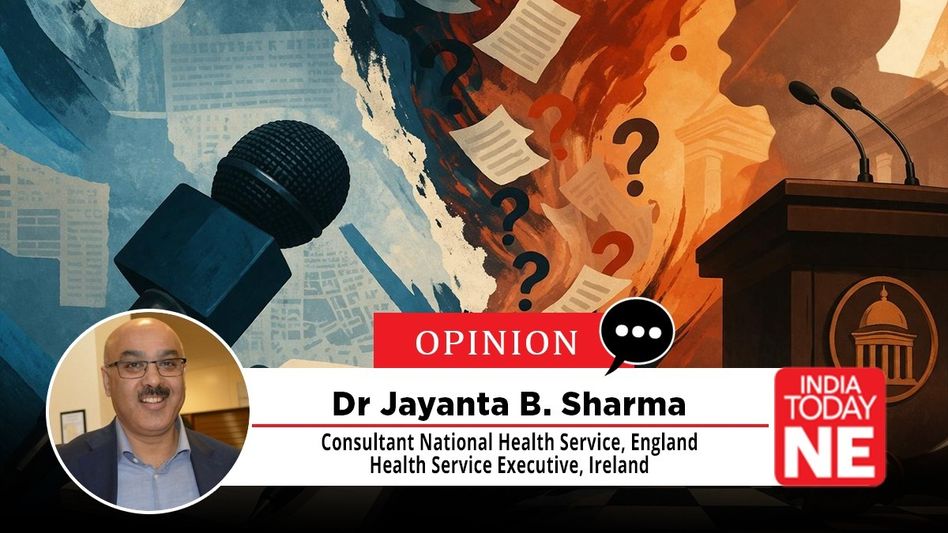
In the compressed, high-voltage environment of an election campaign, truth often appears not as a settled fact but as a contested performance. A recent exchange between a journalist from BBC News and Assam’s Chief Minister offers a revealing glimpse into this transformation—not merely of politics, but of journalism itself.

- Apr 07, 2026,
- Updated Apr 07, 2026, 7:38 PM IST

In the compressed, high-voltage environment of an election campaign, truth often appears not as a settled fact but as a contested performance. A recent exchange between a journalist from BBC News and Assam’s Chief Minister offers a revealing glimpse into this transformation—not merely of politics, but of journalism itself.
On April 2, 2026, in the middle of a fast-moving election campaign in Duliajan, Assam’s Chief Minister was approached by a journalist from BBC News. The reporter, identified as BBC Hindi’s Jugal Purohit, was one among many seeking a response in a crowded, high-pressure setting where questions come rapidly and time for reflection is scarce.What followed was a brief but telling exchange—one that has since travelled far beyond that campaign trail, not because of what it revealed about politics, but because of what it exposed about journalism itself.
The exchange, now widely circulated, unfolded in a familiar setting: a moving campaign, a cluster of microphones, and a journalist pressing for an answer. The question reportedly invoked the language of critics::
“People call you anti-democratic… fascist… even Hitler. What do you say?”
To this, the Chief Minister responded:
“BBC calls me Hitler. Assamese people call me ‘Mama’.”
And then, more pointedly:
“Don’t represent Akhil Gogoi… you are not his spokesperson.”
Shortly thereafter, the exchange ended—not with resolution, but with rupture.
At first glance, this may appear to be a routine confrontation: a journalist asking a difficult question, a politician deflecting it. But a closer reading suggests something more layered—and more unsettling.
The question itself did not emerge from a presentation of evidence. It emerged from circulation—from what “people say,” from the language of critics, from the vocabulary of accusation already in motion. Terms like “fascist” and “Hitler” were not unpacked, contextualised, or tied to specific acts of governance. They were presented as labels—powerful, provocative, and unexamined.
And in that moment, the nature of journalism subtly shifted.
For journalism, in its classical form, does not merely transmit language—it interrogates it. To invoke a charge as grave as authoritarianism is to assume a burden of demonstration. What policy? What action? What institutional behaviour justifies such a characterisation? Without this scaffolding, the question risks becoming less an inquiry and more an act of amplification.
It is here that the Chief Minister’s response, often dismissed as evasive, merits a second look.
Instead of engaging with the labels, he challenged the method. By saying, “BBC calls me Hitler,” he reframed the exchange—not as a question about his conduct, but as a question about the journalist’s framing. By adding, “Don’t represent Akhil Gogoi,” he questioned the provenance of the claim itself. In effect, he was not answering the allegation; he was interrogating its transmission.
Whether one agrees with his stance or not, the move was conceptually precise.
In a campaign environment where, as many observers note, senior politicians are pursued by dozens of journalists—often with similarly adversarial framings, often in rapid succession—it is not unreasonable to ask whether the response was less an evasion than a reflection. A mirror held up to a method that has become increasingly common: the conversion of circulating accusations into journalistic questions without sufficient evidentiary grounding.
This is not to absolve politicians of accountability. On the contrary, the more powerful the office, the greater the obligation to answer difficult questions. But accountability is a two-way discipline. Just as politicians must answer responsibly, journalists must ask responsibly.
And asking responsibly requires more than citing what “people say.”
It requires reconstruction.
If the concern is that a leader is authoritarian, the question must be built accordingly: “Your government has done X, Y, and Z—critics argue these reflect authoritarian tendencies. How do you respond?” Such a question invites engagement. It anchors the allegation in demonstrable reality. It transforms rhetoric into inquiry.
By contrast, a question that relies primarily on the vocabulary of accusation risks floating free of substance. It places the burden of clarification entirely on the respondent, while the journalist remains insulated within the ambiguity of attribution.
In such a situation, the politician gains an unexpected advantage.
For he can refuse not merely the allegation, but the method itself.
And that is precisely what appeared to happen here.
There is, in this, a quiet irony. Journalism has historically claimed the authority to question power—to test it, to challenge it, to expose it. But when its own methods become visibly thin, it opens itself to being challenged in return—not on ideology, but on craft.
When a politician begins to correct a journalist—not on facts, but on the framing of facts—it signals not a victory for politics, but a lapse in journalism.
A profession that rests on verification cannot afford to be seen as merely transmitting.
For when journalism stops verifying and starts merely transmitting, something deeper is lost:
Truth becomes negotiable.
Reputation becomes fragile.
Power shifts to those who generate noise.
And the journalist, instead of being a filter, becomes an accelerator.
Author’s Note
Dr Jayanta Biswa Sarma writes on politics, institutions, and society through the lenses of history, philosophy, and systems thinking, drawing on both Indian and Western intellectual traditions. Artificial intelligence tools may be used in preparing this article as research and editorial aids. All arguments, interpretations, and final editorial judgement remain the author’s responsibility.