When Assam reached the world, and then forgot
The Vrindavani Bastra and Assam Bilasini therefore belong together. The first shows that Assam could turn sacred imagination into monumental visual art. The second shows that Assam could turn institutional initiative into printed public discourse. The first wove Krishna into silk. The second printed Assam into modernity. Both emerged from the orbit of Vaishnava-satra culture. Both reveal confidence. Both reveal organisation. Both reveal ambition.

- Jun 17, 2026,
- Updated Jun 17, 2026, 6:00 PM IST

Some histories do not disappear. They simply change address.
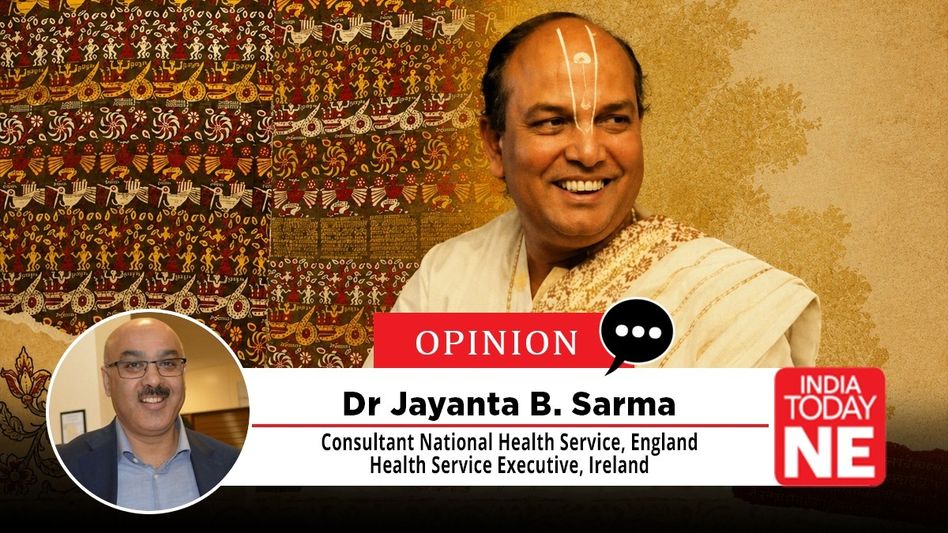
On the morning of 15 June, I accompanied the Satradhikar of Auniati Satra, Satradhikar Prabhu, to the British Library in London. We were there to view something modest in physical form but enormous in historical meaning: an archived copy of Asamabilasini, The Assam Bilasinee, the periodical published by Auniati Satra in the nineteenth century.
The reference had come to me through the library: Volume 5, Number 12, dated 1876, shelf mark OP 218.
A shelf mark is a strange thing. It is dry, administrative, almost emotionless. Yet behind those few characters lies a whole world: a satra in Majuli, a printing press, Assamese prose, institutional ambition, and an indigenous response to the age of print. To sit in the British Library and call up Assam Bilasini was to feel, quietly but sharply, that a part of Assam’s intellectual history had survived, not in public memory at home, but in an imperial archive abroad.
Later that day, we went to the British Museum’s Reading and Archival Research Centre. There, Richard Blurton guided us with unusual generosity, as a special gesture of appreciation to the Satradhikar. The symbolism of the day was difficult to miss. In the morning, Auniati Satra stood before its own printed nineteenth-century voice. In the afternoon, the same living satra tradition stood before the memory of another Assamese civilisational achievement: the Vrindavani Bastra, the great woven Krishna narrative associated with Assam’s Vaishnava world.
One fragment of Assam lay in the British Library as print. Another lived in the British Museum as textile.
One was a periodical. One was a sacred woven narrative.
One belonged to the age of public prose, printing and modern communication. The other belonged to the age of Sankaradeva’s Krishna imagination, satra culture, woven devotion and visual theology. Yet, standing between those two institutions in London on the same day, they seemed to speak to each other.
Together, they told a story that Assam itself has not fully remembered.
The Vrindavani Bastra is now admired as a museum object. It survives in fragments and stitched panels in collections abroad — the British Museum, LACMA, Philadelphia, Chepstow and elsewhere. Its journey is astonishing. Woven in Assam in the Vaishnava devotional world, it travelled north, probably through pilgrimage, trade, monastic networks or gift exchange, and was eventually used in a Tibetan Buddhist setting as a hanging display. There, under the smoke of butter lamps and incense, Krishna’s leela acquired a second life. Buddhist monks may not have read the cloth exactly as Assamese devotees did, but they saw enough sacred power, beauty or prestige in it to preserve it, stitch it, hang it, and live with it.
That may be why it survives.
This is the first irony. A work of Assamese devotional genius became internationally visible because it left Assam. Had it remained within ordinary ritual use, it might have decayed, been cut, replaced, forgotten, or consumed by climate and time. In Tibet, then in London, it became an object of preservation. The museum glass protected what the living tradition could not.
But glass is not life.
The Vrindavani Bastra is not only a textile. It is evidence of an entire ecosystem. Someone imagined the story. Someone knew the Bhagavata. Someone designed the figures. Someone planned the registers. Someone prepared the silk. Someone dyed the threads. Someone operated the loom. Someone funded the labour. Someone gave the object ritual meaning. A whole society of skill, devotion, patronage and institutional confidence had to exist before such a cloth could be woven.
That is what we should see when we look at it: not only Krishna, not only Sankaradeva, not only silk, but capacity.
Then we turn to Assam Bilasini.
The usual story of Assamese print modernity begins, rightly, with Arunodoi, the landmark periodical published by the American Baptist missionaries from Sibsagar in 1846. Arunodoi deserves its place in history. It helped shape modern Assamese prose, carried science, religion, news and discussion, and played a major role in the preservation and renewal of Assamese language in the nineteenth century.
But if the story stops there, it becomes too simple. It becomes a story in which modernity arrives from outside and Assam receives it.
Then comes Auniati Satra.
Just a few decades after Arunodoi, Auniati Satra entered the world of print with Assam Bilasini. This was no small gesture. A satra — often imagined today only as a religious, monastic, ritual institution — acquired a press, organised publication, and produced a periodical that continued for years. The British Library’s preservation of Volume 5, Number 12 from 1876 is a quiet but powerful witness. By its fifth year, this was not a passing experiment. It was an institutional act.
Auniati Satra had not merely preserved the past. It had stepped into the modern public sphere.
This changes the way we should understand Assamese history. The satra was not simply the custodian of devotion, dance, manuscript and memory. It was also capable of technological adoption. It could see the power of print. It could respond to missionary modernity not by retreating, but by producing its own platform. Assam Bilasini was, in that sense, an indigenous Assamese answer to the age of the printed word.
Here again, the pattern repeats.
The evidence survives — but not in our everyday awareness. A copy lies in the British Library. Its shelf mark is known. Its existence can be verified. But in Assam’s public imagination, it is faint, almost absent. We know Arunodoi. We do not know Assam Bilasini with the same intimacy.
Why?
Perhaps because missionary modernity fits the familiar colonial story. It is easier to narrate: the missionaries brought the press; the missionaries published; the missionaries shaped prose; the missionaries awakened a language. There is truth in that. But there is another truth, less often told: Assamese institutions were watching, learning, adapting and responding. They were not inert recipients. They were actors.
That is why the experience of 15 June felt so significant. It was not a tourist visit to two London institutions. It was a pilgrimage through displaced Assamese memory. The living head of Auniati Satra stood before a surviving copy of his institution’s printed past. Later, in the British Museum’s research space, the same satra lineage encountered another preserved testimony to the creative world from which Assamese Vaishnavism once drew its force.
The day joined two forms of evidence.
The first was woven.
The second was printed.
The Vrindavani Bastra and Assam Bilasini therefore belong together. The first shows that Assam could turn sacred imagination into monumental visual art. The second shows that Assam could turn institutional initiative into printed public discourse. The first wove Krishna into silk. The second printed Assam into modernity. Both emerged from the orbit of Vaishnava-satra culture. Both reveal confidence. Both reveal organisation. Both reveal ambition.
And both are now better preserved outside common Assamese memory than within it.
This is not a complaint against museums or libraries. Without them, we might have lost even the fragments. The British Museum, the British Library and other collections have preserved what history scattered. Richard Blurton’s careful scholarship and generosity that afternoon were a reminder that recovery often depends on such custodianship too. But preservation is not the same as possession. Catalogue is not the same as consciousness. A shelf mark is not the same as cultural memory.
The deeper question is not merely: when will the Vrindavani Bastra return to Assam, even temporarily? Or when will the British Library copy of Assam Bilasini be digitised, studied and republished?
The deeper question is: what will Assam do with the knowledge that such things once existed?
Pride is easy. Recovery is harder.
It is easy to say, “Look, we had this.” It is harder to ask, “What kind of society produced it?” It is easy to demand recognition. It is harder to rebuild the conditions that make recognition deserved again. The loom did not produce Vrindavani Bastra by nostalgia. The press did not produce Assam Bilasini by sentiment. Both required discipline, patronage, learning, organisation and seriousness.
That is where the possibility ahead lies, but only if we understand the lesson correctly.
The future is not in mechanically recreating a nine-metre textile and declaring revival. Nor is it in printing a facsimile of Assam Bilasini and congratulating ourselves. Those would be worthy acts, but insufficient. The real revival would be institutional.
What if Assam treated Vrindavani Bastra not as a lost museum object but as a curriculum, teaching art history, weaving technology, Vaishnava aesthetics, design, performance and trans-Himalayan cultural exchange?
What if Assam Bilasini became not merely an archival curiosity but the starting point for a new history of Assamese public thought, one in which satras, indigenous institutions, reformers, printers, monks, scholars and lay readers all appear as makers of modern Assam?
What if Auniati Satra’s publishing initiative were studied alongside Arunodoi, not to diminish the missionary contribution, but to complete the story?
What if Assam built a digital archive where these scattered fragments — textile, manuscript, periodical, photograph, oral memory, performance — could be brought into one intellectual home?
What if young Assamese designers saw Vrindavani Bastra and did not merely copy its motifs, but understood the courage of its ambition?
What if young writers saw Assam Bilasini and realised that Assamese public discourse did not begin with social media outrage, nor even with modern newspapers, but with fragile, disciplined acts of publication carried out by people who believed language and civilisation needed institutions?
Then these objects would stop being museum pieces.
They would become provocations.
They would say: Assam once had the confidence to weave its theology into silk and print its voice into public life. It once had institutions capable of beauty and argument, devotion and adaptation, memory and experiment. It once stood at the edge of change and did not merely complain that the world was changing. It responded.
That is the hidden message of the soot-darkened cloth and the surviving periodical.
One hung in a monastery far away, absorbing the smoke of another civilisation’s lamps. The other rested quietly in a library catalogue, waiting for someone to ask. On 15 June, in London, both seemed to stir again — not as relics asking to be worshipped, but as witnesses asking to be understood.
They have survived long enough to return, perhaps not physically at first, but intellectually.
And that may be the beginning.
Assam does not need to recover its past as a museum of lost glory. It needs to recover its past as evidence of capacity.
The question is not whether Assam once produced greatness. The evidence is there, woven and printed.
The question is whether Assam can again build the institutions that make greatness possible.
(Author’s Note: Dr Jayanta Biswa Sarma writes on politics, institutions, and society through the lenses of history, philosophy, and systems thinking, drawing on both Indian and Western intellectual traditions. Artificial intelligence tools may be used in preparing this article as research and editorial aids. All arguments, interpretations, and final editorial judgement remain the author’s responsibility)