When Dominance Becomes Systemic: Assam’s Opposition Question
A series of recent defections from the Congress to the Bharatiya Janata Party (BJP), alongside deepening organisational weaknesses within the opposition, suggests that the state may be moving toward a phase where electoral contest becomes increasingly uneven. The question is no longer whether the BJP is dominant in Assam. It clearly is. The more pressing question is whether a credible opposition is steadily disappearing.

- Mar 25, 2026,
- Updated Mar 25, 2026, 1:06 PM IST

A series of recent defections from the Congress to the Bharatiya Janata Party (BJP), alongside deepening organisational weaknesses within the opposition, suggests that the state may be moving toward a phase where electoral contest becomes increasingly uneven. The question is no longer whether the BJP is dominant in Assam. It clearly is. The more pressing question is whether a credible opposition is steadily disappearing.
The exits of leaders such as Bhupen Kumar Borah and Pradyut Bordoloi are not routine political realignments. They are indicators of a deeper structural problem within the Congress. These are not marginal figures; they are individuals who once shaped the party’s organisational and electoral strategies. Their departure signals not just dissatisfaction, but a loss of confidence in the party’s future in Assam.
More importantly, these defections are unlikely to be the last. Political momentum, once it tilts decisively, tends to accelerate. Leaders who might otherwise have stayed back are now reassessing their options in a rapidly changing landscape where proximity to power increasingly determines political survival.
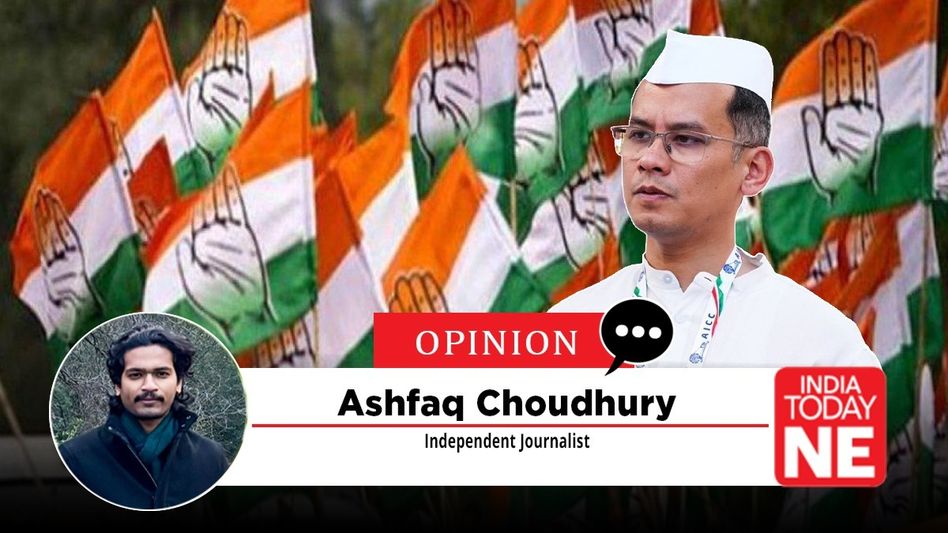
At the centre of this crisis is the leadership of Gaurav Gogoi. His appointment as president of the Assam Pradesh Congress Committee was intended to mark a generational shift and organisational renewal. Instead, it has coincided with one of the most visible phases of internal instability in recent years.
This is not to suggest that the crisis is entirely of his making. The Congress in Assam has been in decline for over a decade. However, leadership is ultimately judged by outcomes, and the current trajectory raises uncomfortable questions. The party appears unable to retain senior leaders, manage internal dissent, or project itself as a viable alternative to the BJP.
Equally concerning are persistent allegations within political circles that sections of the Congress leadership maintain tacit alignments with the BJP. Whether these claims are exaggerated or politically motivated is secondary. The fact that such perceptions exist and are being openly discussed points to a deeper erosion of trust within the party. An opposition that doubts its own internal coherence cannot effectively challenge a dominant ruling party.
Meanwhile, the BJP under Chief Minister Himanta Biswa Sarma has executed a strategy that goes beyond conventional electoral politics. It has combined governance, narrative control, and systematic absorption of opposition leaders into a single framework of expansion. The message is clear: political relevance in Assam increasingly runs through the BJP.
This has created a powerful incentive structure. For many politicians, particularly those with limited organisational backing, remaining in a weakening opposition carries significant risk. Joining or aligning with the ruling ecosystem offers stability, visibility, and access to resources.
This dynamic is particularly evident among minority politicians. Directly joining the BJP continues to carry electoral risks in certain constituencies. As a result, an alternative pathway has emerged: alignment through allied parties such as the Asom Gana Parishad (AGP). This allows leaders to maintain a degree of political distance while effectively operating within the BJP-led coalition. It is a pragmatic adaptation to a changing political reality, but it also underscores the extent of the BJP’s expanding influence.
Within the Assam Legislative Assembly, the opposition continues to function under the leadership of Debabrata Saikia. However, the issue is no longer procedural presence but substantive capacity. An opposition that is numerically reduced and organisationally fragmented cannot provide the level of scrutiny and accountability that a functioning democracy requires.
If current trends persist, Assam risks transitioning into a dominant-party system where electoral competition exists formally but is weakened in practice. Such systems are not uncommon in Indian political history, but they carry inherent risks. Without a credible opposition, policy debate narrows, dissent weakens, and political accountability becomes increasingly internalised.
This brings into focus an important paradox. The decline of the opposition does not eliminate political competition, it relocates it.
As the BJP continues to expand, it is also becoming more internally complex. The influx of leaders from different political backgrounds is creating new layers within the party. There are distinctions between long-standing cadre and recent entrants, between ideological loyalists and pragmatic defectors, and between different leadership networks, including those perceived to be close to the Chief Minister.
In the absence of a strong external challenger, these internal dynamics are likely to intensify. Candidate selection, distribution of power, and policy direction may increasingly become subjects of intra-party negotiation rather than inter-party contestation. In effect, the BJP could become both the principal governing force and the primary arena of political competition in Assam.
This is not necessarily a stable equilibrium. Dominant parties often face internal contradictions as they expand. Managing competing ambitions, expectations, and loyalties becomes progressively more complex. What appears as consolidation today can, over time, generate internal friction.
However, the immediate concern remains the weakening of the opposition. Democracies do not function on the strength of ruling parties alone. They require credible alternatives, institutional checks, and the possibility of political turnover.
The Congress and other opposition forces in Assam still have a window—albeit a narrowing one—to reorganise and reassert themselves. This would require not just leadership changes but structural reforms, clearer political messaging, and the rebuilding of grassroots networks.
Failing that, Assam may soon enter a phase where the BJP’s dominance is not merely electoral but systemic.
The state would still hold elections. Parties would still contest. But the outcome, increasingly, may appear predetermined.
And that is the point at which dominance begins to resemble absence, specifically, the absence of a meaningful opposition.