When Monopolies Hold Passengers Hostage: The IndiGo Crisis and India's Aviation Reckoning
When IndiGo, which controls nearly 70% of India's domestic aviation market, decided to game the system rather than comply with safety regulations, it knew exactly what would happen: passengers would suffer, and the government would capitulate.

- Dec 06, 2025,
- Updated Dec 06, 2025, 4:54 PM IST

The chaos unfolding at Indian airports this week is not merely an operational failure. It is the inevitable consequence of allowing a single airline to amass such overwhelming market power that even the regulator designed to oversee it becomes impotent. When IndiGo, which controls nearly 70% of India's domestic aviation market, decided to game the system rather than comply with safety regulations, it knew exactly what would happen: passengers would suffer, and the government would capitulate.
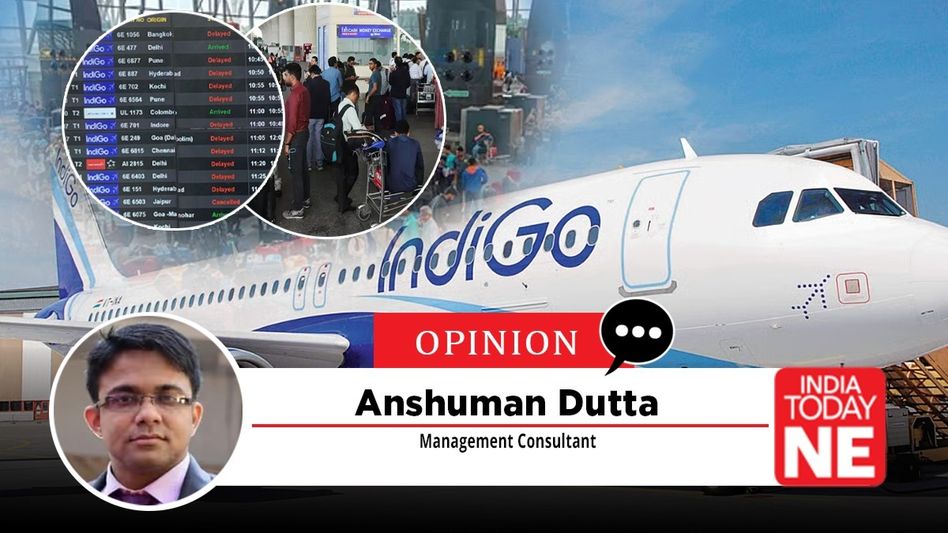
The statistics are numbing over 1,200 cancellations in December, on-time performance collapsing to 8.5%, more than 700 flights cancelled on Friday alone. But numbers cannot capture the desperation in passengers like Swati's voice as she stood stranded at Jammu airport, returning from a pilgrimage, telling reporters, "We have been stranded here for the last three hours. We do not know what to do." They cannot convey Arti Razdan's exhaustion after her flights were cancelled three days in succession, December 2nd, 3rd, and again on Friday as she tried desperately to reach Bengaluru for a wedding with her two children, her leave days exhausted, her dignity eroded by the airline's indifference.
Across India, the pattern repeated itself with cruel consistency. Ayush Kuchya posted from a delayed flight about passengers stuck for hours with no clear communication. Amol Shah raged from Delhi about the "absolute chaos & mockery" as passengers remained stranded for over twelve hours with no confirmation. Even Singapore's High Commissioner to India, Simon Wong, found himself stranded in Delhi, forced to tweet his apologies for missing a wedding. When diplomats and pilgrims alike are reduced to pleading on social media, something has gone catastrophically wrong.
The cruelty was compounded by opportunistic price gouging. As IndiGo choked capacity, other airlines seized the moment. Mumbai Congress MP Varsha Gaikwad revealed how tickets that normally cost Rs 5,000 were suddenly priced at Rs 50,000 to Rs 60,000. This is the true cost of monopoly: when one player dominates, everyone else profits from the chaos, and passengers are left with impossible choices pay ransom prices or don't travel at all.
The Anatomy of Regulatory Capture
What makes this crisis truly scandalous is not that IndiGo failed to manage new fatigue rules, it's that the failure was deliberate. The airline had nearly two years to prepare for Flight Duty Time Limitation regulations announced in January 2024 and phased in specifically to allow adjustment. Every other major carrier managed the transition smoothly. Air India, Spice Jet, and Akasa Air adjusted their schedules without creating nationwide chaos. But IndiGo chose a different path: it increased its winter schedule by 15,014 domestic departures per week while maintaining a hiring freeze and pursuing what insiders call a "lean manpower strategy." This was not incompetence. This was brinkmanship.
Industry analysts suspect IndiGo's strategy was calculated. By allowing the situation to deteriorate into a nationwide crisis, the airline appears to have been arm-twisting the Ministry of Civil Aviation into relaxing rules. Create enough pain for enough travelers, and the government will have no choice but to fold. And fold it did, with predictable alacrity.
Despite the Directorate General of Civil Aviation's public assurances on November 24, 2025, that "no dispensation, exemption, or variation, particularly those motivated by commercial interests, would be granted to any operator," the DGCA granted IndiGo a sweeping one-time exemption until February 10, 2026. The concessions are breathtaking in their scope. The definition of "night" was narrowed from midnight-6am to midnight-5am for IndiGo alone. Permitted night landings tripled from two to six. The rule preventing airlines from substituting leave for mandatory 48-hour weekly rest was withdrawn for all carriers. Civil Aviation Minister Ram Mohan Naidu attempted to frame this capitulation as temporary relief, placing FDTL rules "in abeyance" in the "interest of passengers." The Orwellian logic is staggering: safety rules designed to prevent pilot fatigue were suspended because one airline, which had two years to prepare, chose commercial expediency over compliance.
The Airline Pilots' Association of India was not fooled. In a scathing letter to the DGCA, they warned that "not only has the night definition been relaxed, but the permitted number of landings encroaching on night has been increased, directly contradicting the original CAR issued by the DGCA. Such modifications fundamentally dilute the protective intent of the regulation and jeopardise pilot alertness and flight safety." They accused IndiGo of engineering an "artificially engineered crisis" and warned that passenger safety should never be compromised for commercial reasons. Their conclusion was damning: any accidents arising from fatigue due to these dispensations would be the DGCA's responsibility, not the pilots'.
This is regulatory capture and rupture in its purest form. The regulator exists to protect passengers and enforce safety standards. But when one airline controls 63-70% of the domestic market, the calculus shifts. Grounding a substantial portion of IndiGo's fleet or imposing penalties severe enough to matter would paralyze two-thirds of India's air travel. The airline becomes ungovernable, not because it's above the law, but because enforcing the law becomes economically and politically impossible. As AAP MP Raghav Chadha observed, "IndiGo has almost 70% share of the market. If such a big airline shuts down, obviously, the passengers are facing a lot of trouble." Congress leader Rahul Gandhi was more direct: "IndiGo fiasco is the cost of this Govt's monopoly model. Once again, it's ordinary Indians who pay the price - in delays, cancellations and helplessness."
Breaking the Stranglehold: The Case for Open Skies
The solution to India's aviation crisis is neither complex nor untested. India must immediately dismantle IndiGo's stranglehold by opening domestic routes to international carriers through strategic cabotage reform. Cabotage, the right of foreign carriers to operate domestic routes, is currently prohibited under India's Aircraft Act, 1934, and bilateral Air Services Agreements. This protectionism may have made sense when Indian aviation was nascent and vulnerable. Today, it enables monopolistic abuse and leaves passengers with no recourse.
The global precedents are compelling and varied. The European Union operates a fully integrated single aviation market where any EU carrier can fly domestic routes within member states. Ryanair and EasyJet routinely operate what would once have been considered domestic flights across the continent, driving down prices and expanding connectivity. Australia and New Zealand have a similar arrangement under their Closer Economic Relations agreement, with carriers from both countries operating domestically and internationally in each other's territories. In 2007, the United Kingdom granted Singapore carriers rights to fly domestic UK routes as part of an open skies agreement. Even the United States, fiercely protective of its domestic market, authorized Polynesian Airlines to provide temporary cabotage service in American Samoa when all US-flagged airlines ceased operations, proving that national security concerns can be managed when necessity demands it.
India should adopt a phased, conditional liberalization model. Begin with underserved routes where IndiGo's monopoly is most pronounced and alternatives are scarce, particularly regional connectivity under the UDAN framework. Grant temporary cabotage rights during peak demand periods, holidays, festival seasons, to address capacity constraints. Negotiate bilateral agreements ensuring reciprocity, so Indian carriers gain comparable access to foreign domestic markets. And after establishing competitive balance, consider broader opening of domestic routes to any carrier meeting safety and service standards.
The benefits would be immediate and substantial. International airlines already operating in India, Emirates, Singapore Airlines, Qatar Airways, British Airways, Lufthansa, have aircraft, crew, and systems ready to deploy. They could begin domestic operations within months, not the years required to nurture new domestic carriers. They would bring world-class service standards and accountability mechanisms forged in competitive global markets. When passengers have genuine alternatives, airlines must compete on quality, reliability, and value, not just on the hollow promise of low fares that evaporate when flights are cancelled. These carriers would hire Indian ground staff, maintenance crews, and service personnel, pay airport fees, purchase fuel, and contribute meaningfully to the economy. The net employment effect could well be positive, and the market discipline would be transformative.
Critics will invoke national security, sovereignty, and the specter of job losses. These objections wilt under scrutiny. Modern aviation already operates under strict international safety protocols established by the International Civil Aviation Organization. India's security agencies already vet international carriers for international flights; domestic routes would follow identical protocols. The DGCA would retain full regulatory authority to license operations, set safety standards, and enforce consumer protection rules. And the employment argument rings hollow when IndiGo itself maintains a hiring freeze while expanding schedules. The real threat to Indian jobs comes not from international competition but from a domestic monopoly so confident in its market power that it can treat both employees and passengers with impunity.
The Uncomfortable Reckoning
The DGCA's surrender to IndiGo reveals a truth that policymakers have been reluctant to confront: we have allowed one carrier to become so systemically important that enforcing basic regulations becomes a threat to the entire aviation ecosystem. As one analysis bluntly stated, "This is not regulation. This is capitulation." The government will argue that temporary relief was necessary to prevent further passenger suffering, but this logic inverts cause and effect. Passenger suffering occurred precisely because IndiGo, secure in its monopolistic position, knew it could force regulators to bend rather than face meaningful consequences for non-compliance.
This crisis should serve as India's aviation awakening. We face a stark choice: continue down the current path where IndiGo's dominance grows unchecked and regulators grow increasingly reluctant to enforce standards, or embrace competition as the only sustainable solution to monopolistic abuse. The immediate steps are clear and urgent. Impose substantial financial penalties on IndiGo for selling tickets it couldn't honor and for systematically failing to plan for regulations announced two years in advance. Launch a pilot cabotage program immediately, inviting expressions of interest from international carriers for operating high-demand routes where IndiGo's monopoly is strongest. Accelerate approval processes for new domestic carriers, reducing barriers to entry while maintaining rigorous safety standards. Strengthen consumer protection with automatic refunds for cancellations, substantial compensation for delays, and personal liability for executives who oversee systemic failures. And establish clear structural rules: any carrier exceeding 40% market share faces enhanced regulatory scrutiny and forfeits eligibility for exemptions from safety regulations.
The lesson from this week's chaos is unambiguous. IndiGo's crisis was not caused by onerous new safety rules, it was caused by a monopoly that calculated, correctly, that it could force regulators to retreat rather than face accountability. The solution is not to keep relaxing standards every time IndiGo miscalculates or manufactures a crisis. The solution is to introduce genuine competition that forces all carriers to plan properly, serve passengers with respect, and comply with safety rules because they know passengers have alternatives.
India's air travelers deserve better than being held hostage to a single airline's commercial calculations. They deserve the competitive market that once brought down airfares and expanded connectivity dramatically. They deserve regulators who prioritize their safety over an airline's quarterly earnings. And they deserve a government willing to make the hard but necessary choice: breaking the monopoly that has made a mockery of both market discipline and regulatory oversight.
As Indian Railways scrambles to add 37 trains with 116 additional coaches to accommodate stranded passengers, and as IndiGo promises full operational stability by February 10, 2026, one question lingers: how many more crises will India endure before it acknowledges that monopoly power and passenger welfare are fundamentally incompatible? The answer should not require another thousand cancelled flights to discover.
Personally for me, I have rescheduled my December 5, 2025 travel plan to December 15, 2025. Not everyone has that luxury.