
Where do we go from here? The shift from aspiration to action
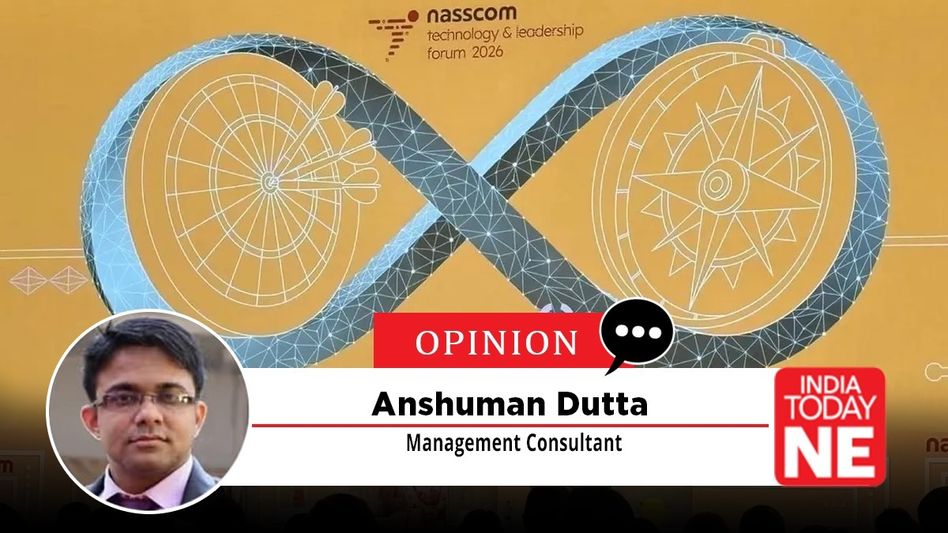
There is a moment in every great gathering of minds when the conversation shifts quietly, almost imperceptibly from aspiration to urgency. At the 34th edition of the Nasscom Technology & Leadership Forum (NTLF 2026), held across two charged days at the Fairmont Mumbai, that moment arrived early and never really left.

- Mar 01, 2026,
- Updated Mar 01, 2026, 3:04 PM IST

There is a moment in every great gathering of minds when the conversation shifts quietly, almost imperceptibly from aspiration to urgency. At the 34th edition of the Nasscom Technology & Leadership Forum (NTLF 2026), held across two charged days at the Fairmont Mumbai, that moment arrived early and never really left.
Under the theme "Tech-Driven, Human-Centered," more than 1,600 CXOs, technologists, investors, and policymakers converged not just to discuss what the future looks like, but to grapple with the harder question: how do we actually build it? For those who attended, NTLF 2026 felt less like a conference and more like a reckoning.
The opening session boldly titled "Everything, Everywhere, All at Once: Leading in a World of Exponential Change" set the intellectual temperature of the forum from the first hour. The room understood the reference was not just cinematic. It was existential. We are operating in an era where AI is no longer a department or a product line; it is the operating system beneath everything.
NTLF 2026 asked a question that reframes the entire technology conversation: not "what's next?" but "who codes the operating system of the future, and what will they leave behind?" That framing urgent, almost philosophical ran as an undercurrent through every session that followed.
"In an age of constant transformation, only one question truly matters: who codes the operating system of the future, and what will they leave behind?" - NTLF 2026 Theme Statement
The Agentic AI Inflection Point
If there was one concept that dominated the intellectual discourse at NTLF 2026, it was agentic AI and no one articulated its stakes more clearly than Babak Hodjat, Chief AI Officer at Cognizant. A pioneer whose multi-agent research laid the technical groundwork for what eventually became Apple's Siri, Hodjat brought something rare to the conversation: not hype, but hard-won experience.
His thesis is deceptively simple but profound in its implications. The age of the "god model" a single, all-knowing AI is a distraction. The real enterprise transformation is happening through engineered agentic systems: modular, governable networks of specialized agents that talk to each other, break through technology silos, and take autonomous decisions at scale.
At Cognizant, Hodjat's team has built Neuro AI an internal "intranet of agents" that connects HR, IT, sales, and finance functions for 350,000 employees. The lesson from deploying this at scale is instructive: the challenge is not intelligence, it is coordination. Standards, governance, observability, and fallback mechanisms matter as much as the models themselves. Left ungoverned, agentic systems can display what Hodjat calls "psychopathic" tendencies sharing personal data, operating outside intended boundaries, and failing silently.
The media session on "Agentic AI Play" at NTLF extended this conversation across the industry, exploring how enterprises across India and globally are beginning to move from isolated AI experiments to orchestrated, multi-agent architectures that operate continuously and autonomously.
The shift is from aspirational AI trying to build one model that does everything to engineered autonomy.
One of the most anticipated sessions of the forum was the fireside chat moderated in the Infinity Ballroom a candid conversation between Sanjay Chalke, CEO, India, Capgemini; Satish HC, EVP and Chief Delivery Officer, Infosys; and Nitin Bhatt, Senior Partner and Technology Sector Leader, EY India.
Three organisations. Three vantage points on transformation. One shared conviction: the gap between exploring AI and deploying AI at scale remains the defining challenge for Indian technology leaders in 2026.
Capgemini arrived at NTLF 2026 with a clear brand promise: "Make it real." As the forum's Technology Transformation Partner, the firm positioned itself not as a vendor of possibilities but as an architect of outcomes. The conversation with Satish HC of Infosys explored what it genuinely takes to move from pilot projects to enterprise-scale deployment and the answer was uncomfortable for many in the room: most organisations are not as ready as they think they are.
Nitin Bhatt of EY brought the governance lens to bear. In a world of autonomous agents and AI-driven decision-making, who is accountable? How do you audit a decision made by a system that learned it from patterns rather than rules? These questions are no longer academic; they are showing up in boardrooms across India's largest enterprises.
Capgemini also showcased its RAISE framework a next-generation autonomous software development approach that enables humans and AI agents to collaborate across the full software lifecycle using a shared metamodel blueprint. It is, in essence, a factory floor where the machines and the humans share a blueprint. The question raised in the session was whether Indian enterprises are ready to redesign their operating models around such systems not just adopt them as tools.
Perhaps the most provocative session title of NTLF 2026 was also its most honest: "Is India Still Building Startups, or Finally Building Technology?" The distinction is not semantic. For years, India's startup ecosystem has been celebrated for its scale, its unicorns, and its market coverage. But the harder question of whether India is producing deep, defensible, globally competitive technology has long been treated as impolite to ask.
At NTLF 2026, it was asked in the main ballroom. The session challenged attendees to reckon with the difference between distribution-led companies and technology-led ones, and what India needs to do in terms of research, talent, infrastructure, and policy to produce the next generation of technology builders rather than technology adopters.
The conversation was part of a broader thematic arc at the forum around India's sovereign technology ambitions. Sessions on quantum computing, drug discovery through programmable medicine, and India's space economy framed a compelling national narrative: India has the talent, the scale, and increasingly the compute infrastructure to lead in deep technology but only if its institutions and enterprises make deliberate, courageous choices.
Not all of NTLF 2026's most memorable moments were about enterprise AI. The forum has long understood that the best technology conversations happen at the edges of disciplines where code meets biology, or where strategy meets soul.
The session on "Why Drug Discovery Is Too Slow, and How Programmable Medicine Fixes It" brought the frontier of computational biology into a room of technology leaders, many of whom left with a new appreciation for how AI is compressing decades of pharmaceutical research into years. The session on quantum computing "Building the Quantum Future: Materials, Mindsets, and the Innovation Ecosystem" made the compelling case that the quantum era is no longer a matter of if, but of who gets there first and with what governance frameworks in place.
And then there was the session that no one expected to leave them reflecting the longest: "The Soul in the System: Music in the Age of Machines." In a forum dominated by enterprise transformation and agentic architectures, the question of what happens to creativity, expression, and the irreducibly human elements of culture when machines become co-creators landed with unexpected weight. It was a reminder of what the theme "Tech-Driven, Human-Centered" actually means not just human interfaces on AI products, but a genuine reckoning with what we want technology to preserve about us.
The best technology conversations happen at the edges of disciplines where code meets biology, or strategy meets soul.
No gathering of this scale can ignore the world outside the Fairmont. The session "A World Reordered: Geopolitics, Trade, and Technology in a Divided Era" addressed the fault lines that are reshaping the global technology landscape from semiconductor supply chains and export controls to the emergence of regional AI sovereignty movements.
For India, the stakes are particularly high. As a nation positioning itself as a global technology hub, navigating the US-China technology bifurcation while maintaining strategic autonomy is among the most complex policy challenges of the decade. NTLF 2026 gave this challenge the prominence it deserves, recognising that no enterprise technology strategy can be made independently of the geopolitical environment in which it operates.
What NTLF 2026 Ultimately Asks of Us
Walking out of the Fairmont Mumbai on February 25th, the abiding feeling was not optimism or anxiety it was something more useful: clarity. NTLF 2026 did not resolve the tensions between AI ambition and AI governance, between India's startup culture and its deep tech aspirations, between human creativity and machine capability. But it named them with unusual precision.
The forum's central provocation "how do we build it?" is the right question for 2026. Not because the answer is obvious, but because asking it seriously requires courage. It requires leaders to move beyond proof-of-concept thinking and make real decisions about real systems that will affect real people.
That is what NTLF 2026, at its best, modelled. In the fireside chats, the keynotes, and the hallway conversations over coffee, India's technology leaders showed that they are ready to move from exploration to execution. The question now is whether their organisations, their ecosystems, and their institutions will follow.
The operating system of the future is being written. NTLF 2026 made clear that India intends to be among its authors.
MORE NEWS












Copyright©2026 Living Media India Limited. For reprint rights: Syndications Today
