
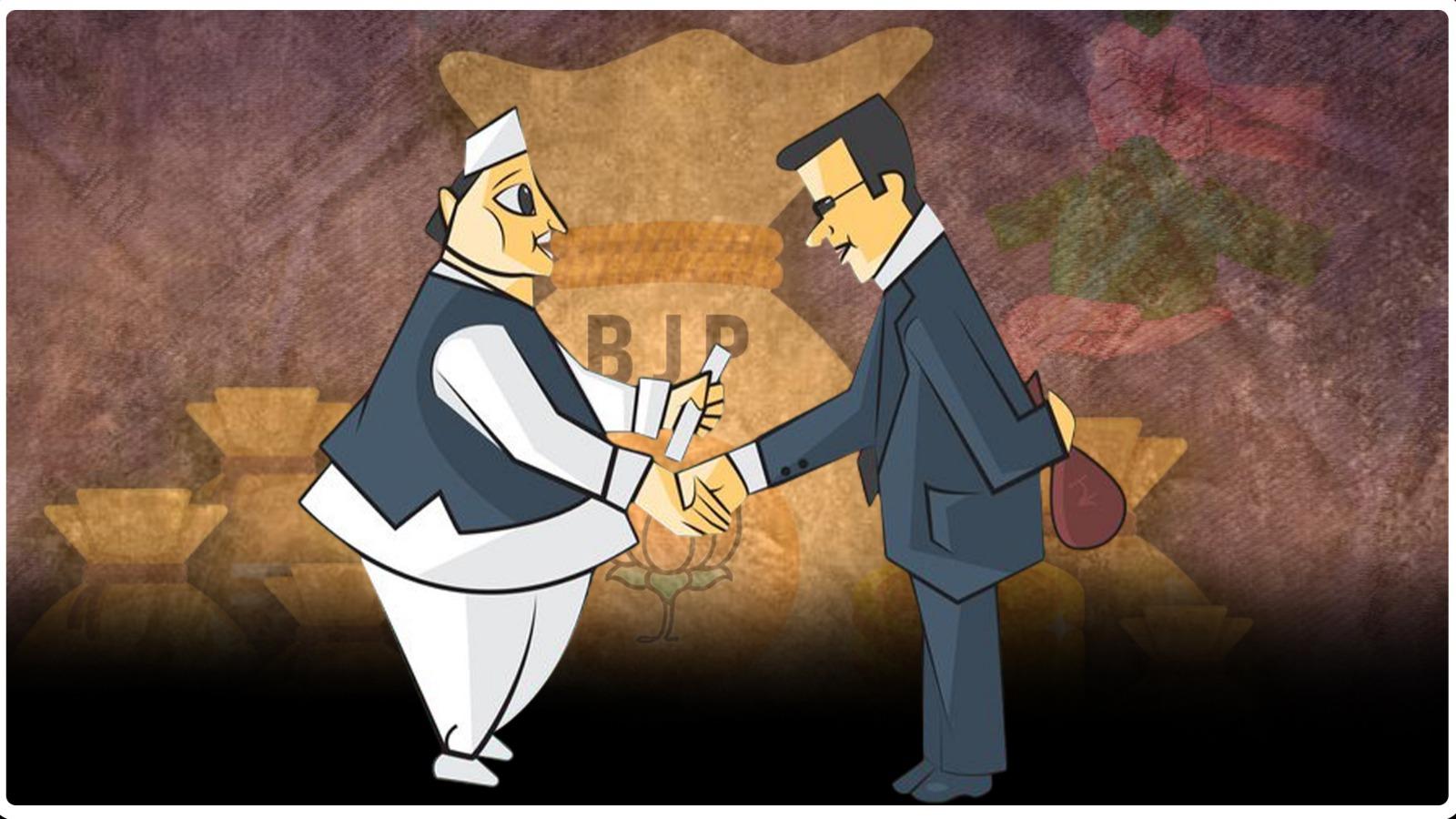

Whether UPA or NDA is in power, why India Inc donates more to BJP
The latest electoral trust data confirms a long-standing pattern: corporate India continues to favour the BJP, regardless of who is in power. This, however, is not necessarily about favoritism. The BJP’s preference for bank-routed donations strengthens the party’s finances, while others have often lost out to intermediaries in cash-based transactions.
Advertisement


India TodayNE
- Dec 21, 2025,
- Updated Dec 21, 2025, 11:57 PM IST
The latest Electoral Trust Contribution reports are out. They confirm what Indian politics has known for years but rarely confronts honestly. Political funding in India remains overwhelmingly corporate-driven. And corporate money continues to gravitate towards power.
In 2024–25, electoral trusts donated Rs 3,811 crore to political parties. Of this, the BJP received Rs 3,112 crore, or a little over 83 per cent. The Congress received Rs 299 crore, just under 8 per cent. All other parties together shared the remaining 9 per cent.
This is not a marginal skew. It is a structural concentration.
To understand what this means, one must first understand how electoral trusts function. Electoral trusts were introduced in 2013. Their purpose was straightforward. Move corporate donations away from cash. Channel them through banks. Make the source and destination of political money visible.
Under this system, companies and individuals donate to a registered trust. The trust then donates to political parties. The rules are strict on paper. Trusts cannot accept cash. They must distribute at least 95 per cent of the money they collect in the same financial year. Both donors and beneficiaries are disclosed to the Election Commission. Transparency, at least formally, is built in.
What the system does not regulate is balance. A trust is free to donate its entire corpus to a single party. It can back the party it believes will best protect its interests. The system reveals preference. It does not restrain it. That is how, this year, more than four-fifths of all trust donations ended up with one party.
It was this limitation that led to the introduction of electoral bonds in 2018. The government argued that transparency without anonymity was pushing donors back to cash. Companies, it said, feared political retaliation if their preferences became public. Anonymity, the government claimed, would ensure a level playing field.
Electoral bonds allowed donors to buy bonds from banks and give them to political parties. The party could encash the bond. The donor’s identity would not be disclosed publicly. The stated objectives were clear. Eliminate cash. Bring black money into the banking system. Reduce intermediaries. Protect donors.
There was, however, one crucial structural difference between electoral trusts and electoral bonds that shaped donor behaviour. Electoral trusts operate under a cap. Electoral bonds did not. Under the Companies Act, donations through trusts are limited to 7.5 per cent of a company’s average net profits over the previous three years. This was meant to keep donations proportionate and to prevent shell companies from becoming political conduits.
Electoral bonds dismantled this ceiling. The profit-linked cap was removed. Companies could donate unlimited amounts. Even loss-making firms could contribute. Newly incorporated companies could do the same. The government argued that limits encouraged benami transactions. Remove the ceiling, it said, and money would flow cleanly through banks.
What followed was predictable. With unlimited donations and guaranteed anonymity, corporate money gravitated overwhelmingly towards the party most likely to remain in power. Over time, data showed that the BJP cornered the bulk of bond proceeds year after year. Concerns deepened because bonds were issued and redeemed through the State Bank of India, a public sector bank. Donations were anonymous to citizens, critics argued, but not necessarily to the state.
In 2024, the Supreme Court agreed. It scrapped the electoral bond scheme, ruling that absolute anonymity violated the voter’s right to information.
Once bonds were gone, corporate donors returned swiftly to electoral trusts. The surge was dramatic. Trust donations more than tripled in a single year. Corporate money did not disappear. It simply changed routes.
This brings us to the central question. Is the BJP gaining because it is in power? There is no definitive answer. But history complicates the argument. Between 2004 and 2014, when the Congress-led UPA ruled, the BJP received more declared donations in most years, barring a brief window between 2005 and 2007. After 2014, however, the gap widened dramatically. By 2023–24, the BJP’s donations crossed Rs 2,200 crore, while the Congress remained below Rs 300 crore.
Does this mean corporate India has always preferred the BJP? Partly, yes. The BJP has long been seen as process-driven in fundraising. It prefers direct channels between donors and the party. It minimises intermediaries. Money reaches the party organisation directly. This discipline has compounded over time.
The Congress tells a different story. Despite being in power for a decade, it failed to build a robust institutional fundraising system. It is widely acknowledged that several leaders prospered as intermediaries, even as the party organisation weakened financially. Over time, this hollowed out its capacity to compete.
Yet no discussion on political funding can avoid the real elephant in the room—cash. Donations below Rs 20,000 can still be made without disclosure. Earlier, the limit was Rs 2,000. A large portion of political money continues to flow through this route. It remains invisible. It remains unaccounted.
Electoral bonds tried to fix one part of this problem. They failed because anonymity became absolute without accountability and limit. Electoral trusts improve disclosure. But they do not ensure a level playing field. As long as cash remains legal and corporate money remains concentrated, transparency will remain incomplete. What the latest data tells us is not just who gets the money, but how far India still is from a funding system that is both clean and fair.
(Kaushik Deka is the Managing Editor of India Today Magazine and Editor of India Today NE)
POST A COMMENT
MORE NEWS












Copyright©2025 Living Media India Limited. For reprint rights: Syndications Today
