Why Assam must move beyond ceremonial worship of Sankardev
There are two ways to honour a teacher. The first is to preserve him, having his name on our lips, his portrait on our walls, his birthday marked in our calendars, and showering him with love and respect through garlands and speeches. The second is to be changed by him, to let his questions walk into our lives and restructure our perspectives and thoughts.

- Sep 21, 2026,
- Updated Sep 21, 2026, 1:43 PM IST

There are two ways to honour a teacher. The first is to preserve him, having his name on our lips, his portrait on our walls, his birthday marked in our calendars, and showering him with love and respect through garlands and speeches. The second is to be changed by him, to let his questions walk into our lives and restructure our perspectives and thoughts.
The first costs nothing and demands nothing. The second costs everything. Five hundred and seventy-seven years after Srimanta Sankardev was born at Bordowa, we have mastered the first and quietly, comfortably, abandoned the second.
Let me be careful here, because this is easy to misread. There is nothing wrong with respecting a mahapurusha with honorary symbolism. There is nothing wrong with having a traditional dress code for visiting Bordowa Than. There is nothing wrong with the rule itself, and nothing wrong with the person who follows it. Traditional attire can be an act of humility, a small bow of the body before something larger.
My quarrel is not with the cloth. My quarrel is with what the cloth has come to replace. For too many of us, the dhoti-kurta is the beginning, the middle, and the end of our remembrance. We dress the part and assume the part is the point. And so a man who rewrote the spiritual architecture of an entire region is reduced, on his own birthday, to a dress code at the gate.
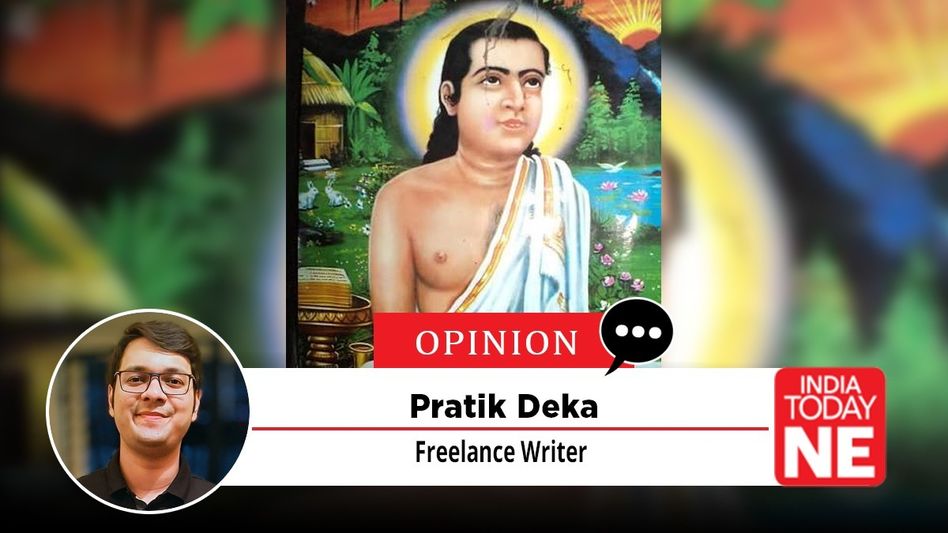
Let us be honest about what we do with our mahapurushas. We turn them into statues. We garland them. We fold our hands and bow our heads and chant their names in unison. We build marble structures around them and put up boards about what to wear and what not to wear. And then we go home feeling that we have done right.
We have done nothing. We have performed respect. Performing is not the same as learning.
Things like these always remind me of Amitabh Bachchan’s X bio, a quote by Harivansh Rai Bachchan, and I cannot get it out of my head. It reads - तुमने हमें पूज पूज कर पत्थर कर डाला; वे जो हमपर जुमले कसते हैं, हमें ज़िंदा तो समझते हैं (You’ve worshipped us into stone with your worship; those who hurl their quips at us at least take us for alive).
That is what many of us have done to Sankardev. We have made him a monument. And monuments cannot argue with you, nor can you with them. Monuments cannot ask you uncomfortable questions. Monuments cannot tell you about the liberal ideas, the opposition to caste hierarchy, the exact things they spent their life fighting for. A statue is safe and easy. Ideas are not. So, many chose the statue.
Think about what Sankardev actually did. He didn't just write poetry. He took the Bhagavata Purana and rendered substantial portions of it into the language of the people, so that those who had never opened a Sanskrit book could hear its stories themselves. He wrote Borgeet that people still hum and listen to. He established the early Sattras that were not just temples but centres of learning, where music and dance and craft were preserved and taught.
He developed a new theatrical form - Ankiya Naat, i.e., one-act plays performed in the villages, telling stories from Krishna's life. He wrote the scripts, composed the music, choreographed the movement, the vocabulary, and trained the performers. The result was Bhaona - a form of theatre that combined music, dance, and drama, a storytelling tradition so powerful that it's still performed five centuries later. From these performances grew Sattriya, a classical dance form that was recognised as one of India's eight classical dances only in the year 2000, but had been alive in the sattras for hundreds of years.
Every single thing he did was about access. About breaking the lock on knowledge. About saying: this is yours, take it, sing it, live it. None of what he did was beyond the intellectual capacity of the common man. This was his Ekasarana Dharma: surrender to one God and the belief that everything is accessible to all.
And notice the method behind it. Sankardev did not simply inherit his society's customs and defend them. He looked at them, tested them, and where they failed human dignity, he replaced them. His vision seems almost scientific in its willingness to question - a mind that treated convention as a hypothesis rather than a commandment.
He envisioned an egalitarian community at a time when caste was not just social order but social law, and he built the namghar as a working experiment for that idea, rather than writing slogans about it. His religious movement challenged aspects of ritual hierarchy and expanded participation beyond established Brahmanical structures. He was, in the truest sense, a liberal, not because he used the word, but because he refused to let inherited authority decide who was allowed to belong.
And we must remember that his liberalism was not a decorative detail. It was the whole point. He was tolerant, inclusive even before they were in the everyday vocabulary. If we claim him, we are claiming that inheritance too, which means the same openness has to live in us - in how we treat those who disagree with us, those who look different, those who worship differently, those who do not worship at all. You cannot bow to a liberal reformer and then practice illiberalism in his name. The two do not sit in the same namghar.
And what do we do with that inheritance? Many of us sing or hear the Borgeets without knowing what exactly they are saying. We perform the Bhaona as a cultural exhibition once a year. We teach our children to bow at the namghar but not to ask why it was built. We all know Sankardev's name. But everyone might not know his argument.
This is the same disease we have with dharma. We treat it as a set of rituals and customs to be followed, not a philosophy to be understood. We fast on the right days, we wear the right threads, we say the right mantras. But ask someone what dharma actually says about how to live, how to treat a stranger, how to hold power, how to sit with uncertainty, and the room goes quiet. We have the shell. We lost the meat a long time ago.
On Sankardeva’s Janmotsav, ‘naam’ reverberates through thousands of namghars across Assam. The khol and taal beat in unison. The old songs rise. And somewhere, a child is probably being told the traditional legend of the boy who swam the Brahmaputra. People will garland his portrait and post it with a nice caption. That’s great.
But we can do something more than that.
Maybe read the Kirtan Ghosha, not just the parts that are sung in the namghar, but the parts that make you think. Watch your next Bhaona and ask what they are actually saying about power, about devotion, about who gets to be close to God. Question him. That is what living traditions do - they argue with themselves and grow. In fact, questioning is the most faithful thing we can do, because questioning is exactly what he did.
But do not pretend that the argument is over because you wore the right clothes to the than.
A young person in an oversized t-shirt and ripped jeans who has actually read Sankardev, who has wrestled with his philosophy, who has tried to see the caste problem in her own neighbourhood through her eyes - that person is closer to him than a man in a spotless dhoti who has never opened a page and lectures others about culture to everyone around. I mean that. The cloth is not the dharma. The cloth is the wrapping.
So what would it actually look like to carry him forward? Not in grand declarations, but in small, practical things. Put his verses where people already look - not only in temples and textbooks, but on government calendars and diaries, in important public spaces, the way we once printed slogans of literacy and family planning on everything that reached the last village. In schools, don't just teach the dates and the names; rather, ask the class what it means, and let them disagree with it. Let students write new ankiya naat about what troubles them now: floods, caste, the internet. Open the sattra archives to scholars, translators and filmmakers. And let the namghar become what it was always meant to be - not only a place to sing, but a place to also deliberate over ideas.
None of this needs money we don't have. It needs only that we treat Sankardev as a teacher and not a totem.
Sankardev did not ask to be worshipped. He asked to be heard. He did not want a queue outside his birthplace with a dress code at the entrance. He wanted a namghar with no queue at all.
He left behind a civilisation of the everyday - a way of living where devotion wasn't a separate hour in the temple but a thread running through the whole cloth of life. We just need to revisit it, through perusal of his creations.
Five hundred and seventy-seven years later, some of us have given him the opposite of what he asked for, and we call it respect. We have built him a beautiful stone body and forgotten he ever had a voice.
It is time we let him speak again. Not through our folded hands. But through our questions.
And lastly, I want to confess something - I have studied in a school that is named after the mahapurush and where the morning prayers were compositions of his disciple Madhavdev. Every morning, I sang those compositions in assembly. Loudly. Confidently. Cluelessly. I can still hum the tunes. But I still don’t understand what they say. So this isn't a lecture. It's a confession. I'm the accused, the witness, and the judge — and I'm pleading guilty.