
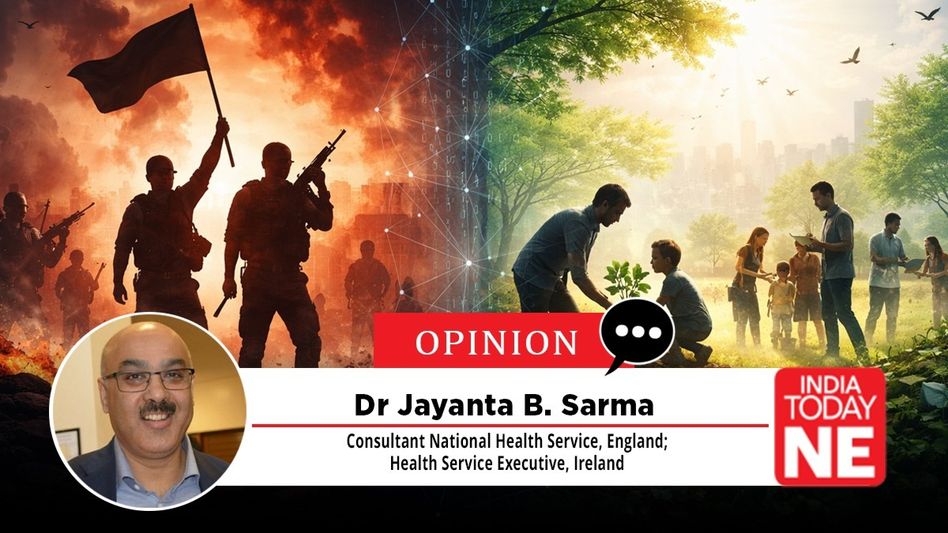
Why violent ideology spreads faster than hope?
Today’s extremist movements no longer resemble traditional organisations. They behave more like decentralised ecosystems: loose constellations of semi-autonomous actors connected by shared narratives rather than strict hierarchy. Leadership matters far less than it once did. Instead, ideology itself functions as portable “code”—a compact story of grievance, identity, duty, and permission that can be downloaded anywhere and adapted locally.

- Feb 07, 2026,
- Updated Feb 07, 2026, 3:44 PM IST

Recent warnings from the United Nations about the continued resilience of Al-Qaeda and Islamic State reveal a disturbing paradox. These movements persist and, in some regions, grow despite lacking charismatic leaders, territorial control, or central command.
At the same time, positive causes public health, education, climate action, social justice, struggle to scale with comparable speed or cohesion, even when backed by governments, institutions, and overwhelming moral legitimacy.
Why does destructive ideology seem to travel faster than constructive purpose?
The answer lies less in religion or geopolitics than in how modern networks work.
Today’s extremist movements no longer resemble traditional organisations. They behave more like decentralised ecosystems: loose constellations of semi-autonomous actors connected by shared narratives rather than strict hierarchy. Leadership matters far less than it once did. Instead, ideology itself functions as portable “code”—a compact story of grievance, identity, duty, and permission that can be downloaded anywhere and adapted locally.
In effect, these groups have shifted from pyramids to platforms.
That change makes them remarkably hard to defeat. Removing leaders does not collapse the system; functions simply redistribute. Recruitment, propaganda, financing, and operations are replicated across many nodes. Local groups experiment independently. Tactics that work spread quickly through imitation, not instruction.
This is emergence: coordinated global behaviour arising from countless small, loosely connected actions.
Crucially, extremist ideology carries a permissive action rule. Violence does not require approval. Once someone internalises the narrative, they can act alone while still feeling part of something larger. That dramatically lowers the barrier to participation. A lone actor needs no committee. A small cell needs no strategic consensus. Action becomes immediate and improvisational.
Fragile environments accelerate this dynamic. Weak governance, displacement, poverty, and porous borders create fertile ground. Violence drives instability; instability fuels recruitment; recruitment enables more violence. These feedback loops quickly become self-sustaining.
Technology amplifies everything. Encrypted messaging, cheap video production, and digital finance reduce coordination costs while expanding reach. Even without direct command, alignment emerges as actors respond to shared symbols and tactics circulating online.
From an evolutionary perspective, this system learns fast. Dozens of local groups test strategies in parallel. Failures fade quietly. Successes propagate rapidly. The movement adapts more quickly than any central authority could manage.
And it doesn’t need mass approval. Extremist networks thrive on asymmetry. Small, inexpensive acts can generate enormous psychological and political impact. Violence guarantees attention. Even negative media coverage amplifies visibility, reinforcing identity and recruitment. Fear itself becomes a resource.
Positive movements operate under very different constraints.
Building schools, hospitals, climate resilience, or democratic institutions requires trust, coordination, professional standards, and sustained cooperation. Their rewards are delayed and diffuse. Success is gradual; failure is immediate. Ethical safeguards, consultation, consent, accountability introduce friction. That friction is essential, but it slows replication.
Where violent ideology benefits from brutal simplicity, constructive change must accommodate pluralism. It involves multiple stakeholders, competing priorities, and complex logistics. There is no single action rule that converts grievance into instant mobilisation.
There is also a visibility problem. Prevented disease makes no headlines. Educated children don’t trend on social media. Strong institutions rarely produce spectacle. Our media ecosystems reward disruption, not durability.
In systems terms, positive ideologies are optimised for stability, not speed.
They are designed to last, not to surge.
Extremist ideology, by contrast, offers immediacy: identity, belonging, and agency compressed into rapid action. For people living amid chaos or marginalisation, this can feel powerfully empowering.
Yet constructive ideas can spread through similar decentralised dynamics, when deliberately designed to do so.
They scale best when they offer simple, repeatable actions; low barriers to participation; visible local wins; strong community identity; portable toolkits; and narratives that make complexity meaningful. Mutual-aid networks, open-source communities, and some public health campaigns show how decentralisation can work for good.
But they face a fundamental asymmetry: they refuse harm as a catalyst.
Violent systems tolerate or seek, destruction to accelerate change. Positive systems deliberately constrain themselves. They accept slower progress in exchange for dignity, consent, and social cohesion. This is not a weakness. It is the ethical price of civilisation.
The policy implications are profound.
Counter-terrorism still focuses heavily on leadership decapitation and territorial control. But the real threat now lies in adaptive capacity: recruitment pipelines, financing pathways, narrative ecosystems, and the ability to regenerate across regions.
Likewise, efforts to promote positive change must move beyond top-down programmes. They need better “distribution architecture”—lower participation thresholds, stronger local autonomy, faster feedback, and storytelling that makes long-term gains emotionally tangible. In short, they must learn to design for emergence.
The UN’s evolving language, describing extremist threats as multipolar and networked, implicitly recognises this shift. The danger no longer resides primarily in leaders or strongholds. It lies in self-reproducing ecosystems of belief and practice.
But the same logic offers hope.
If destructive ideologies can scale without central command, so can constructive ones—if we build them intentionally.
Decentralisation is not inherently dangerous. It is simply powerful.
The same dynamics that spread fear can also spread care. Emergence will shape our future regardless.
The only real question is which values we embed into the networks we build.
The views expressed in this article are those of the author and do not necessarily reflect the views of India Today NE or its affiliates.
MORE NEWS












Copyright©2026 Living Media India Limited. For reprint rights: Syndications Today
