
Women, Welfare and Power: Assam’s Strategic Political Economy
Assam’s expanding network of women-centred schemes may look like welfare on the surface, but a closer reading reveals a deeper experiment in reshaping household economics and political power. The real question is whether these transfers will remain short-term relief—or quietly evolve into the foundation of a new grassroots economy driven by women.

- Mar 13, 2026,
- Updated Mar 14, 2026, 10:54 AM IST

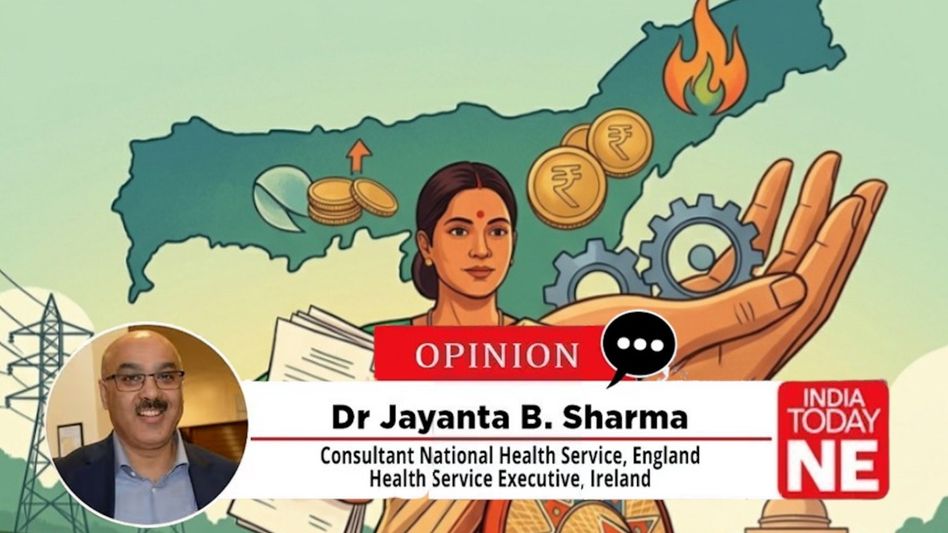
Public debate around welfare often oscillates between two extreme positions. One camp celebrates cash transfers as the fastest way to alleviate poverty; the other dismisses them as populist politics. The truth, however, lies somewhere in between. When viewed carefully, Assam’s evolving women-centred welfare architecture—anchored around Orunodoi, Mukhya Mantri Mahila Udyamita Abhiyaan (MMUA), Nijut Moina, and targeted widow support—reveals something more complex. It is not simply about distributing money. It is about building a layered political economy around women.
The architecture has three distinct pillars.
First comes income protection. The Orunodoi scheme, now one of Assam’s flagship programmes, provides Rs 1,250 per month to financially vulnerable households, with the woman designated as the beneficiary. The logic is straightforward: in a state where formal social security remains limited and income shocks are common, predictable cash support provides a minimum financial floor. For millions of families, that modest monthly amount helps pay for food, medicines, school expenses or small debts. More importantly, the fact that the transfer is directed to women subtly shifts financial authority inside households.
Second comes life-cycle investment.
The government’s Nijut Moina programme provides monthly support for girls pursuing higher education—Rs 1,000 for Class XI students, Rs 1,250 for first-year undergraduate students, and Rs 2,500 for first-year postgraduate or B.Ed. students. While the sums may appear modest, the objective is strategic: reducing dropout and discouraging early marriage by making daughters’ education financially viable for families. In a society where girls’ schooling often competes with economic constraints and social pressures, even small incentives can alter household decisions.
Third comes productive capital.
The MMUA attempts something more ambitious. Instead of consumption support, it offers Rs 10,000 as seed capital to women in self-help groups, followed by bank linkage and access to larger loans. The goal is to convert beneficiaries into micro-entrepreneurs—encouraging small enterprises ranging from livestock and weaving to food processing and retail trade.
Taken together, these schemes form a ladder: protection, preparation, and participation.
The recent announcement of a Rs 9,000 transfer to Orunodoi beneficiaries has once again ignited debate. Whether the payment ultimately proves to be a special additional transfer or a lump-sum adjustment within the scheme’s structure, the discussion highlights a deeper question: what is the opportunity cost of cash transfers compared with long-term empowerment policies?
Cash transfers have undeniable advantages. They are simple, transparent and relatively efficient. In states where administrative capacity is uneven, direct benefit transfers can often reach beneficiaries more reliably than complex development programmes. For households living on fragile incomes, cash support provides immediate relief from the pressures of food insecurity, medical expenses and seasonal shocks.
Yet relief and empowerment are not the same thing.
A monthly transfer improves consumption but rarely transforms the underlying structure of poverty. Sustainable empowerment comes from productive capability—skills, capital, market access and opportunities for income generation. In that sense, programmes like MMUA are fundamentally different from welfare transfers. They are attempts to seed economic agency.
Consider the difference in economic logic. A cash transfer spent on daily necessities disappears once consumed. Seed capital invested in a small enterprise, however modest, can generate recurring income. A poultry unit, weaving activity, or small trading venture may produce modest returns individually, but when millions of women participate in such activities the cumulative effect can reshape local economies.
Economists sometimes describe this phenomenon as distributed capital formation—the creation of productive assets at the grassroots level rather than through large industrial investments alone.
The opportunity cost question becomes clearer when placed against the scale of public spending. Assam’s budget for 2025–26 projects net expenditure of roughly Rs 1.46 lakh crore. Within that framework, allocations such as Rs 5,000 crore for Orunodoi and more than Rs 3,000 crore for MMUA are significant policy choices. Each rupee directed toward income support is a rupee not immediately invested in other sectors such as healthcare, agriculture, infrastructure or education.
But the argument that all such funds should instead be redirected to development projects overlooks a key reality: governance capacity.
The opportunity-cost argument, then, should not be framed crudely as cash versus development. In Assam, that is too simplistic. The more serious question is this: what mix of immediate income support and long-term capacity building produces the highest resilience for women in a low-capacity state? This matters because the state does not operate in an ideal governance environment. The CAG’s 2023–24 State Finances Audit Report recorded 6,335 pending utilisation certificates involving Rs 18,669.55 crore, while PRS notes that in 2023–24 actual spending lagged budget estimates in several sectors, including rural development (-34%) and social welfare and nutrition (-27%). In such a setting, a cleanly delivered DBT can sometimes outperform a theoretically superior scheme that is trapped in bureaucracy, delay, and leakage. So one must be careful before arguing that every rupee shifted away from cash would automatically do more good elsewhere.
India’s public finance system often struggles with delayed utilisation of funds, complex procedures and implementation bottlenecks. In such an environment, a well-designed direct benefit transfer can sometimes deliver results faster than large programmes trapped in bureaucratic inertia. The real policy challenge, therefore, is not choosing between welfare and development but balancing them intelligently.
This is where comparisons with advanced welfare states such as England become instructive. The United Kingdom is projected to spend more than £330 billion annually on social security, covering pensions, disability support, low-income households and other benefits. At the same time, the state invests heavily in long-term capacity building—education, childcare, job training and healthcare.
In other words, mature welfare states do not treat social protection and economic capability as competing priorities. They treat them as complementary pillars of stability.
Assam operates in a very different fiscal universe. The state cannot sustain European-scale welfare spending. Yet the principle remains valid: societies must combine short-term protection with long-term capacity building if they wish to reduce vulnerability sustainably.
Seen from this perspective, Assam’s women-centred policy architecture appears less random and more strategic. Orunodoi provides liquidity and social recognition. Nijut Moina intervenes earlier in the life cycle by supporting girls’ education. MMUA attempts to transform women from recipients of welfare into participants in economic production.
Whether the system ultimately succeeds will depend less on announcements and more on implementation. Seed capital without training, market access and credit discipline may simply become another transfer by another name. Educational incentives without quality schooling may fail to produce meaningful employment opportunities.
But the strategic direction itself is noteworthy.
There is, of course, another dimension that cannot be ignored: politics.
In modern democratic systems, welfare policies are rarely neutral instruments. They shape political coalitions. Women beneficiaries of social programmes often become one of the most influential electoral constituencies. A political leader who builds a visible welfare architecture around women is not merely addressing social policy—he is also reshaping the political landscape.
Niccolò Machiavelli observed long ago that rulers must understand the nature of people if they wish to govern effectively. In contemporary democracies, this translates into recognising the aspirations and insecurities of voters. Programmes that visibly support households—particularly women who manage family finances—create trust and loyalty.
A savvy political strategist understands this well. Visible welfare builds credibility; economic opportunity sustains it.
The real test of Assam’s strategy will lie in whether the second half of that formula grows as strong as the first. Relief wins gratitude. But enterprise, education and resilience build enduring prosperity.
Ultimately, the question facing policymakers is not whether to support women through welfare programmes. That debate is already settled. The question is whether these programmes will evolve into a system that allows women not merely to receive assistance, but to shape the economic future of their communities.
If that transition succeeds, Assam’s women-centred welfare strategy may come to be seen not as populism, but as the early architecture of a more resilient rural economy.
MORE NEWS












Copyright©2026 Living Media India Limited. For reprint rights: Syndications Today
