Women’s reservation and the politics of redrawing India: When reform meets representation
A widely supported reform collapsed in Parliament not because of disagreement over gender justice, but because it collided with India’s most unresolved constitutional question—who gets how much political power in a changing demographic landscape.

- Apr 19, 2026,
- Updated Apr 19, 2026, 5:58 PM IST

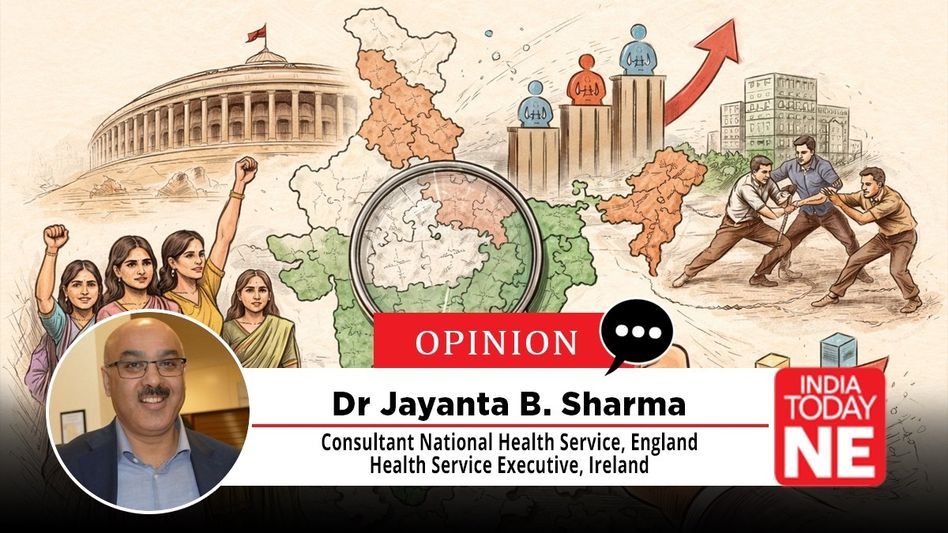
The recent failure of the women’s reservation effort in Parliament is, on the surface, a familiar story in Indian politics: a widely supported reform undone by disagreement. Yet to read it merely as a setback for gender justice is to miss its deeper significance. The proposal became entangled with a far more consequential and unresolved question—the redesign of India’s political map through delimitation. What collapsed in that moment was not just a bill, but a fragile attempt to reconcile two competing logics of the Indian republic: democracy as population-based representation, and federalism as a balance among states.
The women’s reservation framework, building on the 2023 constitutional amendment, requires constituencies to be identified and rotated. That technical requirement pulls it inevitably into the orbit of delimitation. One cannot reserve seats without first knowing which seats they are. Thus, a reform grounded in equity became structurally dependent on a process grounded in power redistribution. The result was predictable: consensus on principle dissolved into conflict over consequences.
To understand why this linkage proved so combustible, one must turn to the long arc of India’s demographic transformation since the last effective delimitation in 1971.
Northern and central states such as Uttar Pradesh and Bihar have seen their populations more than double—often approaching three times their 1971 levels—driven by sustained fertility and demographic momentum. In contrast, southern states like Tamil Nadu and Kerala grew far more modestly, typically by 1.5 to 1.8 times, having transitioned early to low fertility regimes.
This divergence has a direct political consequence. Representation in Parliament still reflects the demographic realities of half a century ago. A Member of Parliament from Uttar Pradesh today represents far more citizens than one from Kerala. The democratic principle of equal representation is therefore visibly distorted.
Yet correcting this distortion creates a paradox. The southern states that successfully controlled population growth now risk losing political influence. The northern states that grew rapidly demand proportional representation. What appears as a democratic correction to one is a structural penalty to another.
It is this tension that the women’s reservation bill inadvertently activated.
Three pathways lie before India. A pure population-based delimitation would restore democratic proportionality but trigger a dramatic redistribution of power. Decoupling reservation from delimitation would enable immediate reform but defer the structural problem. The third option—a uniform expansion of Lok Sabha seats while preserving relative state shares—offers a pragmatic compromise.
This compromise may lack theoretical purity, but it carries political wisdom. It avoids punishing any state, simplifies implementation, and preserves systemic balance in a volatile environment. It allows India to move forward on women’s representation without simultaneously destabilising its federal equilibrium.
Seen this way, the women’s reservation bill could have anchored a phased reform, one that recognises that in complex systems, sequencing matters as much as substance.
But this raises a deeper question: if the structural pathway was available, why did politics fail to seize it?
India’s opposition was not wrong to resist, but its failure to offer a coherent alternative reveals a deeper problem: the inability to move from critique to constitutional design.
If the structural tensions underlying the women’s reservation debate are clear, the behaviour of political actors invites a deeper inquiry. Why did the opposition respond as it did? Was it strategic prudence, or does it reflect a deeper exhaustion of political imagination?
At one level, the opposition’s stance is entirely rational. A population-based delimitation would increase the weight of high-growth northern states—precisely where the ruling party and its allies are strongest. For opposition parties rooted in southern and eastern regions, resisting such a redesign is not obstructionism; it is self-preservation.
India’s long freeze on seat redistribution has created a path-dependent political order. Parties have adapted to an equilibrium that reflects the demographic realities of 1971 rather than those of today. When such an equilibrium is threatened, defensive politics is inevitable.
In this sense, the opposition is not merely resisting change—it is defending a system within which it still retains relevance.
Yet this is only part of the story.
Constitutional politics is not just about blocking proposals; it is about shaping alternatives. The opposition demonstrated its ability to veto. What it did not demonstrate was an equally compelling capacity to design.
A uniform expansion model—simple, non-punitive, and stabilising—could have been articulated as a constructive counter. It would have preserved federal balance while allowing women’s reservation to proceed. It could have reframed the debate from confrontation to consensus.
Instead, the response largely remained reactive.
This reflects a deeper structural weakness. The opposition is not a unified entity but a coalition of regionally anchored parties. Each views delimitation through its own electoral geography. What benefits one may harm another. The result is fragmentation—an inability to converge on a shared institutional vision.
Meanwhile, the ruling side deployed a powerful framing strategy. By embedding structural reform within the moral language of women’s empowerment, it occupied the higher ground of public discourse. The opposition, forced into a defensive posture, struggled to communicate a complex institutional critique against a simpler narrative.
This is where the critique sharpens.
The opposition was politically prudent, but not politically generative. It recognised the risks but did not convert that recognition into a persuasive alternative. It knew what to oppose, but not what to propose.
In moments of systemic transition, this distinction becomes decisive.
India is approaching a constitutional inflexion point. The long-frozen equilibrium of representation is beginning to shift. In such moments, political actors are tested not only on their ability to resist unfavourable change, but on their capacity to imagine and articulate viable futures.
The true measure of opposition is not its ability to say “no,” but its ability to say “instead.”
The failure of the women’s reservation-linked reform is therefore not just a legislative setback. It is a signal. It suggests that while the ruling side is willing to experiment—strategically or otherwise—the opposition has yet to match that with a coherent design of its own.
In a democracy as large and complex as India’s, that absence is not merely a political weakness. It is a structural risk.
Author’s Note: Dr Jayanta Biswa Sarma writes on politics, institutions, and society through the lenses of history, philosophy, and systems thinking, drawing on both Indian and Western intellectual traditions. Artificial intelligence tools may be used in preparing this article as research and editorial aids. All arguments, interpretations, and final editorial judgement remain the author’s responsibility.