
Year three of unquiet: Manipur’s fractured ethnic landscape and the slow unravelling of peace
Three years. For thirty-six agonising months, Manipur has been burning, trapped in a relentless cycle of ethnic polarisation, sophisticated warfare, and political instability. What erupted on 03 May 2023, as a localised clash over Scheduled Tribe (ST) status between the majority Meitei community and the tribal Kuki-Zo people has morphed into an entrenched, low-intensity civil war.
Advertisement

Rituparna Bhattacharyya
- May 18, 2026,
- Updated May 18, 2026, 6:53 PM IST
Three years. For thirty-six agonising months, Manipur has been burning, trapped in a relentless cycle of ethnic polarisation, sophisticated warfare, and political instability. What erupted on 03 May 2023, as a localised clash over Scheduled Tribe (ST) status between the majority Meitei community and the tribal Kuki-Zo people has morphed into an entrenched, low-intensity civil war.
Despite a year of direct governance from New Delhi under President’s Rule (imposed in February 2025) and the subsequent installation of a new state government led by Chief Minister Yumnam Khemchand Singh in February 2026, peace remains a distant illusion. The state has fractured along geographical and ethnic lines, leaving behind a shattered landscape where even peace emissaries and innocent children are no longer safe.
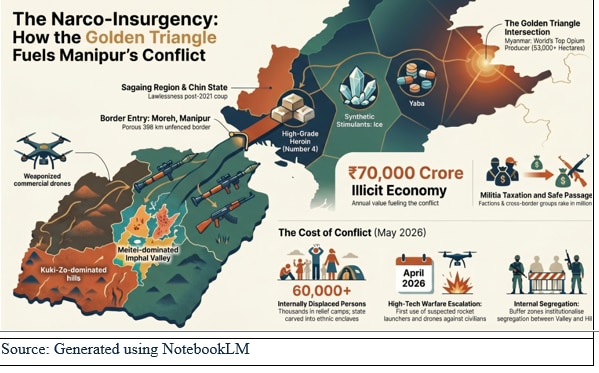
Arguably, the oxygen keeping the fire alive for over three years is financial. Sitting directly adjacent to the Golden Triangle, the infamous transnational drug-producing zone encompassing the intersection of Myanmar, Laos, and Thailand—Manipur has ceased to be a mere transit point for contraband. It has evolved into a strategic narco-state landscape where illicit drug money directly finances sophisticated ethnic militias, purchasing the heavy weaponry prolonging the state's agony.
The Fresh Wave of Terror: High-Tech War and Highway Ambushes
Any hope that 2026 would bring reconciliation was brutally shattered in the spring. In April 2026, the state was rocked by a gruesome bombing in the Meitei-dominated Bishnupur district. The attack on a civilian home in Tronglaobi killed a five-year-old boy and a five-month-old infant girl, critically injuring their mother. The use of sophisticated weapon systems, including suspected rocket launchers and weaponised drones—underscored a terrifying reality: the conflict is no longer just a riot between neighbours; it has evolved into a highly militarised standoff.
The tragedy in Bishnupur triggered widespread riots and clashes with security forces, resulting in further casualties and the reimposition of internet blackouts across five valley districts.
Before the state could process the grief of Tronglaobi, a fresh crisis erupted in mid-May 2026. Armed militants ambushed a two-vehicle convoy on a remote highway in Kangpokpi district, killing three senior church leaders—Rev. Dr. V. Sitlhou, Rev. Kaigoulun Lhouvum, and Pastor Paogoulen Sitlhou of the Thadou Baptist Association. The brutal killing of unarmed religious figures who dedicated their lives to service shocked the northeast.
The ambush immediately triggered a volatile chain reaction. In a terrifying spiral of "proxy violence" and retaliation, more than 38 civilians from both the Kuki and Naga communities were abducted and held hostage across various districts. While coordinated negotiations by the state government and tribal councils managed to secure the release of most hostages, mass protests have once again paralysed the state. In Churachandpur, the Kuki Women Organisation for Human Rights (KWOHR) led a massive "rally for justice," demanding the reimposition of President’s Rule and a constitutional "separate administration." Concurrently, Meitei and Naga civil bodies formed massive human chains in Imphal West, demonstrating the precarious, multi-layered strain now pulling at every ethnic seam of the state.
A Fractured Geography and Geopolitical Shadows
The violence has effectively carved Manipur into two distinct, segregated enclaves: the Meitei-dominated Imphal Valley and the Kuki-Zo-dominated hills. The "buffer zones" separating them are manned by thousands of Indian paramilitary forces, yet militant factions frequently breach these lines. Over 260 lives have been officially claimed, and more than 60,000 people remain displaced, living in squalid relief camps with no prospect of returning home.
Adding fuel to the fire is the state's porous international border. Intelligence reports and police FIRs from recent border incursions in Kamjong district point to cross-border movements involving foreign-backed outfits like the Kuki National Army-Burma (KNA-B), exploiting the political chaos in neighbouring Myanmar. The ready availability of looted and smuggled automatic weapons has transformed civilian "village volunteers" into heavily armed insurgent groups, making disarmament a near-impossible task for the central government's Commission of Inquiry, which was recently granted its fifth extension until November 2026.
PM Modi’s Landmark Visit, the Role of New Delhi, and the Battle for Peace in Manipur
For over two years, the single most potent weapon in the opposition’s political arsenal was a scathing question: Why hasn’t the Prime Minister visited Manipur? As the state burned through 2023 and 2024, New Delhi’s approach was heavily criticized as detached, relying primarily on security deployment rather than direct, top-tier political empathy.
The Prime Minister's two-day visit in September 2025 arrived at an incredibly delicate political juncture. Seven months prior, in February 2025, the Centre had finally bowed to immense pressure and forced the resignation of the highly controversial Chief Minister N. Biren Singh, placing Manipur under direct federal control via President’s Rule.
Navigating a literal and psychological boundary, Modi’s itinerary was carefully designed to straddle the state's physical ethnic partition. Security forces blanketed both the Meitei-dominated capital of Imphal and the Kuki-dominated hill stronghold of Churachandpur.
Speaking at the Peace Ground in Churachandpur, Modi struck an emotional note, addressing a community that had long accused his government of majoritarian bias. “The government of India is with the people of Manipur,” Modi told the crowd. “I promise you today that I am with you... we must walk on the path of peace to secure the future of our children.”
Later in Imphal, the Prime Minister attempted to pivot the conversation from bloodshed to economic rejuvenation. He unveiled massive infrastructure packages worth over ₹7,300 crore—including highway expansions, info-tech development projects, and the fast-tracking of the National Sports University. Crucially, addressing the humanitarian crisis, he announced direct financial allocations—including a ₹3,000 crore special package, an additional ₹500 crore specifically for rehabilitation, and the sanctioned construction of 7,000 permanent homes for Internally Displaced Persons (IDPs) languishing in relief camps.
The immediate impact of the visit was a temporary cooling of raw emotions, providing a symbolic "healing touch" that civil society had begged for. By showing up in both the hills and the valley, Modi sought to position the Central Government as an objective, paternal arbiter rather than a partisan player. This political ground-clearing eventually paved the way for the revocation of President's Rule and the democratic installation of a new BJP-led state government under Chief Minister Yumnam Khemchand Singh in February 2026.
However, the visit also faced fierce pushback. Opposition leaders, including Congress President Mallikarjun Kharge, dismissed the trip as a "three-hour farce and tokenism," lambasting the PM for taking more than two years and dozens of foreign trips before visiting a bleeding Indian state. On the ground, youth wings held black-flag protests in Imphal, and angry local factions pulled down decorations for the PM’s arrival in parts of Churachandpur, demonstrating that deep-seated trust deficits cannot be easily erased by economic packages.
The Proximity to the Golden Triangle: A Geography of Chaos
The Golden Triangle is historically one of the world's largest illicit drug corridors, traditionally famous for opium and heroin. Following the 2021 military coup in Myanmar and subsequent intense civil conflict, the region experienced a dramatic regression. According to the United Nations Office on Drugs and Crime (UNODC) 2025/2026 reports, Myanmar surged to become the world’s top opium producer (surpassing Afghanistan), with cultivation hitting a 10-year high of over 53,000 hectares.
Crucially, this boom expanded directly toward Myanmar's western border regions, such as Chin State and the Sagaing Region—the immediate neighbours of Mizoram and Manipur.
Manipur shares a highly porous, 398 km unfenced international border with Myanmar. Over decades, this geographical vulnerability allowed the Golden Triangle’s traditional network to split. A major western pipeline branched out, funnelling high-grade Heroin (locally called "Number 4"), Methamphetamine crystals ("Ice"), and Yaba synthetic stimulant pills directly into Northeast India via border towns like Moreh in Manipur and Champhai in Mizoram. Experts estimate the local illicit drug economy cascading through this border at a staggering Rs 70,000 crore ($8.3+ billion) annually.
Impact on the Manipur Violence: The Cycle of Narco-Insurgency
The intersection between the Golden Triangle’s drug trade and the ethnic war between the Meiteis and Kuki-Zo communities manifests in three critical ways:
A. The Weaponry Funding Mechanism
Modern warfare requires immense capital. The sophisticated weaponry seen in recent 2026 clashes—including weaponized commercial drones, remote-triggered improvised explosive devices (IEDs), and automatic assault rifles—cannot be financed by local extortion alone. Both Meitei and Kuki militant factions, alongside cross-border outfits like the Kuki National Army-Burma (KNA-B), tax the drug syndicates. In exchange for offering "safe passage" or protecting smuggling routes cutting across contested valley checkpoints and hill forests, armed groups rake in millions. This "narcotics-for-arms" cycle completely undermines the federal government's attempts to dry up militant resources.
B. The Domestic "War on Drugs" and Ethnic Polarisation
In 2018, the state government launched its flagship "War on Drugs" campaign. While the campaign led to the destruction of over 19,000 acres of illegal poppy cultivation using remote-sensing mapping, its political execution inadvertently widened ethnic fault lines.
Because the rugged, isolated hill terrains suitable for poppy cultivation are primarily inhabited by tribal communities, the state's aggressive clearing drives and forest evictions were framed by tribal civil bodies as a targeted, majoritarian economic warfare against Kuki villages. Conversely, Meitei groups pointed to the expanding poppy fields as definitive proof of "narco-terrorism" and illegal demographic influxes from Myanmar. What should have been a neutral law-and-order initiative became an explosive ethnic talking point.
The Rise of "Brown Sugar" Refineries
Manipur is no longer just a passive transit highway. Drawn by the immense profits, local drug lords have established hidden processing factories within the state’s deep hill sectors (such as Churachandpur and Tengnoupal). Raw opium gum harvested locally or smuggled from Myanmar is chemically processed inside domestic makeshift labs into "Brown Sugar", a cheaper, highly addictive heroin variant—turning Manipur into a domestic production hub.
The Ghost of Armed Forces Special Powers Act (AFSPA)
As Manipur grapples with this deep militarization, it is impossible not to look back at the state's long, complicated history with security laws, most notably the Armed Forces Special Powers Act (AFSPA). For decades, civil society in Manipur fought against the excesses of AFSPA, a law that grants sweeping powers to the armed forces in "disturbed areas."
No figure embodies that struggle more than Irom Chanu Sharmila, the "Iron Lady of Manipur."
Following the Malom massacre in November 2000, where 10 civilians were shot dead by paramilitary forces, Sharmila embarked on the world’s longest hunger strike. For 16 agonising years, she was kept alive via nasogastric intubation under judicial custody, transitioning into a global symbol of peaceful defiance. Her singular, unwavering demand was the total revocation of AFSPA from Manipur.
Yet, history takes cruel turns. Recognising the limitations of a hunger strike that the state chose to indefinitely force-feed her through, Sharmila made the monumental decision to end her fast in August 2016. She chose to transition from activism to politics, believing that entering the democratic system was the only way to genuinely repeal the draconian law.
The tragedy of her sacrifice culminated in the 2017 Manipur Legislative Assembly elections. Contesting against then-Chief Minister Okram Ibobi Singh in the Thoubal constituency under her newly formed party, People's Resurgence and Justice Alliance (PRJA), Sharmila was heartbreakingly rejected by the very electorate she had starved for. She secured a meager 90 votes. The absolute failure at the ballot box highlighted a painful truth about Manipur’s fractured polity: while the public revered her as a martyr, they were unready to back her as a political leader. Distounded and isolated, Sharmila left the state shortly after, her 16-year sacrifice leaving behind a hauntingly unfulfilled legacy.
The Role of the Central Government: Security vs. Political Solace
While the Prime Minister provided the public face of reconciliation, the Union Government, led by the Ministry of Home Affairs (MHA), has deployed a complex, sometimes contentious, multi-pronged strategy to tackle the violence:
1. Direct Federal Administration & Governance Reboot: By invoking Article 356 (President’s Rule) in early 2025, the Centre took direct responsibility for the state’s security apparatus, sidelining a local police force that had fractured along ethnic lines. The subsequent transition to the Khemchand Singh administration in early 2026 was engineered by New Delhi to present a fresh, less polarising local leadership capable of engaging both communities.
2. The "Buffer Zone" Strategy and Paramilitary Enclaves: The Centre deployed tens of thousands of personnel from the Indian Army and the Assam Rifles. Their primary mandate has been maintaining strict "buffer zones" between the valley and the hill districts to prevent mass cross-border tribal raids. However, this strategy has faced severe criticism for effectively institutionalising the segregation of Manipur, turning ethnic boundaries into internal, heavily militarised international-style borders.
3. Weaponised Border Management and the Myanmar Conundrum: Recognising that the Kuki-Zo-Chin ethnic ties span into war-torn Myanmar, the Union government cancelled the Free Movement Regime (FMR) and ordered the complete fencing of the porous 1,643 km Indo-Myanmar border. New Delhi has also extended the mandate of its judicial Commission of Inquiry until November 2026 to thoroughly investigate allegations of foreign-backed insurgent outfits (like the KNA-Burma) smuggling automatic weapons and weaponised drones into the conflict.
4. The Perils of Selective Engagement: The Centre’s behind-the-scenes negotiations have occasionally triggered fresh anxieties. Intelligence leaks regarding potential political compromises within the Suspension of Operations (SoO) agreement—hinting at a separate administrative setup or Union Territory status for Kuki areas—have deeply alarmed the Meitei majority. The Meiteis view any such concession as a direct threat to Manipur’s historical and territorial integrity, creating a volatile paradox where pacifying one community immediately inflames the other.
5. Comprehensive Strategies to Tackle the Golden Triangle Drug Business
To sever the lifeline of the Manipur conflict, New Delhi and regional stakeholders must pivot from standard riot control to aggressive, multi-layered counternarcotics strategies:
|
Strategy Domain |
Core Action Items |
Expected Impact |
|
Border Hardening |
• Complete the absolute fencing of the Indo-Myanmar border.
• Permanent termination of the Free Movement Regime (FMR).
• Strategic deployment of long-range reconnaissance radars and thermal imaging drones. |
Plugs the physical entry points of contraband and deters cross-border rebel movements. |
|
Financial Decapitation |
• Deploy the Enforcement Directorate (ED) and Financial Intelligence Unit (FIU) to track narco-profits.
• Enforce the NDPS Act (Section 68) to freeze and confiscate benami assets of politicians, bureaucrats, and cartel bosses. |
Destroys the economic incentive of the trade; targets the white-collar masterminds rather than just poor couriers. |
|
Agrarian Transformation |
• Introduce high-value alternative cash crops (e.g., saffron, organic coffee, horticulture).
• Guarantee Minimum Support Price (MSP) and immediate supply chain integration for hill farmers. |
Weakens the economic dependency of impoverished hill communities on drug lords who offer cash advances for poppy. |
|
Intelligence Synchronisation |
• Create a unified command uniting the Narcotics Control Bureau (NCB), Assam Rifles, state police, and Directorate of Revenue Intelligence (DRI). |
Eliminates inter-agency rivalry and the ethnic intelligence-sharing vacuum that cartels currently exploit. |
|
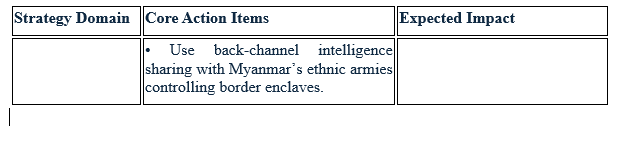
Geopolitical Diplomacy |
• Leverage multilateral forums like the Mekong-Ganga Cooperation and BIMSTEC to coordinate crackdowns.
• Use back-channel intelligence sharing with Myanmar’s ethnic armies controlling border enclaves. |
Targets the problem at its roots inside Myanmar’s lawless liberated zones. |
The Path Forward: A State Lost in the Dark
The Central Government's intervention in Manipur has successfully shifted the crisis from an active, anarchic inferno into a heavily policed, low-intensity freeze. PM Modi’s 2025 visit sent a necessary signal that New Delhi had not entirely abandoned the jewel of the Northeast.
Today, parts of Manipur remain under AFSPA, while other areas are governed by curfews, internet bans, and the omnipresence of automatic weapons. The irony is stark: the institutionalised peace and demilitarisation that Irom Sharmila starved for has been entirely eclipsed by a brutal, localised ethnic warfare.
Manipur is bleeding from within. The current conflict is no longer just about ST status, land rights, or illegal immigration, it has become an existential struggle for identity, survival, and retribution. By treating the Manipur crisis primarily as a law-and-order and border-security issue, the Centre has managed to suppress large-scale warfare, but it has yet to build the "bridge of brotherhood" Modi spoke of. As fresh killings like church leaders being ambushed, infants killed in rocket attacks, and communities retreat further into their ethnic silos, the soul of Manipur is being hollowed out. Until New Delhi and local stakeholders move past band-aid security measures and address the deep-seated psychological and territorial divisions, the fire in the jewel of the Northeast will continue to burn. It is paramount to recognise that peace in Imphal and the surrounding hills is inextricably linked to breaking the spine of the Golden Triangle's western pipeline. The Government must move beyond symptom level fixes and confront the underlying structural causes. Until the economic engine of this narco-insurgency is systematically dismantled, any ceasefire achieved will only be a temporary truce before the next well-funded shipment of weapons arrives.
POST A COMMENT