FIFA could punish Argentina after Lo Celso's Falklands banner sparks controversy
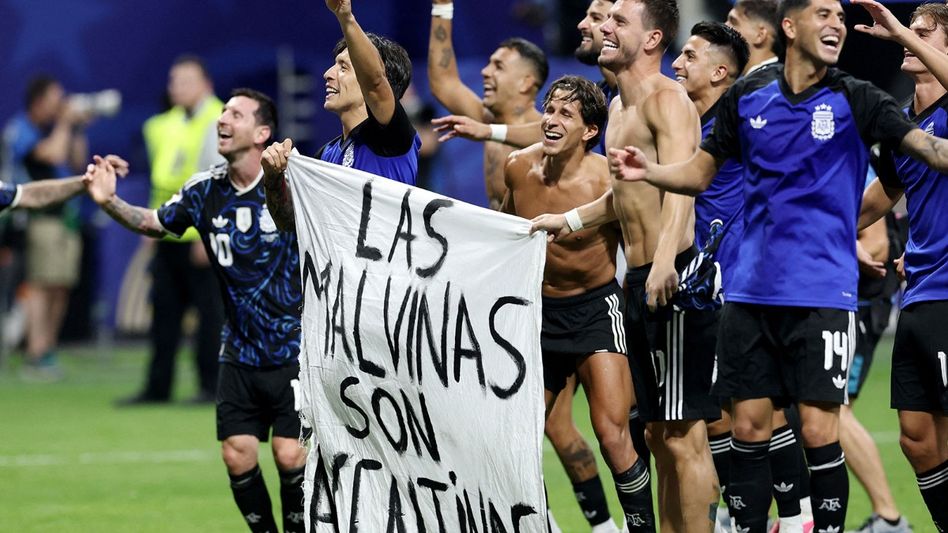
Argentina's celebrations after beating England were overshadowed by Giovani Lo Celso displaying a Falklands banner. The act could invite FIFA action and revived the long-running sovereignty dispute.

- Jul 16, 2026,
- Updated Jul 16, 2026, 9:38 AM IST

- Banner saying Las Malvinas son Argentinas was passed from supporters
- Otamendi briefly held the banner before it was later placed pitchside
- Rules ban political, religious and personal messages on clothing or equipment
Argentina could face disciplinary action from FIFA after midfielder Giovani Lo Celso displayed a banner asserting the country's claim over the Falkland Islands while celebrating the team's FIFA World Cup 2026 semi-final victory over England.
Following Argentina's dramatic 2-1 win over England in Atlanta, Lo Celso was seen holding a banner reading "Las Malvinas son Argentinas" ("The Malvinas are Argentine"), referring to the South Atlantic islands known in Argentina as Las Malvinas. Defender Nicolás Otamendi also held the banner, which was reportedly passed to the players from supporters in the stands. Although the pair initially put it away, Lo Celso later placed it on the pitch during the celebrations, according to The Athletic.
FIFA and the International Football Association Board (IFAB) prohibit political messages, slogans and symbols from being displayed during matches. IFAB's Laws of the Game state that players must not display political, religious or personal slogans, statements or images on their equipment or clothing. Breaches can result in sanctions imposed by the competition organiser, the relevant national association or FIFA.
The Falkland Islands, a British Overseas Territory located around 480 kilometres east of Argentina, have been at the centre of a sovereignty dispute between the United Kingdom and Argentina for decades. Britain re-established control of the islands in 1833, while Argentina continues to claim sovereignty over the territory.
The dispute escalated into armed conflict in 1982 when Argentina invaded the islands, triggering the Falklands War. The conflict lasted from 2 April to 14 June before Argentine forces surrendered. The war claimed the lives of 255 British military personnel, 649 Argentine troops and three civilians.
Reacting to the incident, Argentina's Vice-President Victoria Villarruel defended the display in a post on X, writing that although banners were reportedly not allowed inside the stadium, "The Falklands are Argentine. They banned bringing them to the stadium and forgot that we carry them in our blood and our hearts."
On the pitch, defending champions Argentina staged a late comeback to defeat England 2-1 and book their place in the World Cup final.
After a goalless first half, Anthony Gordon gave England the lead in the 55th minute by converting Morgan Rogers' cross. England then retreated deeper, allowing Argentina to dominate possession and create several chances, with Jordan Pickford making crucial saves and Alexis Mac Allister striking the post.
Argentina eventually levelled in the 85th minute through Enzo Fernández after a pass from Lionel Messi. Deep into stoppage time, Messi delivered a cross that Lautaro Martínez headed home to seal a dramatic victory.
Argentina will face Spain in the World Cup final, while England will take on France in the third-place play-off.