Meghalaya's education paradox: Highest enrolment, weakest classrooms? NITI Aayog flags deep learning gaps
A NITI Aayog report says Meghalaya has high school enrolment but weak learning outcomes and infrastructure. The findings point to unresolved foundational gaps, thin classroom resources and teacher deployment problems.

- Jul 12, 2026,
- Updated Jul 12, 2026, 9:18 AM IST

- Upper primary Gross Enrolment Ratio rose to 115.6 per cent in 2024-25
- Grade 9 mathematics performance at 29 per cent was region's lowest
- Just 4.3 per cent schools had functional smart classrooms statewide
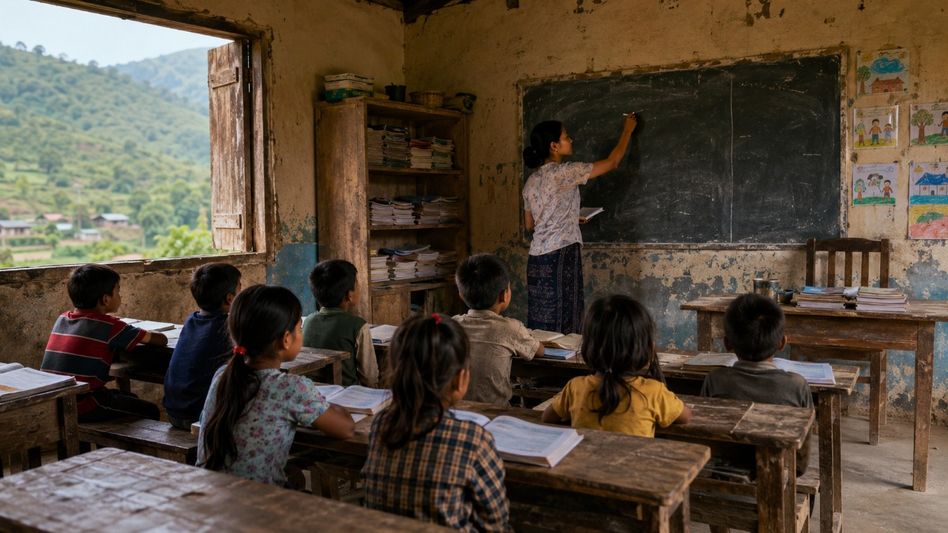
Meghalaya has one of the highest school enrolment rates in India, yet some of the country's weakest learning outcomes, the lowest smart classroom coverage and more than 1,400 single-teacher schools, according to a new NITI Aayog report that highlights persistent structural challenges in the state's education system.
The report, School Education System in India: Temporal Analysis and Policy Roadmap for Quality Enhancement, presents a mixed picture for the Northeast, with Meghalaya emerging as one of the region's biggest concerns despite making significant gains in bringing children into schools.
At the upper primary level, Meghalaya recorded a Gross Enrolment Ratio (GER) of 115.6 per cent in 2024-25, placing it among the highest in the country alongside Chandigarh (120.3 per cent), Delhi (117.1 per cent) and Goa (116.2 per cent). The state's GER has also improved significantly over the past decade, rising from 98.59 per cent in 2014-15.
However, the report says strong enrolment has not translated into better learning.
According to PARAKH 2024, Meghalaya's Grade 3 students scored 58 per cent in language and 53 per cent in mathematics, both below the national averages of 64 per cent and 60 per cent, respectively.
The gap widens further at the middle stage (Grade 9), where Meghalaya recorded 47 per cent in language, 29 per cent in mathematics, 33 per cent in science and 34 per cent in social science, compared to national averages of 54 per cent, 37 per cent, 40 per cent and 40 per cent, respectively.
The report also identifies Meghalaya among the weakest-performing states at the preparatory stage, noting that learning gaps visible in the foundational years continue into higher classes, suggesting that early deficits remain unaddressed.
Infrastructure indicators paint a similarly worrying picture.
Only 4.3 per cent of schools in Meghalaya had functional smart classrooms in 2024-25, the lowest proportion in the country. The figure has risen only marginally from 2.3 per cent over the past four years, while states such as Tamil Nadu expanded smart classroom coverage from 0 per cent to 60.8 per cent, Chandigarh from 41.2 per cent to 95.2 per cent, and Maharashtra from 17.3 per cent to 63.6 per cent during the same period.
Accessibility remains another weak point. Only 32.8 per cent of schools in Meghalaya have ramps for children with special needs, the second-lowest coverage in the country after Arunachal Pradesh (28.2 per cent). Although the state's coverage has improved slightly from 29.2 per cent, it remains well below the national leaders such as Delhi (99.2 per cent) and Odisha (95.3 per cent).
One of the report's most striking findings concerns teacher availability.
Meghalaya has 1,414 single-teacher schools, where 49,807 students are taught by just one teacher. The report says such teachers are expected to manage multiple grades while simultaneously handling administrative work, record-keeping, midday meals and coordination with parents, severely limiting classroom instruction.
The state also has 74 schools with zero enrolment, despite 152 teachers being posted in those institutions. Nationally, India has 7,993 zero-enrolment schools employing 20,817 teachers, while 1,04,125 single-teacher schools educate 33,76,769 students.
Despite the challenges, Meghalaya reported no vacancies at the elementary and secondary levels and only 16 vacancies at the senior secondary level in government schools, suggesting that teacher deployment rather than recruitment may be a larger issue.
Across the Northeast, the report shows considerable variation.
At the middle stage, Arunachal Pradesh scored 60 per cent in language, 34 per cent in mathematics, 39 per cent in science and 42 per cent in social science. Assam recorded 53 per cent, 35 per cent, 38 per cent and 38 per cent, while Tripura scored 53 per cent, 35 per cent, 38 per cent and 37 per cent respectively. Nagaland registered 58 per cent, 30 per cent, 37 per cent and 39 per cent, Manipur scored 52 per cent, 35 per cent, 39 per cent and 39 per cent, Sikkim recorded 60 per cent, 32 per cent, 41 per cent and 42 per cent, while Mizoram managed 47 per cent, 31 per cent, 34 per cent and 34 per cent. Meghalaya's mathematics score of 29 per cent was the lowest in the region.
The report also highlights disparities in single-teacher schools across the region. Assam has 2,820 such schools serving 92,699 students, Arunachal Pradesh 562 schools with 6,912 students, Manipur 383 schools with 9,115 students, Tripura 340 schools with 6,492 students, Mizoram 117 schools with 3,056 students, Sikkim 36 schools with 319 students, and Nagaland 26 schools with 292 students.
The NITI Aayog report recommends consolidating under-enrolled schools, reducing single-teacher institutions, improving digital infrastructure, strengthening foundational literacy and numeracy, rationalising teacher deployment and expanding integrated school complexes to improve learning outcomes across the country.