Abuse of law, delayed justice undermine public faith in legal system: Kiran Bedi in Tripura
Kiran Bedi addressed law students in Tripura on legal-system failings and prison reform. She said responsible implementation, timely justice and inmate education were essential to strengthen public faith.

- Nov 14, 2026,
- Updated Nov 14, 2026, 3:52 PM IST

- Police, prosecutors and defence lawyers share responsibility for justice system weaknesses
- She urged students to understand and uphold the law's spirit
- Tihar's IGNOU centre offered inmates computer education and fee-free courses
Former IPS officer and former Puducherry Lieutenant Governor Dr Kiran Bedi on November 14 said the misuse of laws, delays in delivering justice and shortcomings in law enforcement and judicial processes undermine public confidence in the legal system.
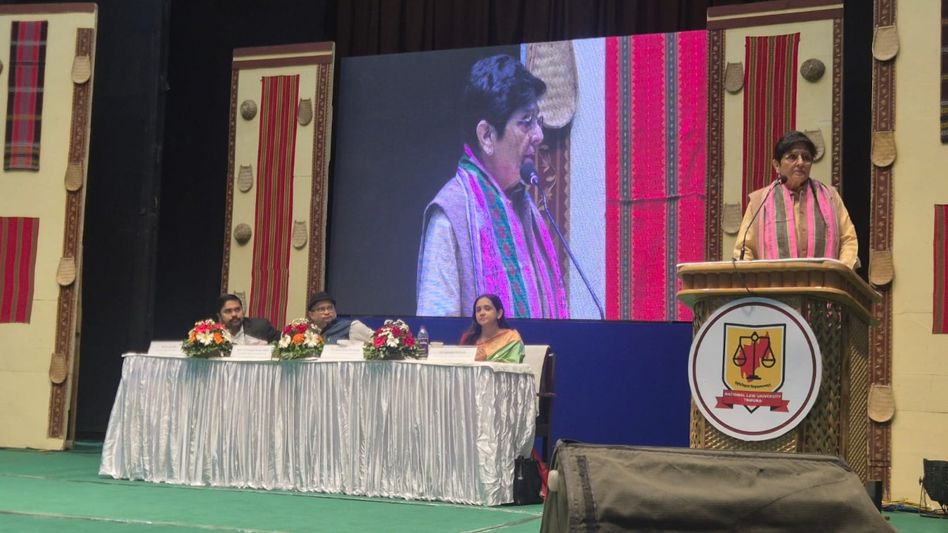
Addressing law students at the fifth Dialogue Forum organised by the National Law University, Tripura, Bedi said the law itself was not the problem, but its misuse and improper implementation created difficulties.
She pointed to the roles of the police, prosecution and legal defence, along with delays in judicial proceedings, as factors that collectively weaken the justice system.
“Read the law, follow the law, and you will get justice or at least remain on the right side of it without getting into trouble,” she said, urging students to understand and uphold the spirit of the law.
Drawing from her experience in prison reforms at Tihar Jail, Bedi spoke about the introduction of educational programmes through the Indira Gandhi National Open University (IGNOU). She recalled that a proposal to establish an IGNOU centre inside the prison had been pending when she took charge. She facilitated its establishment by providing space, while the university arranged teachers and other resources.
According to Bedi, the initiative received an encouraging response from inmates, many of whom showed interest in computer education and Bachelor of Computer Applications (BCA) courses.
She said the initiative also led to a policy under which prisoners would not be charged fees for IGNOU courses when the university opened a centre inside a prison. What began at Tihar Jail subsequently expanded to other parts of the country, she said.
Bedi encouraged Tripura to explore the possibility of setting up IGNOU centres in its prisons, if such facilities were not already operational, to provide inmates with access to education.
Emphasising the need to understand prison life, she urged law students and legal professionals to visit prisons and gain firsthand knowledge of inmates' conditions and challenges.
She also recommended her book It's Always Possible, which documents her experiences and prison reform initiatives at Tihar Jail. The book, she said, provides an evidence-based account of the conditions she observed, the measures she introduced and their outcomes, including prisoner education, meditation programmes and educational support for children living inside prisons.
Bedi further urged students, particularly those pursuing law, to watch the documentary Doing Time, Doing Vipassana to gain a deeper understanding of prison reform and rehabilitation.
Referring to POCSO cases in Tripura, she said the law itself was not inherently flawed, but its misuse, delays in justice delivery and unfair legal defence could weaken public confidence in the legal system.
She stressed that strengthening the justice system required responsible conduct from all stakeholders, adherence to the law and timely delivery of justice.