Arunachal sets up panel to review 80:20 reservation policy after AAPSU demand
The Arunachal Pradesh government has formed a high-level committee to review the 80:20 reservation ratio and the use of PRC and APST certificates in recruitment. The move follows AAPSU's memorandum and opens a formal review of the policy within a two-month deadline.
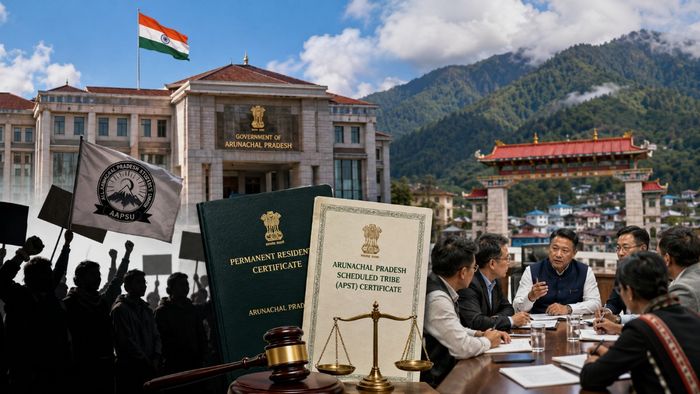
- Jul 07, 2026,
- Updated Jul 07, 2026, 8:30 PM IST
The Arunachal Pradesh government has constituted a high-level committee to examine the feasibility of abolishing the 80:20 reservation ratio in state government recruitment and making the Permanent Resident Certificate (PRC) and Arunachal Pradesh Scheduled Tribe (APST) Certificate mandatory for all competitive recruitment processes.
The committee was formed following the All Arunachal Pradesh Students' Union's (AAPSU) memorandum submitted on June 2, 2026, and comes days after the student body sought a time-bound response to its 13-point charter of demands.
According to an order issued by the Chief Secretary, the committee will be chaired by Industries, Skill Development and Labour & Employment Minister Nyato Dukam. Its members include the Principal Secretary (Home/PWD), Secretary (Law), Secretary (Personnel), Secretary (Social Justice, Empowerment and Tribal Affairs), and Joint Secretary (Administrative Reforms and Training). The AAPSU president, or a nominated representative, will participate in the committee's proceedings as a special invitee.
The panel has been asked to examine the constitutional and legal framework governing reservation and the applicability of PRCs in government recruitment. It will also study reservation systems followed in neighbouring Assam, Mizoram, Nagaland and Manipur, review the recommendations of an earlier high-level committee on the issue, and assess the existing criteria for issuing PRCs in Arunachal Pradesh. The committee has been directed to submit its report within two months.
Welcoming the move, AAPSU president Meje Taku said the committee's formation was the result of the union's sustained campaign on the issue. He described it as an important first step and said the organisation would continue to engage with the government until the recommendations are translated into policy.
Taku also said the government had assured the union that the remaining demands in its memorandum would be addressed on a priority basis by the respective departments. These include the re-amendment of Article 371(H), resolution of the Chakma-Hajong issue, completion of the Assam-Arunachal boundary demarcation, enactment of a central anti-racism law, introduction of the Chief Minister's Research Fellowship for APST PhD scholars, establishment of additional CUET examination centres, and other welfare measures.
Earlier this week, AAPSU had given the state government a seven-day deadline to respond to its 13-point memorandum.