Blades and beaks: Inside the sacred heritage of Arunachal Pradesh
In Arunachal Pradesh, the dao blade and Nyishi byopa remain central to ritual and daily life. Their craftsmanship and changing materials reflect identity, inheritance and conservation.
Anushriya Nath
- Sep 15, 2026,
- Updated Sep 15, 2026, 4:56 PM IST
Some call it a machete, for others it’s just another blade forged in fire. But in the remote green hills and river valleys of Arunachal Pradesh, this machete, locally known as ‘ dao ’, whispers an entirely different tale of resilience, identity and survival. Walking through the tiny villages of Arunachal Pradesh, one cannot picture a Nyishi warrior without two specific things- his dao slung securely at his hips and the ‘ byopa ’ seated proudly on his head. Byopa or the Bopiya is not an ordinary headgear but a traditional feathered crown that carries a heritage older than time, a woven crown of authority. The dao, however is not just a part of the Nyishi community but shares a deeply sacred bond with every community of these hills. Together the iron blade and the woven crown form an essential part of the sacred history of Arunachal's blades and beaks heritage.
The blade with a tale
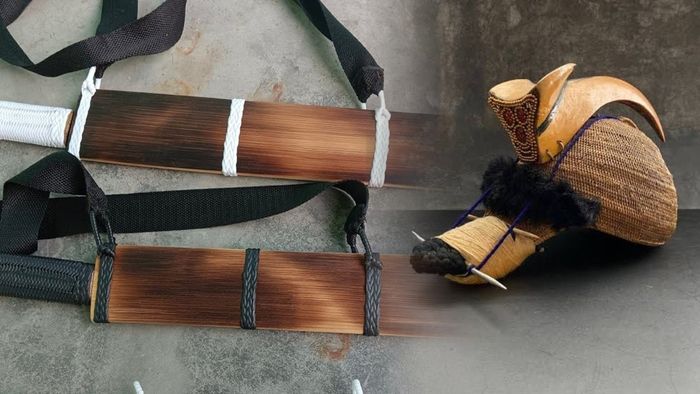
For the tribal people of Arunachal Pradesh, the dao is a representation of their identity, culture and a heritage that has been passed on from generations among the indigenous communities. Forged by local blacksmiths, the traditional dao is made of iron or steel or even recycled metal featuring a heavy single-edged blade. The blade is fitted in a handle carved out of study wood, bamboo or bone. Shaped entirely by hands, each blade carries the mark of its maker and differs from the other.
An everyday dao is a tool designed for farming, butchering and clearing fields for cultivation, typically housed in a simple bamboo sheath. In contrast, the ceremonial dao is reserved for rituals and weddings, often offered as a prestigious gift to the bridegroom. These ceremonial blades showcase high quality iron where each blade has its own unique intricate carved designs. They are kept in scabbards woven with animal fur and cowrie shells.
The true value of a dao lies in the art of its craftsmanship- specifically its lamination patterns, where more forged layers command greater value. The price of the dao reflect this art, it can range anywhere from Rs 5000 to over Rs 20 lakhs (approximately) depending on the length and quality, “ because every dao is different, each tribe has its own design and due to the modern times, the traditional dao has become a rare heirloom, hence the prices of the traditional blade can sometimes go up to lakhs of rupees ,” says Mr. Taw Teri, a member of the Nyishi community. In this land rarely two daos are identical; each tribe has developed their own distinct style, the blade changes its shape, size, length and value not only from tribe to tribe, but from household to household, serving as the unique identity of the holder. “ There are various variations of the dao, some are longer than the others, few have brass handles, some show a visible curvature. Because the dao serves as our identity, that’s why so many variations exist ,” says Miss Churina Sikom, a member of the Tagin community.
The bond between the tribes and their blade is so deeply sacred that when the patriarch of a family passes away, his dao is laid to rest in his grave alongside him. When the eldest son comes of age, his father gifts him his first blade, passing down a legacy of protection. Each community and family has their own rituals and beliefs, every version slightly different from the other, however across every valley, one universal truth remains: the dao is not just a tool of survival, but the physical piece of the community’s soul.
The woven crown of beaks
Byopa is far more than a decorative cap, this traditional headgear is an irreplaceable symbol of Nyishi manhood, vigor and identity. Woven tightly from split cane, the dome-shaped base helmet fits precisely over the head. Historically, the crown’s defining centerpiece was the upper beak and casque of the Great Indian Hornbill, mounted prominently at the front and crowned with striking black and white tail feathers.
Traditionally the byopa was worn by the priests ( Nyub ) during sacred rituals, it served as a visual mark of dignity and authority. Today this feathered crown is reserved for auspicious occasions, marriages and major cultural gathering like the Nyokum Festival ( Nyokum Yullo ).
Crafting a single byopa can take the artisan upto 4 to 5 days. The dome-shaped base helmet of the crown called the Podum is woven tightly from split cane strands, specifically the one that bends smoothly without breaking. Once the podum is sun-dried, the headgear is adorned with distinct symbolic accessories. The beak of the hornbill called the Paga Hibu is mounted at the front. The traditional casque of the Great Indian Hornbill is now carved from local timber due to hunting prohibition. Fixed behind the beak is a crest of white feathers sourced from domesticated Muscovy ducks, these feathers are widely used as an eco-friendly replacement for hornbill plumes. Another distinct element of the byopa is the dum pudum and dumso. Because modern men no longer grow their hair long, synthetic hair ( dum pudum ) substitutes for the long topknots once worn by Nyishi warriors. It is tied with bright red and yellow yarns ( dumso ) and attached to the front of the headgear. Along with the threads the dum pudum is secured in place with two needle-like bamboo or aluminum pins called the dumko and kobak. The byopa travels a long journey from raw cane to the finished crown. Each byopa fetches between Rs 2000 to Rs 5000 in local markets.
The conservation shift from feathers to fiber occurred by the late 1990s, the centuries-old demand for the hornbill beaks threatened the survival of the canopy icon. Realizing that the extinction of the bird would mean the death of the very ecosystem that inspired their culture, the Nyishi community initiated this historical transformation, replaced authentic hornbill beak with a replica made either of wood or fiberglass. The byopa now serves as a revered ritual heirloom- a celebrated piece of indigenous craftsmanship.
In the rapidly modernizing valleys of Arunachal Pradesh, the rhythm of the blacksmith’s hammer, however rare, remains unbroken. The dao and the byopa are not just indigenous artifacts; rather they are active visual symbols of tribal sovereignty and craftsmanship.
MORE NEWS
Read more!