Satellite imagery points to river diversion works at China's Medog hydropower site upstream of Arunachal
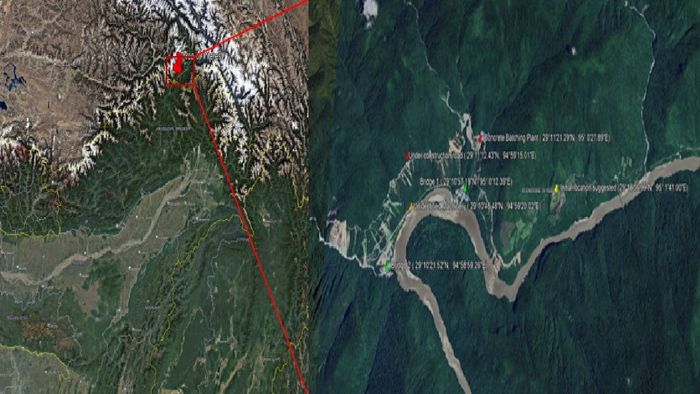
Satellite imagery reviewed by Indian geospatial firm EarthSense Labs has pointed to land clearing, the construction of a new access road and possible river diversion works at Mainling in Tibet, where China formally launched its massive Medog hydropower project in July 2025. The developments have renewed concerns over the potential impact of the project on downstream river flows, sediment movement and communities in Arunachal Pradesh and Assam.
- Nov 22, 2026,
- Updated Nov 22, 2026, 9:10 PM IST
Satellite imagery reviewed by Indian geospatial firm EarthSense Labs has pointed to land clearing, the construction of a new access road and possible river diversion works at Mainling in Tibet, where China formally launched its massive Medog hydropower project in July 2025. The developments have renewed concerns over the potential impact of the project on downstream river flows, sediment movement and communities in Arunachal Pradesh and Assam.
The project is being developed on the lower reaches of the Yarlung Tsangpo, which enters India as the Siang in Arunachal Pradesh before flowing into Assam as the Brahmaputra. With a reported planned capacity of 60,000 megawatts, the project is expected to comprise five hydropower stations built in succession, at an estimated investment of 1.2 trillion yuan, or approximately USD 168 billion at the time of its announcement.
China has maintained that the project will supply electricity to Tibet and other parts of the country without significantly affecting water availability in downstream regions.
In its EarthSense Discovery Report, the company said satellite imagery of Mainling showed land clearing in settlement and agricultural areas on the river's south bank, upstream of the proposed dam site. It also identified a newly constructed access road on the north bank and what it described as possible river diversion works.
River diversion is a standard component of large dam construction, involving the temporary rerouting of a river to facilitate work on the main dam structure.
Dr Nirdesh Kumar Sharma, Co-Founder and CEO of EarthSense Labs, said the company had analysed satellite imagery alongside tender records to identify Pai and Xirang as two other potential dam locations associated with the project.
According to the company's assessment, the proposed hydropower complex could involve tunnels beneath the Namcha Barwa massif to divert water through a section of the Great Bend of the Yarlung Tsangpo. While China has publicly identified Mainling as the site of the project's groundbreaking, the identification of Pai and Xirang and the proposed tunnel alignment are based on EarthSense Labs' analysis.
EarthSense Labs, a deep-tech company incubated at the Foundation for Innovation and Technology Transfer (FITT), IIT Delhi, develops AI-enabled digital twins for critical infrastructure.
Potential downstream impact
The scale and manner of the project's operation could have implications for river flows in Arunachal Pradesh and Assam, particularly during the dry season.
According to EarthSense Labs, the timing of reservoir filling and the release of water for electricity generation could alter the natural flow patterns of the Siang. The proposed cascade of hydropower stations could also trap a portion of the sediment that the river carries downstream to Assam's floodplains.
However, the extent of the impact would depend on several factors, including the project's reservoir storage capacity, water release schedules and the contribution of tributaries joining the river downstream.
The concerns are significant for a region that has previously witnessed devastating floods linked to sudden changes in water flow upstream.
In 2000, a massive landslide blocked the Yigong River in Tibet, a tributary of the Yarlung Tsangpo, creating a temporary natural dam. When the obstruction breached, a huge volume of water surged downstream into Arunachal Pradesh and subsequently reached the Brahmaputra floodplains.
The incident highlighted the risks associated with limited cross-border information sharing on river conditions and potential upstream disasters.
India's concerns over the availability of hydrological data have also persisted. The Centre informed Parliament in 2025 that China had stopped sharing Brahmaputra hydrological information in June 2023 following the expiry of the bilateral data-sharing agreement. India had subsequently taken up the matter with Beijing and sought the resumption of data sharing.
Opposition to proposed Siang dam
The satellite findings come amid continuing opposition in Arunachal Pradesh to the proposed 11,200-MW Siang Upper Multipurpose Project (SUMP), with survey and drilling activities for its pre-feasibility study triggering protests in the Siang region.
The state government has maintained that the proposed reservoir could help regulate sudden changes in water flow from upstream and provide a measure of protection against potential downstream impacts of China's hydropower project.
However, sections of the Indigenous Adi community have opposed the project, citing concerns over displacement, the loss of ancestral land and the disruption of traditional livelihoods.
The Siang Indigenous Farmers' Forum (SIFF) has also alleged that affected landowners were not adequately consulted before survey activities were undertaken.
Opposition to the project escalated into protests in Pasighat on October 23, which turned violent, resulting in damage to public and private property and injuries to police personnel.
The developments have brought renewed attention to the competing concerns surrounding hydropower infrastructure on the Siang. While the state government views the proposed reservoir as a possible safeguard against upstream water-related risks, local communities have questioned its social and environmental costs.
The satellite analysis by EarthSense Labs provides fresh indications of physical activity at the Medog project site. However, the actual impact on downstream river flows, the extent of water regulation and the effectiveness of the proposed Siang reservoir in addressing potential risks remain uncertain.