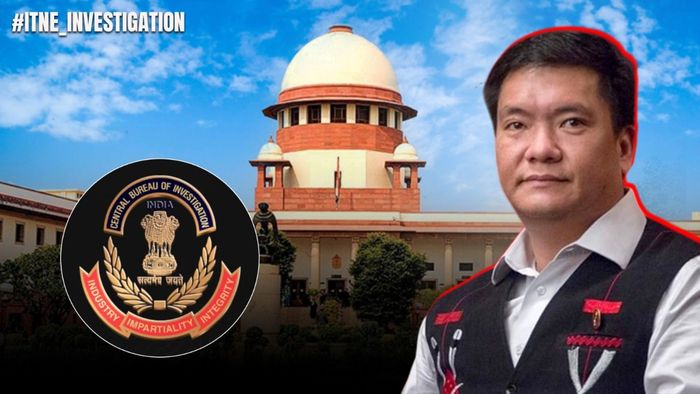
The inside story behind the CBI probe initiated against Pema Khandu government by the Supreme Court
The Supreme Court cracks open a quiet frontier, ordering a CBI probe into Rs 1,270 crore contracts tied to Arunachal’s ruling family. Hidden bids, missing records, and a dynasty’s rise now face scrutiny. What lies beneath this carefully layered system?
- Apr 10, 2026,
- Updated Apr 10, 2026, 7:13 PM IST
In the remote mountain state of Arunachal Pradesh, where roads are carved into Himalayan rock and government spending is the lifeblood of the local economy, a Supreme Court order delivered on April 6 has set in motion the most consequential corruption investigation the region has seen in years.
A three-judge bench led by Justice Vikram Nath directed the Central Bureau of Investigation (CBI) to conduct a preliminary inquiry into whether Arunachal Pradesh Chief Minister Pema Khandu and his family systematically exploited public office to funnel government contracts worth more than Rs 1,270 crore (roughly $150 million) to a web of firms owned by his wife, mother, brother and an extended circle of relatives and political associates.
The Supreme Court delivered its judgment in Writ Petition (Civil) No. 54 of 2024—Save Mon Region Federation & Anr. v. The State of Arunachal Pradesh & Ors.—a public interest litigation filed under Article 32 of the Constitution by the Save Mon Region Federation, a civil society organisation from the Mon region of Arunachal Pradesh, and Joddik Tali, its authorised representative. The petition was argued by senior advocate Prashant Bhushan, with advocates Neha Rathi and Somya Kumari. The respondents include the State of Arunachal Pradesh, and, critically, Chief Minister Pema Khandu (Respondent No. 4), his mother Rinchin Drema (Respondent No. 5), and his brother and Tawang MLA Tsering Tashi (Respondent No. 6).
The 35-page judgment, written by Justice Nath and joined by Justices Sandeep Mehta and N.V. Anjaria, is a rare judicial intervention into the affairs of a sitting chief minister, and a pointed rebuke of the state government’s defence that the contracts in question were too small a fraction of total spending to matter.
“The Constitution does not tolerate a breach of public trust merely because the breach is numerically small when measured against the total universe of State expenditure,” the court declared. “A low percentage cannot become a license. It cannot be a defence to nepotism.”
The CBI has been given two weeks to register a preliminary inquiry and 16 weeks to submit a status report. The state government has been ordered to hand over all records within four weeks and ensure that no document—physical or electronic—is destroyed.
In response to the Supreme Court order, Khandu said he respects the judgment, welcomes the CBI inquiry into the contract allegations, and has assured full cooperation.
The Khandu dynasty
To understand the case, one must understand the political landscape of Arunachal Pradesh, a state of 1.6 million people bordering China, where a single family has dominated politics for more than two decades. Pema Khandu’s father, Dorjee Khandu, served as chief minister from 2007 until his death in a helicopter crash in 2011. Before that, he held powerful ministerial portfolios, including disaster management. Pema Khandu, then barely 32, won his father’s Mukto constituency in a by-election and was catapulted to the chief ministership by 2016. He has held the office ever since, switching political loyalties from the Congress to the People’s Party of Arunachal Pradesh to the Bharatiya Janata Party, which now commands near-total control of the state legislature.
Throughout this period, the petitioners allege, the family’s private business interests grew in tandem with its political power. Election affidavits filed by the Khandus trace a striking arc of wealth accumulation. Dorjee Khandu declared assets of Rs 4.19 crore in 2004. By 2009, that figure had risen to Rs 22.96 crore, a 447 per cent increase. Pema Khandu declared Rs 12.25 crore in the 2011 by-election. By 2014, the figure had ballooned to Rs 129.57 crore, a 957 per cent surge. By 2019, his declared assets stood at Rs 163.50 crore.
His brother, Tsering Tashi, who represents the Tawang constituency in the state assembly, declared assets of Rs 96.43 crore in 2014 and Rs 109.43 crore in 2019.
The petitioners contend that this trajectory of wealth is inseparable from the pattern of contract allocation that now sits before the CBI.
The network of firms
At the centre of the case are four firms whose ownership the state government itself has acknowledged in court filings: M/s Brand Eagles, owned by Tsering Dolma, Pema Khandu’s wife. M/s Frontier Associates, listed as owned by Pema Khandu himself during his father’s tenure. M/s R.D. Construction, owned by Rinchin Drema, Pema Khandu’s step-mother and widow of Dorjee Khandu. M/s Alliance Trading Company, linked to Tsering Tashi, the chief minister’s brother and sitting MLA from Tawang.
But the petitioners argue that this is only the visible surface. Their filings identify at least 15 firms they allege are directly or indirectly linked to the Khandu family, including M/s R.D. Carriage (owned by the late Jambey Tashi, described as Pema Khandu’s cousin), M/s NT Brothers (a cousin’s firm), M/s TD Enterprises (an uncle’s firm), M/s Zen Associates (a younger brother’s firm), and several others connected to political associates and in-laws.
According to the state government’s own affidavits, filed pursuant to Supreme Court directions, the four acknowledged firms alone received contracts worth Rs 1,245.04 crore through tenders and Rs 25.72 crore through work orders, totalling more than Rs 1,270 crore, across seven major departments between 2014 and 2025. That translates to 121 contracts awarded through competitive tender and 322 through direct work orders, 443 contracts in all.
The departments in question— Public Works, Rural Works, Water Resources, Hydro-Power Development, Power, Urban Development, and Public Health Engineering—are the arteries of governance in a frontier state where the Central government pours in funds for roads, bridges, flood protection, and public buildings. Crucially, Pema Khandu himself held the Water Resources portfolio from 2019 to 2024, a period during which petitioners allege his family’s firms continued receiving contracts from that very department.
The collusion question
Perhaps the most damaging element of the petitioners’ case is not the volume of contracts, but the pattern of bidding. Data drawn from the state’s own affidavits reveals multiple tenders where the competing bidders were themselves firms linked to the Khandu family. In the Rural Works Department’s Tawang division, for instance, a Rs 480 lakh contract for a road from Chhagar to Kimnas Gonpa was awarded to M/s R.D. Construction. The other bidder? M/s Brand Eagles, the chief minister’s wife's firm. The price difference between the two bids was 0.70 per cent.
Similar patterns recur across the data. In a Rs 107.77 lakh contract for a cultural centre, the tender was awarded to M/s Brand Eagles, with the competing bidder being M/s Alliance Trading Company, the chief minister’s brother’s firm. The price gap: 1.90 per cent. For a Rs 134.10 lakh project at Bongleng staff quarters, the same two firms competed, with a gap of 0.91 per cent.
In the Public Works Department’s Tawang division, this pattern continues. Across contracts worth hundreds of crores, for roads, multipurpose halls, community centres, badminton courts, and government colleges, the competing bidders are, with striking regularity, drawn from the same cluster: M/s Alliance Trading Co., M/s R.D. Construction, M/s Brand Eagles, and M/s Rinchin Dorjee Construction. In several tenders, all three bidders are family-linked firms.
Advocate Prashant Bhushan, representing the petitioners before the Supreme Court, argued that these patterns amount to collusive bidding, a system where competition is simulated on paper while outcomes are effectively predetermined. The consistently narrow margins between bids from related entities, he contended, point not to genuine market competition but to coordinated price-setting.
The work order route
Beyond the tender process, the petitioners flagged a parallel channel through which contracts flowed to the Khandu family’s firms: direct work orders issued without any competitive bidding at all.
Arunachal Pradesh government’s defence rests on a state law, the Arunachal Pradesh District Based Entrepreneurs and Professionals (Incentives, Development and Promotional) Act, 2015, which permits contracts below Rs 50 lakh to be awarded through work orders without tender, ostensibly to support local entrepreneurs in a geographically difficult region. Section 3A, inserted through a 2020 amendment, codified this provision.
But the petitioners identified several problems with the state’s reliance on this defence. First, the provision was introduced only in November 2020, while work orders to the Khandu-linked firms had been flowing for years before that. Second, the state’s own rules under the Act limit any single contractor to three simultaneous work orders in a department, a cap the petitioners allege was routinely breached, with hundreds of work orders issued to the same firms across PWD, Rural Works, and Water Resources. Third, several contracts awarded through work orders exceeded the Rs 50 lakh threshold or involved projects requiring specialised technical expertise, such as high-voltage power lines and government colleges, for which the work-order exemption was not designed.
The court found this defence wanting. The judgment noted that a statutory framework permitting limited dispensation with competitive tendering “does not authorise unstructured discretion” and “does not permit repeated departures from competition without recorded reasons”.
The CAG Report: A trail of missing records
The case acquired additional weight with the filing of a report by the Comptroller and Auditor General of India in July 2025, pursuant to Supreme Court directions arising from an earlier, connected case, SLP (C) No. 34696 of 2010, filed by Voluntary Arunachal Sena.
In 2007, Voluntary Arunachal Sena, an anti-corruption NGO from Arunachal Pradesh, filed a PIL in the Gauhati High Court alleging that the state government under then-Chief Minister Dorjee Khandu was awarding public works contracts without floating tenders, specifically to firms owned by or linked to Dorjee Khandu's family. The High Court dismissed the PIL.
In 2010, the NGO appealed to the Supreme Court via this SLP, challenging the High Court’s dismissal. Dorjee Khandu was a respondent in his personal capacity. The core allegation: 165 contracts were awarded without following tender procedures to family-connected firms.
In 2011, Dorjee Khandu died in a helicopter crash. The state argued the SLP had abated against him. However, the petitioners later impleaded the incumbent Chief Minister Pema Khandu as an additional respondent, arguing the same pattern was continuing under the son.
In 2023, the matter came alive again before Justices Aniruddha Bose and Bela M. Trivedi. Pema Khandu submitted a response in a “sealed envelope”. The bench directed the CAG to examine whether close relatives of a state’s executive head can be awarded government contracts and what norms govern such awards.
On March 20, 2024, the bench disposed of the SLP, directing the CAG to examine the nine original corruption allegations from the 2007-2011 period. Crucially, the court noted that interlocutory applications seeking interference in subsequent contracts (post-Dorjee Khandu era) were not being examined in this case because an independent writ petition had already been filed, which is the present case, W.P.(C) No. 54/2024.
On July 21, 2025, the CAG filed its final report on the nine allegations. This is the report that fed into the current judgment, documenting no-tender awards, missing vouchers, absent records, and the Rs 68.44 crore rice transport contract given to M/s R.D. Carriage without any quotation process.
So essentially, the Voluntary Arunachal Sena SLP is the mother case—spanning the Dorjee Khandu era—era the Save Mon Region Federation writ petition (the present case) is its sequel, covering the Pema Khandu era.
The CAG’s findings, covering nine specific allegations, painted a picture of systematic documentary failure in Arunachal Pradesh’s public procurement system. The audit flagged multiple instances where works were executed without any call for tender, where no reasons were recorded for bypassing competitive bidding, and where vouchers, comparative bid statements, and tender evaluation materials were simply unavailable.
The scale of missing documentation was substantive. For a road project from Lhou Nallah to Mukto, the chief minister’s own constituency headquarters, vouchers for expenditure amounting to Rs 12.24 crore were not produced, and documents relating to comparative bid statements and the award process were unavailable. The audit noted that it could not probe the award further for want of essential records. For two other NLCPR projects in the Tawang region, vouchers totalling over Rs 1.30 crore were similarly missing. In a water supply project for Tawang township, vouchers for Rs 273.92 lakh were not made available.
On the earliest allegation, a Rs 68.44 crore contract for transporting 24,800 metric tonnes of rice under the Sampoorna Gramin Rozgar Yojana in 2004-05, the CAG confirmed that the contract was awarded to M/s R.D. Carriage without any tender or quotation process. The proprietor of that firm was the late Jambey Tashi. While the CAG noted that official records did not establish his family relationship with Dorjee Khandu, the petitioners pointed out that Jambey Tashi was widely known to be Dorjee Khandu’s nephew, the son of Goleng, who was Dorjee Khandu’s brother. At the time the contract was awarded, Dorjee Khandu was the minister in charge of disaster management.
Regarding a Rs 23 crore corpus fund sanctioned to the Bodhi Language and Literature Promotional Society, the audit found that while the principal remained as a fixed deposit, the accrued interest, running into several crores, had been transferred to a savings account. The CAG could not confirm how this money was used, as documentation linking expenditures to specific end uses did not exist. The audit also noted that the Society had never renewed its registration after 1993.
The Supreme Court gave these findings significant weight, not as proof of criminal guilt, but as indicators that a proper criminal investigation was needed. The judgment drew a critical distinction between what an audit can do and what a criminal probe must do: an audit can verify accounts and test compliance, but it cannot conduct searches and seizures, trace beneficial ownership through layered entities, examine the money trail, identify who was responsible for destroying or concealing files, or determine whether the facts constitute cognisable offences.
The state’s defence and its demolition
The Arunachal Pradesh government mounted its defence on four principal arguments, each of which the Supreme Court systematically rejected.
The CAG argument: The state contended that since the CAG is a constitutional authority, its report properly belongs in the domain of the Governor and the state legislature through the Public Accounts Committee. The court called this a “misconception”, holding that legislative scrutiny does not displace the constitutional role of the judiciary when allegations implicate arbitrariness, conflict of interest, and misuse of public office.
The geography argument: The state sought to normalise the work-order system by attributing it to Arunachal Pradesh’s remote terrain and limited contractor base. The court accepted that local conditions may justify adapted procurement methods but held that “what is under scrutiny is not the existence of a work order system as a concept” but rather “the manner of its deployment”, the absence of recorded reasons, the lack of a decision trail, and the pattern of awards to related parties.
The burden-of-proof argument: The state argued that the petitioners had failed to produce “explicit proof” of statutory violations. The court reversed this, noting that the state, not the petitioners, is the custodian of public records. “When serious allegations of unfairness and conflict of interest arise and the record itself shows gaps in essential documents, the Court cannot place the entire onus on the petitioners to establish the illegality by materials they do not control.”
The percentage argument: The state’s most prominent defence was statistical: that the share of contracts awarded to Khandu-linked firms was negligible when measured against total state expenditure—figures like 0.32 per cent in the Power Department or 0.03 per cent in Public Health Engineering. The court rejected this most forcefully of all. “Even a single instance of award of public work through a process tainted by conflict of interest, or by a deliberate bypass of competition, constitutes an affront to Article 14,” the judgment declared. It added that a statewide denominator “can conceal concentration within a district, concentration within a particular department, concentration in high-value projects, or concentration within a small set of contractors.”
The order
Having found that the material disclosed a prima facie case of systemic procurement irregularities involving the highest public functionary in the state, the court issued a series of specific directions.
The CBI must register a preliminary inquiry within two weeks. The inquiry will cover all public works contracts and work orders in Arunachal Pradesh from January 1, 2015, to December 31, 2025, with particular focus on awards made to the chief minister, his mother, his brother, and firms linked to them. The agency is empowered to trace transactions outside this period if necessary for establishing beneficial ownership, related-party links, or fund flows.
The state government must hand over all records, sanction orders, administrative approvals, technical sanctions, tenders, comparative statements, tender committee records, work orders, agreements, measurement books, bills, vouchers, utilisation certificates, completion certificates, and all electronic procurement and payment data, within four weeks.
The Chief Secretary must designate a nodal officer within one week for coordination with the CBI, and each concerned department must do the same. All records, physical and electronic, must be preserved. No document may be destroyed, altered, or rendered inaccessible.
What next?
The court emphasised that its observations are for the limited purpose of determining whether an investigation is warranted. They are not findings on the merits of any allegation and shall not prejudice any person in future proceedings.
The CBI’s preliminary inquiry will determine whether sufficient evidence exists to register a formal criminal case, a step that would escalate the matter from a fact-finding exercise to a full-fledged investigation with the power to arrest, search and prosecute. The inquiry will examine not only whether the contracts were awarded improperly, but whether the facts disclose offences under the Prevention of Corruption Act, 1988, including criminal misconduct by a public servant and obtaining undue advantage from persons connected with official business.
The order carries significant political implications. Arunachal Pradesh is a strategically sensitive border state where the BJP has maintained a strong grip under Khandu’s leadership. Any CBI investigation involving the chief minister’s family, especially one directed by the Supreme Court, poses an acute challenge for the party’s governance narrative in the Northeast, a region where the BJP has invested heavily in political expansion over the past decade.