A Morning with His Holiness the Dalai Lama
In Tibetan Buddhism, compassion is not merely an emotion but a vibration of positive energy that transforms everything it touches. His Holiness embodies that energy. Despite being a leader of a nation in exile, he continues to radiate calmness, humility, and purpose.
Biraj Das
- Nov 08, 2025,
- Updated Nov 08, 2025, 8:58 PM IST
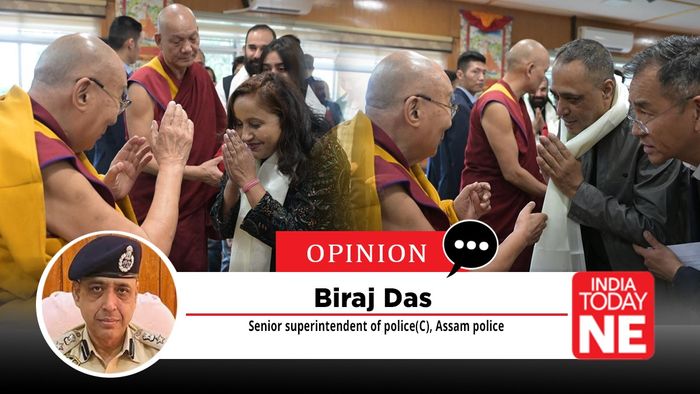
On the serene morning of November 5, 2025, in the peaceful town of Dharamshala nestled among the Himalayas, we were blessed with a moment that words can barely describe. Along with my wife Dr Sweety Sarma and our daughter Aradhana Kashyap, I had the divine opportunity to receive the spiritual blessings of His Holiness the 14th Dalai Lama. It was a brief interaction, not more than three minutes, yet it felt timeless. My wife offered His Holiness her debut children’s book “Xun – The Golden Child” wrapped with an Assamese Gamucha, a symbol of respect and purity from our land Assam. The moment he smiled and blessed us, the energy around us changed, gentle, radiant, and deeply moving. When His Holiness touched our fingers, tears rolled down from my daughter’s eyes without a word being spoken. It was not just emotion; it was energy manifesting as compassion, the highest form of peace the human soul can experience.
In Tibetan Buddhism, compassion is not merely an emotion but a vibration of positive energy that transforms everything it touches. His Holiness embodies that energy. Despite being a leader of a nation in exile, he continues to radiate calmness, humility, and purpose. His strength does not come from authority or wealth but from the consequence of compassion, a force more powerful than any weapon. When compassion becomes action, it transforms societies and nations. The consequence of His Holiness’s compassion is visible in the way Tibetans continue to live with discipline, politeness, and faith even after decades of displacement from their homeland, a homeland they still breathe for without harming or undermining other belief systems.
Walking into the premises of the Tibetan Government in Exile in Dharamshala, one can feel an invisible yet powerful field of positive energy. The prayer flags fluttering in the mountain breeze, the rhythmic chanting of monks, the fragrance of non-toxic incense, and the smiling faces of the Tibetan officials, all these elements together awaken every human sense. The ears resonate with mantras, the eyes rest on vibrant scriptures, and the mind becomes still. It is an atmosphere where discipline is not forced but flows naturally as a consequence of spiritual training.
What makes His Holiness extraordinary is his unshakeable commitment to peaceful resistance. He has been fighting a superpower for Tibet’s sovereignty without firing a single bullet or spilling a single drop of blood. His government in exile stands as a unique model of democratic resilience and moral strength. Every word he speaks carries the fragrance of peace yet it echoes the firmness of justice. His actions show the world that true power lies not in aggression but in the consequence of inner peace. Even the security personnel and officials within the Tibetan premises carry themselves with discipline and humility. Their politeness is not a formality; it is the natural outcome, the consequence of years of spiritual practice. Watching the Tibetan monks walking silently in line, maintaining perfect order and respect, one realizes that Buddhism is not just a religion but a way of disciplined living, rooted in compassion and self-awareness.
We too, like many others, have faced the consequences of life. There have been phases of turbulence, loss, and pain. We lost some of our family members at very early ages, and many others too, whose memories still linger within us. But these are not sorrows confined to our family alone; they are part of every human journey. Every person faces such consequences in life, for life itself is a rhythm of ups and downs. What matters is how we respond to them. If we can embrace compassion and realize that everything we desire in life already exists in the form of energy within the universe, we begin to live differently. To feel that energy and bring it into our lives in physical form is the highest expression of spirituality. Everything else is temporary, just like the Mandala in Tibetan Buddhist practice that is beautifully created with colored sand and later swept away, symbolizing impermanence. My father, Late Ruleswar Das, often said, “You may lose the battle but win the war, and it is the war that is counted, not the battle.” His words now make deeper sense. The battle may be personal, but the war is always spiritual.
A few years ago, through the coordination of our retired SDG Shri S. N. Singh, IPS Sir, a team of Tibetan doctors and other personnel used to visit our APRO Headquarters at Ulubari, Assam once a week and treat us with their natural medicines. Among them was a kind doctor named Dr Tenzin Tsomo, who taught me the sacred mantra “Om Mani Padme Hum.” It was explained that these six syllables are not mere sounds but powerful vibrations that purify the mind, awaken compassion, and connect one’s inner being to the divine energy of the universe. Over time, I came to understand that this mantra is not meant to be recited for miracles but to transform the mind into a vessel of calmness and empathy. Since then, it has remained with me as a reminder that compassion and mindfulness are not separate from everyday living; they are the essence of it.
India has been the guardian of compassion since ages. Our Sanatan Dharma, the eternal path, teaches that the highest duty of any human being is to uphold humanity. This national character of India, the instinct to help, to shelter, and to protect, has remained unchanged across governments and generations. From Jawaharlal Nehru to the present leadership and those yet to come, every Indian government has shown kindness towards Tibet and its spiritual leader. This is not politics; this is the consequence of Sanatan culture, which recognizes divinity in every living being.
One shining example of this compassion can be found in our history. During the Second World War, when a boat carrying orphaned Israeli children sought refuge, the then King of Nawanagar in Gujarat, Maharaja Jam Saheb Digvijaysinhji, opened his arms to them. He provided them shelter, education, and safety in Jamnagar until the war ended and they could return home. This act of humanity reflected the true Indian spirit, the very soul of Sanatan Dharma, where compassion is not selective but universal. It is the same compassion that made India welcome His Holiness and thousands of Tibetan refugees when they fled their homeland. Dharamshala became their second home, not by political decision alone but by a spiritual connection rooted in the consequence of humanity.
During our visit, people from across the world, from Russia, Europe, and various Indian states, had gathered, nearly 350 people, seeking His Holiness’s blessings. Everyone waited patiently without any complaint or restlessness. The discipline of the Tibetan officials, the calm coordination of the monks, and the kindness in their gestures made us realize that spirituality is not about rituals but about behavior. The consequence of their faith is visible in their conduct, respectful, organized, and full of serenity. The Tibetan officials guided every visitor with utmost humility. The monks maintained quiet order, ensuring that every devotee’s moment with His Holiness remained sacred and personal. Even the security personnel carried their duties with grace, alert yet gentle. Such discipline is not the product of training alone; it is the consequence of a life guided by spiritual consciousness.
His Holiness the Dalai Lama stands today as one of the last great torchbearers of universal peace. His existence itself is a message that even when power, politics, and aggression dominate the world, compassion will always have the final consequence. He teaches us that peace is not the absence of conflict but the presence of understanding. When we left the temple that morning, the sound of chanting followed us like a soft wind. My daughter, still holding the blessed scarf, looked back one last time. I could see in her eyes the reflection of an eternal truth that spiritual experiences are not learned; they are felt. What we experienced in Dharamshala was not just a meeting with a monk or a leader; it was an encounter with a force that binds the universe, the energy of compassion.
In the silence of that moment, we understood why His Holiness’s life continues to inspire millions. He is not only a spiritual leader but a living symbol of what happens when compassion becomes strength. His life is proof that the consequence of kindness is peace and the consequence of peace is freedom.
That morning in Dharamshala, among chanting monks and fluttering prayer flags, I realized that we were not merely blessed; we were transformed by compassion, by energy, and by the timeless truth that humanity, above all, is our greatest religion.
Om Mani Padme Hum
MORE NEWS
Read more!