‘A society that fears questions becomes vulnerable to authoritarianism’: Justice Ujjal Bhuyan’s candid views on contentious issues
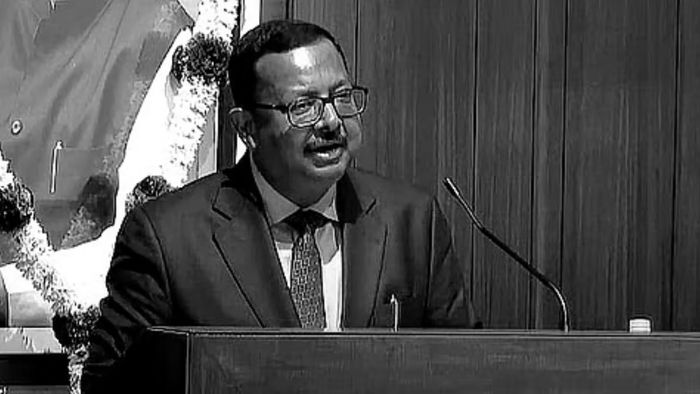
Supreme Court judge Justice Ujjal Bhuyan has been making candid remarks on several contentious issues, including voting rights, judicial appointments, the functioning of the Supreme Court Collegium, the right to dissent and constitutional morality, during public lectures and academic events across the country.
- Nov 05, 2026,
- Updated Nov 05, 2026, 6:14 PM IST
Supreme Court judge Justice Ujjal Bhuyan has been making candid remarks on several contentious issues, including voting rights, judicial appointments, the functioning of the Supreme Court Collegium, the right to dissent and constitutional morality, during public lectures and academic events across the country.
The judge, who was elevated to the Supreme Court on July 14, 2023, has spoken on these issues at several legal and academic forums in recent months, particularly at memorial lectures and university convocations.
His remarks have also triggered debate over judicial propriety, particularly the question of judges commenting publicly on matters that may be sub judice.
On Thursday, Justice Bhuyan delivered a significant judgment holding that the 24-hour deadline for producing an arrested person before a magistrate begins from the time of detention and not from the formal recording of arrest.
On voting rights and citizenship
Speaking at the 19th NALSAR-Justice BR Sawhney Memorial Moot Court Competition on October 4, Justice Bhuyan criticised the process of disenfranchising citizens.
"The process of disenfranchising millions and millions of Indian citizens, making them second-class citizens in their own country, in the sense of being citizens without voting rights, such a process is intrinsically arbitrary. No amount of whataboutery can justify it," he said.
On dissent and constitutional values
Addressing the 12th convocation of the University of Science and Technology Meghalaya on October 31, the judge said, "A society that fears questions becomes vulnerable to authoritarianism."
He also drew attention to the gender imbalance in the Supreme Court, describing it as a "male-dominated" institution and observing that women's representation on the Bench did not reflect their proportion among lawyers or in the country's population.
At a seminar in February, Justice Bhuyan spoke about the gap between constitutional guarantees and everyday discrimination. He shared an incident involving his daughter's Muslim friend, who was allegedly denied accommodation in Delhi because of her religion.
On the Collegium and judicial appointments
Justice Bhuyan has also expressed concerns over the functioning of the Supreme Court Collegium and transparency in judicial appointments.
Speaking at ILS Law College in Pune on January 24, he said, "When the Collegium itself records that a transfer is being made at the request of the central government, it reveals a striking intrusion."
The remarks came around three months after the Supreme Court Collegium modified its recommendation concerning the transfer of Justice Atul Sreedharan from the Madhya Pradesh High Court to the Chhattisgarh High Court, instead of the Allahabad High Court.
At the launch of the Vidhi Centre for Legal Policy's Judicial Transparency Index Report, Justice Bhuyan criticised the Collegium's practice of not providing reasons for its decisions, calling it "a step back from the principle of transparency".
He said withholding reasons could undermine the institution and create space for individuals whose subsequent conduct might be contrary to constitutional values.
"By not giving reasons, the institution actually does a disservice to many judges who are genuinely outstanding and have done tremendous work," he said.
On criminal law and religious discrimination
Speaking at the National Law Institute University in Bhopal, Justice Bhuyan also referred to the arrest of 14 Muslim youths in Varanasi for allegedly consuming chicken biryani on a boat on the Ganga.
"I am sure consuming chicken biryani is not an offence. It can't be an offence," he said, adding that the youths had remained in jail for three months.
His remarks reflected his concerns over the use of criminal law and the protection of individual rights.
From Gauhati High Court to Supreme Court
Born on August 2, 1964, in Guwahati, Justice Bhuyan comes from a family with a legal background. His father, Suchendra Nath Bhuyan, was a senior advocate and former Advocate General of Assam.
He studied at Don Bosco High School and Cotton College in Guwahati before graduating in Arts from Kirori Mal College in Delhi. He subsequently obtained an LL.B. degree from Government Law College, Guwahati, and an LL.M. degree from Gauhati University.
Justice Bhuyan was appointed an Additional Judge of the Gauhati High Court on October 17, 2011, and was confirmed on March 20, 2013.
He was transferred to the Bombay High Court, where he took oath on October 3, 2019. After a two-year stint in Mumbai, he was transferred to the Telangana High Court and took oath on October 22, 2021.
The Supreme Court Collegium recommended his elevation to the apex court on July 5, 2023. He took oath as a Supreme Court judge on July 14 that year.
Justice Bhuyan is scheduled to retire on August 1, 2029, and is not in line to become the Chief Justice of India.