Assam: After decades in darkness, Dhubri village lit up for first time since Independence
A remote border village in Assam’s Dhubri district has received electricity for the first time since Independence, more than 75 years after the nation was lit up. Choto Pokalagi village under Agomoni Tehsil has finally emerged from decades of darkness, powered through a rare and strategic cross-border electricity arrangement with neighbouring West Bengal.
- Feb 12, 2026,
- Updated Feb 12, 2026, 6:12 PM IST
A remote border village in Assam’s Dhubri district has received electricity for the first time since Independence, more than 75 years after the nation was lit up. Choto Pokalagi village under Agomoni Tehsil has finally emerged from decades of darkness, powered through a rare and strategic cross-border electricity arrangement with neighbouring West Bengal.
Home to over 120 households, the geographically isolated village had remained beyond the reach of Assam’s power grid due to technical constraints. Officials confirmed that extending supply from the state grid was deemed “technically non-feasible” owing to the village’s difficult terrain and its proximity to interstate railway infrastructure.
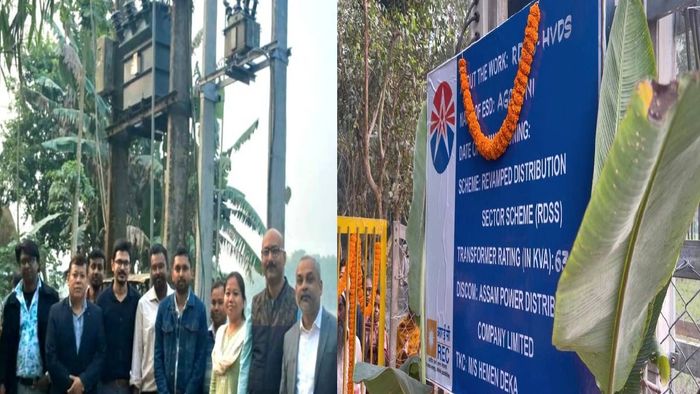
In an unprecedented move to overcome the logistical barrier, Assam Power Distribution Company Limited (APDCL) entered into an agreement to source electricity from the West Bengal State Electricity Distribution Company Limited (WBSEDCL). The arrangement allows APDCL to purchase power from the neighbouring state to ensure reliable supply to the border community.
Rakesh Saha, Assistant General Manager of APDCL Dhubri, said the initiative was part of a broader strategy to electrify remote “pockets” along interstate boundaries where conventional grid expansion is not viable.
The electrification project was executed by the Agomoni Electrical Sub-Division under the Revamped Distribution Sector Scheme (RDSS). To cater to the village’s load demand, three high-capacity transformers were installed — a dual setup of 63 KVA and 25 KVA serving nearly 85 households in the northern sector, and a separate 63 KVA transformer dedicated to around 35 households in the southern sector.
For residents, the development marks a historic turning point. Students who once depended on kerosene lamps and limited solar lighting can now study under reliable electric lights. Small farmers and households are expected to benefit from improved access to irrigation tools, communication devices, and digital connectivity.
“It has been more than 75 years since Independence. Seeing a light bulb glow in our homes feels like a new dawn,” said a village elder, reflecting the emotional significance of the moment.
The electrification of Choto Pokalagi is being seen as a model for other remote border habitations facing similar technical barriers. By prioritising feasibility and inter-state cooperation over administrative boundaries, authorities have ensured that one of Dhubri’s last unconnected settlements finally joins the country’s expanding energy network — signalling both infrastructural progress and long-awaited inclusion.