Assam floods: Debabrata Saikia seeks special rehabilitation project backed by DMFT funds
Former Leader of the Opposition in the Assam Legislative Assembly and former Nazira MLA Debabrata Saikia has urged the Assam government to declare a "Special Integrated Dikhow River Basin Rehabilitation Project" under the District Mineral Foundation Trust (DMFT) and the Pradhan Mantri Khanij Kshetra Kalyan Yojana (PMKKKY), 2024, to support the rehabilitation of flood-affected families, restore the Dikhow River ecosystem and strengthen long-term flood resilience in Upper Assam.
- Jul 29, 2026,
- Updated Jul 29, 2026, 10:58 AM IST
Former Leader of the Opposition in the Assam Legislative Assembly and former Nazira MLA Debabrata Saikia has urged the Assam government to declare a "Special Integrated Dikhow River Basin Rehabilitation Project" under the District Mineral Foundation Trust (DMFT) and the Pradhan Mantri Khanij Kshetra Kalyan Yojana (PMKKKY), 2024, to support the rehabilitation of flood-affected families, restore the Dikhow River ecosystem and strengthen long-term flood resilience in Upper Assam.
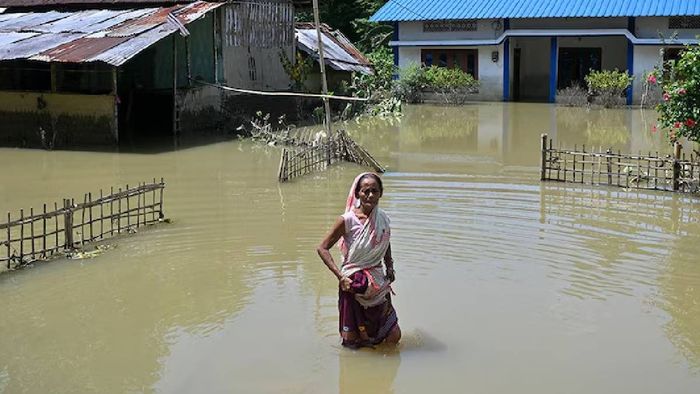
In a detailed representation submitted to Chief Minister Himanta Biswa Sarma, Saikia said the unprecedented floods that affected Sivasagar, Charaideo, Jorhat and adjoining districts had caused extensive destruction, particularly in Nazira Co-District, where prolonged inundation left thousands of families homeless and devastated agriculture, fisheries, livestock and public infrastructure.
Referring to assessments by the Assam State Disaster Management Authority (ASDMA), Saikia noted that Sivasagar was among the worst-affected districts during the floods, with nearly three lakh people impacted at different stages of the disaster. Hundreds of villages were inundated, embankments breached, roads and public infrastructure damaged, and agricultural land covered by thick deposits of sand and silt, rendering cultivation difficult in many areas.
He said the government's response should now move beyond immediate relief to focus on permanent rehabilitation, livelihood restoration, rebuilding of public infrastructure and ecological recovery of the Dikhow River basin.
The representation highlights the Dikhow River's importance to the economy and ecology of Upper Assam, stating that it supports agriculture, fisheries, groundwater recharge and biodiversity. Saikia noted that authorised extraction of sand, stone and other minor minerals has taken place in the river basin for several years under mining leases, while allegations of illegal and unscientific mining have also surfaced.
He referred to proceedings before the Gauhati High Court in a public interest litigation concerning illegal mining in the Dikhow River, arguing that the matter has long been recognised as one requiring stronger environmental oversight. While refraining from attributing the recent floods to any single cause, Saikia called for a scientific assessment to examine whether authorised mining, illegal extraction, river morphology changes, sediment disturbance and other human activities may have aggravated the scale of the disaster.
Citing the provisions of the Mines and Minerals (Development and Regulation) Act, 1957, Saikia argued that the District Mineral Foundation was established specifically to serve the interests of people and areas affected by mining-related operations. He said the revised PMKKKY Guidelines, 2024, further prioritise expenditure on housing, drinking water, healthcare, education, livelihood restoration, agriculture and environmental restoration in mining-affected regions.
According to the representation, communities living in the Dikhow River basin have experienced repeated flooding, erosion and environmental degradation while contributing to the state's mineral economy. Saikia contended that these communities have a strong statutory and equitable claim over the utilisation of DMFT resources, irrespective of whether ongoing scientific studies establish a direct link between mining practices and the recent floods.
To facilitate coordinated rehabilitation, Saikia proposed that the state government launch a Special Integrated Dikhow River Basin Rehabilitation Project under the DMFT and PMKKKY framework. He suggested that the project include construction of disaster-resilient housing, livelihood restoration grants for farmers, fishermen, artisans and self-help groups, mechanised removal of sand and silt from agricultural land, restoration of irrigation systems, fisheries and wetlands, ecological restoration of riverbanks, reconstruction of damaged roads, schools, health institutions and drinking water facilities, development of flood-resilient infrastructure, continuous scientific monitoring of river behaviour and stricter monitoring of mining activities using GIS mapping, drone surveys and satellite technology.
The former MLA also proposed the constitution of a high-level expert committee comprising representatives from the Mines and Minerals Department, Water Resources Department, Revenue and Disaster Management Department, Assam State Disaster Management Authority, Directorate of Geology and Mining, IIT Guwahati, river scientists, environmental experts, agricultural scientists and representatives of affected communities.
He said the committee should examine the cumulative impacts of authorised and unauthorised mining, changes in river morphology, embankment vulnerability, sediment movement, ecological restoration measures, sustainable mining practices and long-term flood mitigation strategies within a fixed timeframe.
Among the key recommendations made to the state government are convening the PMKKKY State Level Monitoring Committee under the Chief Minister's chairmanship, directing the Sivasagar District Mineral Foundation Trust to prepare a time-bound flood rehabilitation action plan, prioritising the use of DMFT resources for rehabilitation, undertaking scientific removal of sand and silt from agricultural fields and public infrastructure, strengthening environmental safeguards for future mining operations, publishing annual DMFT collections and expenditure details, and conducting periodic environmental audits of mining-affected river systems across Assam.
Saikia further stated that while the state government's announced financial assistance for flood victims, including relief for affected families and other support measures, would provide immediate assistance, it would not be sufficient for households that had lost homes, farmland, livestock, fisheries, businesses and lifelong savings. He urged the government to invoke the statutory objectives of the MMDR Act and PMKKKY to ensure that the District Mineral Foundation serves as an instrument for humanitarian rehabilitation, environmental restoration and sustainable development in the flood-affected Dikhow River basin.