Assam: Netai Dhubuni’s ‘Siddha’ footprint reappears on Brahmaputra bank after 30 years
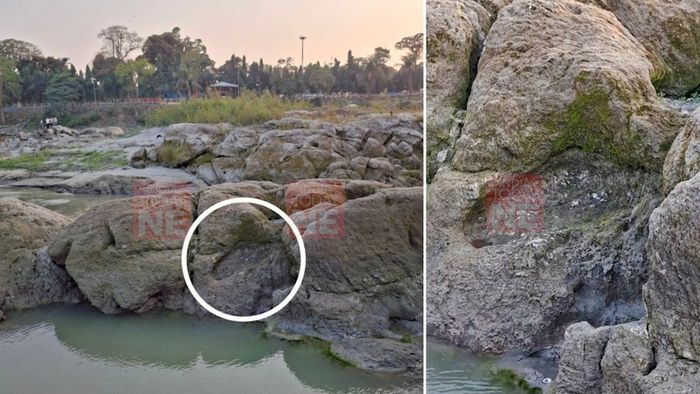
The banks of the mighty Brahmaputra in western Assam witnessed an extraordinary spiritual resurgence on Sunday, February 22, as the legendary “Siddha” footprint of Netai Dhubuni reappeared at Dhubri’s historic Pathar-ghat (Stone Ghat) after nearly three decades. The rare emergence has stirred deep devotion among the Rajak community, who revere Netai Dhubuni as their Kul-Devi (clan deity) and spiritual guardian.
- Feb 22, 2026,
- Updated Feb 22, 2026, 5:57 PM IST
The banks of the mighty Brahmaputra in western Assam witnessed an extraordinary spiritual resurgence on Sunday, February 22, as the legendary “Siddha” footprint of Netai Dhubuni reappeared at Dhubri’s historic Pathar-ghat (Stone Ghat) after nearly three decades. The rare emergence has stirred deep devotion among the Rajak community, who revere Netai Dhubuni as their Kul-Devi (clan deity) and spiritual guardian.
Located at Longitude 26° 1' 24.1104" and Latitude 89° 59' 44.3076", the symbolic footprint surfaced on the riverbank, drawing devotees, local residents and community elders to the site. For many, the moment was not merely an event of folklore but a reaffirmation of faith and identity deeply embedded in the cultural fabric of Dhubri.
While historians continue to debate the origins of regional legends and place names, for the Rajak community of Dhubri, the connection to Netai Dhubuni has never been uncertain. The Netai Dhubuni Ghat is not just a stretch of riverbank; it is regarded as sacred ground where their clan goddess is believed to have walked.
References to Netai Dhubuni appear in revered texts such as the Manasa Mangal and the Padma Purana, where she is portrayed as a woman endowed with immense “Siddha” (spiritual) powers — powerful enough, according to legend, to breathe life into the lifeless. One enduring narrative credits her with reviving Lakhinder, a tale that continues to shape the community’s spiritual imagination and collective pride.
For generations of Rajak families, the act of washing clothes in the waters of the Brahmaputra transcends daily labour. It is seen as a sacred ritual inherited from their goddess, conferring dignity and divine continuity to their traditional occupation. The reappearance of the footprint, community members say, reinforces their belief that Netai Dhubuni continues to watch over them like a maternal protector.
“For the world, she may be a character of folklore; for us, she is the mother whose presence is felt in every ripple of the Brahmaputra,” said a senior member of the community, reflecting the emotional depth of the moment.
The belief in Netai Dhubuni is also closely tied to the very identity of Dhubri, with many asserting that the town’s name traces its roots to the Dhobi (Rajak) community and their revered goddess. As word of the footprint’s emergence spreads, the riverbank has transformed into a site of renewed spiritual gathering — a reminder of how faith, folklore and identity continue to shape Assam’s living heritage.