Assam: New ‘Assamese Spiny Ant’ Discovered in Guwahati’s Garbhanga Reserve Forest Signals Biodiversity Resilience
A new ant species, the Assamese Spiny Ant, has been discovered in Assam's Garbhanga Reserve Forest. This highlights the region's biodiversity and the importance of habitat conservation.
- Apr 15, 2026,
- Updated Apr 15, 2026, 5:16 PM IST
Amid growing concerns over habitat loss and urban expansion in Assam, a landmark discovery offers reassurance, ants are far from disappearing.
Scientists have identified a striking new species of spiny ant thriving in the fragmented forests on the outskirts of Guwahati, highlighting the surprising ecological value of urban green spaces.
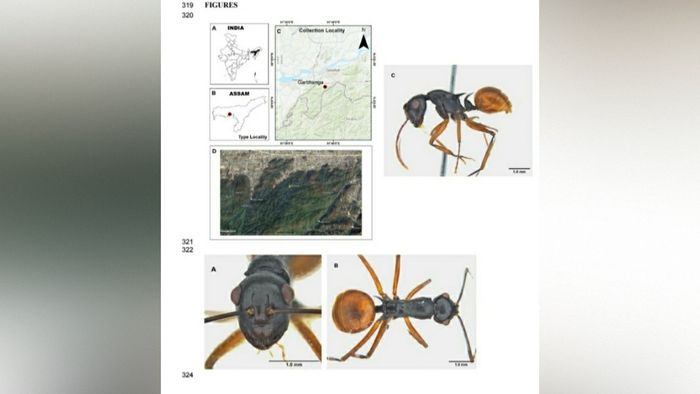
The new species, Polyrhachis garbhangaensis – commonly known as the “Assamese Spiny Ant” – was found in Garbhanga Reserve Forest, a 117 sq km green corridor bordering the city and contiguous with Rani Reserve Forest.
This discovery counters narratives of widespread insect decline in the region and underscores that even pressured forest patches continue to support undocumented biodiversity and complex ecological interactions.
Led by Ankita Sharma, a PhD scholar at the National Institute of Advanced Studies (NIAS), Bengaluru, the research team included Paul Antony Mangaly, Suraj Kumar Singha Deo, Sangavi D, and senior researcher Prof. Anindya Sinha.
Field sampling using pitfall traps was conducted in August 2023 as part of a broader study on the impacts of urbanisation on ant and spider assemblages in South Guwahati.
A preprint was posted on bioRxiv on August 19-20, 2025. The formal description was published in the international journal Asian Myrmecology (Volume 19: 019001, pp. 1-9) on January 30, 2026.
The ant, measuring about 5.6 mm, belongs to the rare Polyrhachis mucronata group , only the third species recorded from India. It stands out with its glossy black body, vivid yellowish-orange abdomen (bright in life, turning yellow-brown when preserved), and distinctive curved spines on the petiole and propodeum, likely serving as defence against predators. Researchers also noted an ant-mimicking spider at the same site, suggesting ongoing predator-prey dynamics.
“This finding… highlights the importance of urban and fragmented forest areas in sustaining tropical ant biodiversity.” The Study noted.
The authors emphasise that Garbhanga’s mosaic of habitats supports specialised species despite surrounding development.
Assam already records 217 ant species across 58 genera, with Polyrhachis showing notable diversity. Earlier surveys had indicated that human activities can reduce ant richness outside core forests, yet this discovery demonstrates that targeted protection of even small urban-adjacent patches can safeguard vital ecosystem engineers , predators, soil aerators, and seed dispersers essential to tropical ecosystems.
While global insect declines remain a serious concern, Assam’s ants appear resilient in these green lungs.
The message is clear, conserving fragmented forests like Garbhanga is crucial to preserving the state’s rich biodiversity before further urban pressure closes the window for such revelations.