BJP fires back as Gaurav Gogoi calls Assam ‘Sankar–Azan Land’: Cultural clash heats up
Assam witnessed a sharp political confrontation on questions of history, identity and cultural legacy after Congress MP Gaurav Gogoi and Chief Minister Himanta Biswa Sarma articulated competing narratives on what defines the civilisational foundation of the state, triggering a fierce backlash from BJP leaders.
- Dec 27, 2025,
- Updated Dec 27, 2025, 7:11 PM IST
Assam witnessed a sharp political confrontation on questions of history, identity and cultural legacy after Congress MP Gaurav Gogoi and Chief Minister Himanta Biswa Sarma articulated competing narratives on what defines the civilisational foundation of the state, triggering a fierce backlash from BJP leaders.
The row began after Sarma, speaking at a party meeting, rejected the idea that Assam is a land of “Sankara–Azan” syncretism. He said such interpretations ignore historical realities and weaken the indigenous cultural foundation of a region that serves as India’s gateway to the Northeast. “Assam is the land of Sankar–Madhav,” Sarma asserted, invoking the Vaishnavite tradition of Mahapurush Srimanta Sankardeva and Madhavdeva, while cautioning against what he described as selective reinterpretations of history.
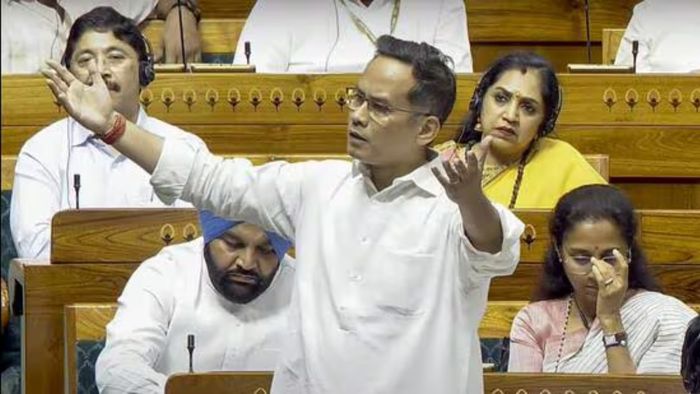
Reacting strongly, Gogoi took to social media to counter the Chief Minister, asserting that Assam will always be the land of “Sankar-Azan,” as well as Madhavdeva, Bir Chilarai and Chaolung Sukapha. He also invoked icons of Assamese literature, culture and nationalism, including Jyotiprasad Agarwala, Laxminath Bezbaruah and Bhupen Hazarika, along with martyrs Swahid Kushal Konwar and Swahid Kamala Miri. Describing Assam as “our land, our Axom, our Bor Axom,” Gogoi said nothing the Chief Minister says can change that.
In a scathing attack, the Congress MP claimed that Sarma’s words carried little weight and accused him of understanding only “syndicate, toll, coal and buying tea gardens.” Gogoi further said the people of Assam would remain united to protect the interests of bhumiputra, khilonjiya and Axombaaxi communities.
However, Gogoi’s remarks sparked what BJP leaders described as an “ugly distortion” of Assam’s history. Lakhimpur MLA Manab Deka said Assam’s heritage, forged by saints and heroes born on its soil, is non-negotiable. He stated that Mahapurush Srimanta Sankardeva, Madhavdeva, Swargadeu Chaolung Sukapha and Assam’s martyrs shaped the spiritual, cultural and moral fabric of the land, and accused Gogoi of drawing politically motivated and historically inaccurate comparisons by equating them with Azan Faqir, whom he described as a foreign saint.
Assam Cabinet Minister Pijush Hazarika also came out strongly, calling such comparisons false and politically motivated. He said equating Assam’s revered saints with Azan Faqir undermines history, misrepresents Assamese culture and insults public sentiment. Hazarika asserted that Sankardeva, Madhavdeva and other saints were born on Assamese soil and that their teachings and legacy belong solely to the people of Assam. He warned that such narratives threaten the pride and dignity of the state’s bhumiputras and Axombaaxi communities, adding that Assam’s heritage is sacred and its saints incomparable.
Senior BJP leader Kaushik Rai accused Gogoi of diluting Assam’s civilisational identity for political convenience. He said no outsider from any era can be equated with Assam’s spiritual icons and described such comparisons as historical distortion that weakens Assamese identity. Rai also claimed that while Gogoi offered “lip service” to martyrs, the BJP government delivered concrete recognition through policy decisions, including honours to Lokapriya Gopinath Bordoloi.
Echoing similar sentiments, BJP leader Rupesh Gowala said Gogoi, despite carrying Assamese blood, was blurring the state’s civilisational roots for cheap politics. He stressed that Sankardeva and Madhavdeva shaped Assam’s spiritual and cultural soul and are not interchangeable symbols. Referring to Azan Faqir’s origins outside Assam, Gowala said equating him with indigenous icons was historically dishonest and insulting. He added that respect for martyrs must be shown through action, not rhetoric.
The escalating exchange has sharpened fault lines in Assam’s political discourse, with cultural identity, history and indigeneity emerging as central themes ahead of future political battles in the state.