Central Silk Board trains Muga seed producers in Assam's Boko to enhance quality and sustainability
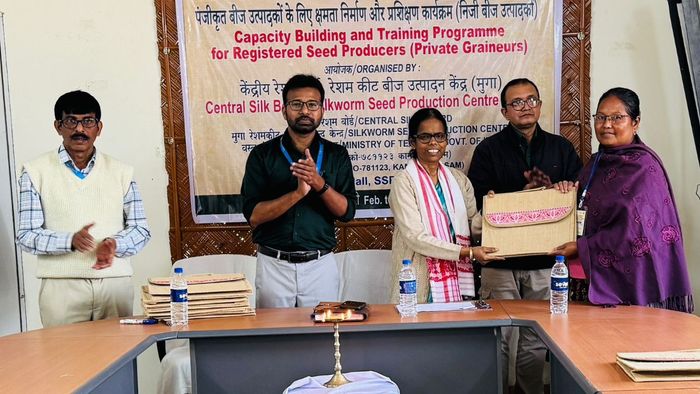
A five-day capacity-building and training programme for registered Muga seed producers was inaugurated on Monday, February 9 at the Central Silk Board’s Silkworm Seed Production Centre (Muga) at Kaliabari, Boko. The initiative aims to enhance scientific seed production practices and improve livelihoods of sericulture farmers in the region.
- Feb 10, 2026,
- Updated Feb 10, 2026, 2:03 PM IST
A five-day capacity-building and training programme for registered Muga seed producers was inaugurated on Monday, February 9 at the Central Silk Board’s Silkworm Seed Production Centre (Muga) at Kaliabari, Boko. The initiative aims to enhance scientific seed production practices and improve livelihoods of sericulture farmers in the region.
The training programme, organised by the Central Silk Board, has brought together 20 registered seed producers from different parts of the region, focusing on quality seed production, sustainable sericulture practices and field-level technological application.
The programme was formally inaugurated by Dr M. Maheshwari, Director, MESSO, who underscored the critical role of scientific Muga culture in improving seed quality and boosting productivity. Addressing the participants, he encouraged farmers to adopt modern, sustainable techniques to strengthen the Muga silk value chain and ensure long-term economic benefits.
As part of the inaugural session, Dr Manabendra Deka, Scientist-D, P3 Unit, Hahim, delivered a technical guest lecture, sharing practical insights and advanced methodologies related to Muga seed production and disease management.
The training programme is being coordinated under the guidance of Shri Dharavath Saicharan, Scientist-B and In-charge of CSB-SSPC (Muga), Kaliabari, with organisational support from Shri Nameshwar Das, Senior Technical Assistant (STA).
Training kits were distributed to all participants to support hands-on learning and facilitate effective adoption of the technologies demonstrated during the programme.