'Comrades Never Die': Artist Marshall Baruah explains the message behind the Zubeen Garg mural | Exclusive
In an exclusive conversation with India Today NE, Marshall Baruah speaks about the controversy, the criticism, his admiration for Zubeen Garg and why he believes art must never stop reflecting society.
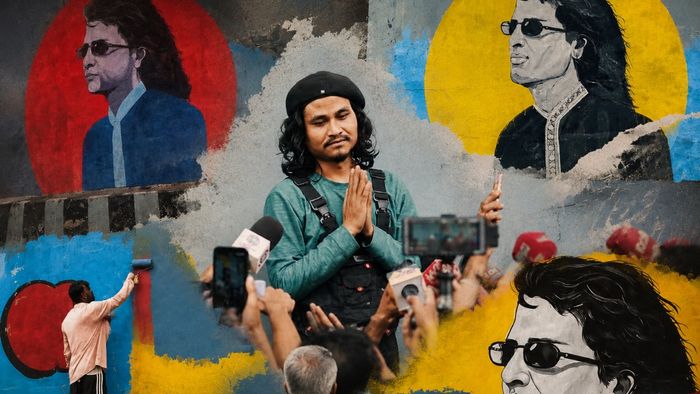
- Jun 20, 2026,
- Updated Jun 20, 2026, 5:43 PM IST
The image of Zubeen Garg staring out from a Ganeshguri flyover wall in Guwahati quickly became more than just a mural. For many, it was a reminder of the singer's enduring influence and the questions surrounding his legacy that continue to resonate with his admirers.
When authorities removed the artwork from the Ganeshguri flyover on June 18, the debate only intensified. Questions were raised over the phrase "Comrades Never Die", the place of public art in public spaces and, eventually, who should be credited for painting the mural.
Known for speaking his mind and standing up for causes he believed in, Zubeen Garg often inspired fierce loyalty among his fans. The phrase "Comrades Never Die" was seen by many as reflecting that rebellious spirit, with some admirers even drawing parallels between Zubeen and Che Guevara for his outspoken views and connection with the people.
At the centre of it all stood artist Marshall Baruah.
In an exclusive conversation with India Today NE, Baruah speaks about the controversy, the criticism, his admiration for Zubeen Garg and why he believes art must never stop reflecting society.
Q: You had said that the Zubeen Garg mural was still incomplete and that the phrase "Comrades Never Die" had not yet been written. Did anyone pressure you not to include those words?
Marshall Baruah: Many people advised me not to do it, but nobody threatened me. What matters is how a message is perceived.
In Zubeen Da's case, people were slowly forgetting the demand for justice. What happened that day proved that nobody had forgotten him. We have to keep his memory alive.
Q: Your work often engages with social issues and public conversations. What message do you hope people take away from your art?
Marshall Baruah: As an artist, I feel it is my responsibility to respond to what is happening in society. Many people told me not to paint the mural, but my question was simple: what is the problem if I draw a picture? If a Prime Minister is visiting, how does a painting harm anyone?
I had promised people that I would paint it, and people wanted it to be painted. Art does not harm anybody. A painting can never be a threat.
Q: There has been controversy over who actually painted the mural, with some claiming that artist Rishav Dutta was the real creator. What is your response?
Marshall Baruah: Whenever I paint, I invite people to join. On that day too, many people were there, including Rishav. I had met with an accident and asked him, along with others, to help complete parts of the work.
The real issue should never have been who painted it. The mural was not about me or any individual artist. It was about Zubeen Da. People gathered together, remembered him and expressed solidarity with the demand for justice. That collective participation was the most beautiful part of the entire process.
Whether someone says I painted it or someone else painted it does not matter to me. What matters is how we keep Zubeen Garg alive in public memory and continue raising questions about justice.
People are still calling me from different parts of Assam, asking me to come and paint Zubeen Da's portrait. I will continue doing that.
Q: Since graffiti and mural art are often seen as forms of public expression, how did this journey begin for you?
Marshall Baruah: I started painting graffiti around 2018–19. Art, in my view, is always dynamic; it is never static.
If you look at ancient cave paintings, people drew what they experienced, hunting, fire, daily life. Art has always reflected society. The same is true today. Whatever is happening around us will naturally find its way into art.
Q: Your art often challenges those in power and sometimes places you at the centre of controversy. Are you ever afraid?
Marshall Baruah: I love my society and I love my people. The unfortunate reality is that someone like Zubeen Da has still not received justice. If we remain silent, nothing changes.
I have done nothing wrong, so why should I be afraid? If people can do wrong without fear, why should I fear painting a picture? I simply wrote "Comrades Never Die." How can that be a wrong message?
Art has power. Whether it is music, literature, painting or dance, it should act as a mirror to society. It influences people, and that is why some are uncomfortable with it.
Q: What are your plans for the mural? When will it be completed?
Marshall Baruah: I definitely want to complete it. On that particular day, it was not possible. I had just arrived from Jorhat, there was no proper ladder and I was already dealing with a lot of anxiety.
Street art is physically demanding, and many people do not realise the circumstances in which such work is created.
Some people criticised the unfinished mural on social media and called it ugly. That did not bother me much. I believe in my abilities. What saddened me was the negativity and lack of compassion.
People should be more humane and understanding. Criticism is fine, but the mindset behind some comments was disappointing.
Q: Tell us a little about your childhood and early years.
Marshall Baruah: I was born in 1994 in Kakilaguri village in Gohpur. It is a beautiful place that still reflects the ideals of Srimanta Sankardev. There is a Namghar at the centre of the community, and hundreds of families come together there. Unlike many places today, our village remains united.
I grew up in an environment where people lived together in harmony. We swam in rivers, played outdoors and spent our days moving freely through the village.
I later studied Mass Communication at Gauhati University. But I was never deeply interested in conventional academics. I always wanted to create what my heart and soul wanted to express.
Q: Which artists have influenced your work?
Marshall Baruah: In street art, I follow Banksy closely. Pablo Picasso's Guernica has been a major inspiration. I also admire Norwegian expressionist Edvard Munch and his famous work The Scream.
Modern art inspires me because it constantly introduces new ways of thinking. It reflects shifts in society and encourages self-awareness.
Q: What does art mean to you personally?
Marshall Baruah: For me, art is a mirror of society. It gives shape to people's thoughts, emotions and realities.
Art must belong to its time. It should reflect the world around us and help society see itself more clearly.
Q: On the occasion of Bishnu Rabha Divas, what message would you like to share with the people of Assam?
Marshall Baruah: Bishnu Rabha was a great artist, a visionary and a source of inspiration. He is one of the figures I deeply admire.
His ideas, principles and way of thinking continue to guide us. On Rabha Divas, I would simply say that we must work together to keep his ideals alive.