Filmmaker Utpal Borpujari’s ‘Manuhar Gaan’ explores the social, socio-political voice of Bhupen Hazarika
The documentary seeks to introduce non-Assamese and non-Bengali audiences to the larger body of Hazarika’s work and the ideas, historical events and social realities that shaped his music.
- Aug 24, 2026,
- Updated Aug 24, 2026, 8:28 PM IST
While much of India knows Bharat Ratna Dr Bhupen Hazarika as a legendary musician, his deeper engagement with social and political realities remains less familiar beyond Assam and Bengal, filmmaker Utpal Borpujari says.
It is this lesser-known dimension of Hazarika’s work that Borpujari seeks to explore in his 82-minute documentary Manuhar Gaan (The Hum of Humanity), as Assam prepares to mark the finale of the singer-composer’s birth centenary this September.
“While entire India knows him as a great musician, except for his ‘Dil Hoom Hoom Kare’ and ‘Ganga Behti Ho Kyon’, very few outside Assam and Bengal know the depth of his social commitment as an artiste,” Borpujari said, explaining the motivation behind the film.
The documentary seeks to introduce non-Assamese and non-Bengali audiences to the larger body of Hazarika’s work and the ideas, historical events and social realities that shaped his music.
Borpujari said the idea for the film was also influenced by his years in Delhi, where he found that Hazarika was often known outside Assam and Bengal through only a handful of songs.
“There was much more about the legendary musician that audiences outside the two regions needed to know,” he said.
Manuhar Gaan examines how several of Hazarika’s songs chronicled social injustice, historical events and the realities of their times, while giving voice to marginalised and downtrodden communities.
The documentary brings together Hazarika’s associates, musicians, scholars, journalists and grassroots singers to examine the continuing impact of his music across generations.
Among those featured are the late Dr Dilip Kumar Datta, author of Bhupen Hazarikar Geet Aru Jiwan Rath; Hazarika’s late sister Sudakshina Sarma; his nephew Hrishiraj Sarma; close associates Ratna Ojah and Dilip Hazarika; and musicians Kamal Kataki and Rupam Talukdar, who performed with Hazarika for several years.
Singer-author Loknath Goswami, singers Nayan Axom Koliaboriya, Asha Sarmah Kataki, Bipul Kathar and Ranjan Kumar Dutta, and journalist-author Dr Samudra Gupta Kashyap also feature in the documentary.
The film also records grassroots voices, including singer Manik Chandra Bordoloi of Boko, Molan Gogoi of Dhalpur village near North Lakhimpur and child singer Chaokhun Gogoi of Sivasagar.
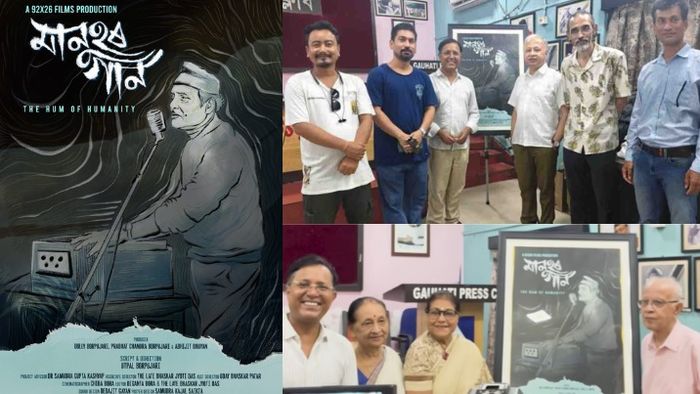
The poster and trailer of the documentary were released on August 22 by singer and president of the Dr Bhupen Hazarika Cultural Trust, Manisha Hazarika.
Borpujari said the film seeks to address, in its own limited way, the gap in how Hazarika’s work is understood outside Assam and Bengal.
“This film strives to fill that gap in its own small way, even though we are fully aware that only one film cannot do justice to the huge expanse of his creative genius,” he said.
The documentary took eight years to complete. A major portion of the filming was carried out in 2018, while the remaining portions were shot last year as the makers continued editing the large volume of footage. Funding difficulties during and after the COVID-19 pandemic contributed to the delay.
Produced by Dolly Borpujari, Prabhat Chandra Borpujari and Abhijit Bhuyan under the banner of 92X26 Films, Manuhar Gaan is positioned as an academic documentary examining Hazarika’s humanist legacy in his birth centenary year.
The trailer and poster launch on August 22 was followed by a panel discussion on whether the breadth of Hazarika’s creativity has been adequately shared with audiences outside Assam.
The makers also plan to release unused footage, including portions of interviews that could not be included in the final film, on YouTube, making the material accessible to academics, researchers and others interested in Hazarika’s music and legacy.
The film’s crew includes Chida Bora as cinematographer, the late Bhaskar Jyoti Das as associate director-editor, Diganta Bora as editor, Debajit Gayan on sound design, Uday Bhaskar Patar as assistant director and Rituraj Shivam as second-unit cameraman. The evocative poster has been designed by Samudra Kajal Saikia.
Watch the Youtube video here: