From a mother’s breast milk to a CBSE class 10 textbook: The story of Assam’s baby civet Bhakat
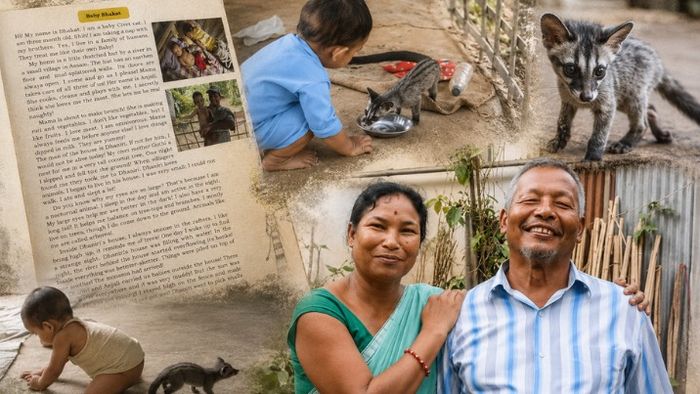
In a modest home in Assam’s Kampur, a tiny wild animal once cried through the night, hungry and helpless. Its eyes had not yet opened. Barely two weeks old, the orphaned baby civet seemed unlikely to survive. Seventeen years later, that same story is being read by lakhs of students across India as part of the CBSE Class 10 curriculum under the title Baby Bhakat.
- Jun 16, 2026,
- Updated Jun 16, 2026, 6:45 PM IST
In a modest home in Assam’s Kampur, a tiny wild animal once cried through the night, hungry and helpless. Its eyes had not yet opened. Barely two weeks old, the orphaned baby civet seemed unlikely to survive.
Seventeen years later, that same story is being read by lakhs of students across India as part of the CBSE Class 10 curriculum under the title Baby Bhakat.
For Dharani Saikia, known across the greater Kampur region as the "Forest Man", and his wife Anjali Saikia, the inclusion of their story in a national textbook is both surprising and emotional.
"We never imagined that our story would one day be printed in a school textbook," Anjali Saikia says with a smile.
The story began in 2009 when Dharani Saikia and his elder son rescued an orphaned baby civet. The animal was only 14 to 15 days old, and its eyes had not even opened.
At the time, the Saikias were raising their seven-month-old son. The family knew the chances of survival for the tiny animal were slim.
Someone from the Forest Department informed Dharani that human milk was far closer in composition to the mother's milk required by the baby civet than cow's milk. If the animal could be fed human milk for a few months, it might survive.
"I brought him home and asked my wife if she could feed him," Dharani recalls.
Anjali was hesitant at first.
"I did not feel comfortable initially," she says. "Then my elder son told me, 'Mother, if the baby dies after we brought him home, we will never forgive ourselves. If you can feed him, please do it and save his life.'"
One day, when nobody was around, she decided to try.
"The little one was crying out of hunger. I tried feeding him, and he immediately started drinking milk. At that moment I felt relieved. I thought, now this baby is going to live."
For the next three months, Anjali breastfed the baby civet alongside her own child.
Soon, the rescued animal became inseparable from the family.
"When my younger son came to me for milk, Bhakat would come too," she laughs.
The family named the civet "Bhakat." The name itself came from their younger son, who had just begun speaking.
"He could not pronounce properly and would call him 'Bhotot, Bhotot.' Eventually, we started calling him Bhakat, and the name stayed."
Bhakat was unlike any pet.
He slept most of the day, followed family members wherever they went, and demanded attention whenever he felt ignored.
"If I was writing something or talking to someone and not paying attention to him, he would not allow me to continue. He always wanted to be involved," Dharani recalls.
At night, Bhakat slept between the family's two sons.
Tea and biscuits quickly became his favourite treats.
"He could be sleeping anywhere in the house, but the moment he heard the sound of cups or utensils, he would wake up and come running for tea and biscuits," Anjali says. "Whenever we had tea, we had to give him some too."
Over time, Bhakat stopped being a rescued animal and became another child in the family.
"I had two sons before Bhakat came," Dharani says. "After he arrived, we had three."
Watch the video story on our Youtube channel here:
The bond between the civet and the family caught the attention of a visiting journalist-photographer from Delhi named Romal. He stayed with the family for several days, documenting their unusual relationship.
Years passed, and life moved on.
Bhakat stayed with the family for about eight months before eventually returning to the wild.
"One day he left with a female civet," Dharani says.
The story might have ended there.
But years later, the Saikias received an unexpected surprise.
Their son, then studying in Class 10, was reading his textbook when he noticed something familiar.
"At first he thought it looked like our story," Anjali recalls. "Then he saw our names and his father's name. He came home excited and told us he had a surprise."
The family opened the book and discovered that Baby Bhakat had become part of the CBSE curriculum.
"We were overwhelmed with happiness," Anjali says. "We never imagined that people across the country would read about our family and Bhakat."
For Dharani Saikia, however, the greatest reward is not recognition.
"If one crore students read this lesson and even ten percent of them develop love and compassion for wildlife, that will be the biggest award for us," he says.
After more than four decades of rescuing animals and protecting nature, Saikia hopes the story teaches children a simple lesson: wild animals deserve kindness too.
"I hope everyone learns to love animals and treat them with compassion," he says.
For the Saikia family, Bhakat may have left years ago, disappearing into the forests with a companion of his own. Yet his story continues to live on, inside classrooms, inside textbooks, and in the hearts of those who learn that sometimes, saving a wild animal begins with treating it like family.