Himanta asks IIT Guwahati to lead technology-driven transformation of Northeast
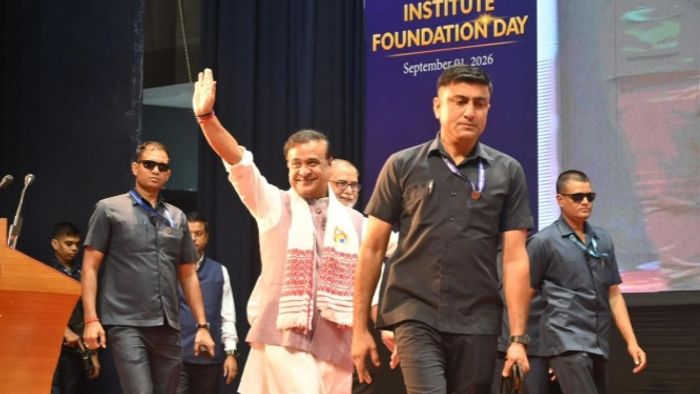
Assam Chief Minister Himanta Biswa Sarma on Tuesday, September 1, called upon IIT Guwahati to take a leading role in driving technology-led transformation across the Northeast, saying the institute's contribution should extend beyond academic and research achievements.
- Sep 01, 2026,
- Updated Sep 01, 2026, 10:45 PM IST
Assam Chief Minister Himanta Biswa Sarma on Tuesday, September 1, called upon IIT Guwahati to take a leading role in driving technology-led transformation across the Northeast, saying the institute's contribution should extend beyond academic and research achievements.
Speaking at the 33rd foundation day programme of IIT Guwahati, Sarma said the institute represented the aspirations of the people of Assam and the Northeast and had a larger responsibility towards the region.
He recalled that the demand for an IIT in Assam was an important part of the aspirations articulated during the Assam Accord. IIT Guwahati was eventually established in 1994, 43 years after the country's first IIT was set up at Kharagpur in West Bengal.
Sarma said the true contribution of IIT Guwahati would be measured by its ability to translate knowledge and research into solutions to challenges faced by the people.
He identified advanced manufacturing, healthcare, skilling, disaster resilience, urbanisation, agriculture and emerging technologies as areas where the institute could make a greater impact.
Highlighting the ongoing collaboration between the state government and IIT Guwahati, the chief minister cited projects involving the Assam Advanced Healthcare Innovation Institute, low-field MRI, surgical robotics and plant-based therapeutics.
He also referred to semiconductor skilling initiatives, drone-based flood response and the use of artificial intelligence for alternative credit assessment of women-led enterprises.
Sarma said Assam's emerging industrial landscape, particularly in semiconductors and advanced manufacturing, would require sustained investment in human capital.
"Our young people should not merely witness the arrival of new industries, they should become active participants in the knowledge, technology and supply chains that these industries create," he said.
He urged IIT Guwahati to work on flood-resilient infrastructure, scientific river management, climate-resilient agriculture, early-warning systems and improved urban planning.
Guwahati and other emerging urban centres, he said, would require scientific solutions for mobility, public transport, drainage, waste management, energy efficiency and climate resilience.
Sarma outlined his vision for Assam's future through the convergence of "Tea, Tree and Tech", representing the state's traditional economic strength, natural and biodiversity wealth, and opportunities arising from technology, innovation and advanced manufacturing.
He also called for stronger collaboration between IIT Guwahati, the state government, industry, startups, universities, civil society and the institute's alumni.
The chief minister announced that the state government would facilitate 100 scholarships for IIT Guwahati students and asked institute Director Devendra Jalihal to work out the framework for the programme.
"IIT Guwahati's journey demonstrates that Assam need not remain constrained by the disadvantages of a late start. The task before us now is not merely to catch up. It is to build institutions and create capabilities that can help Assam move ahead with greater confidence and at greater speed," Sarma said.
Jalihal said IIT Guwahati was committed to partnering with the Assam government in transforming, industrialising and modernising the state and the Northeast.
The institute was working on areas including flood control, riverbank management, semiconductors, mineral processing, healthcare, technical education, skilling, innovation, startups and incubation, he said.