If elected President, will not allow CAA, use of agencies against Opposition: Yashwant Sinha
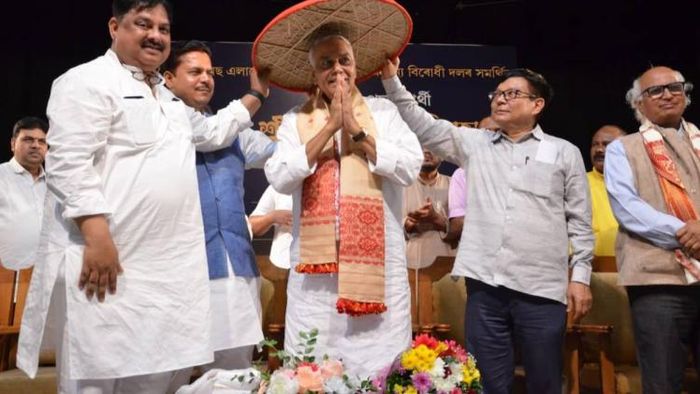
Opposition presidential candidate Yashwant Sinha landed in Guwahati yesterday to a warm reception from leaders and legislators of opposition parties in Assam, to seek support for his candidature.
- Jul 14, 2022,
- Updated Jul 14, 2022, 12:07 PM IST
Opposition presidential candidate Yashwant Sinha landed in Guwahati yesterday to a warm reception from leaders and legislators of opposition parties in Assam, to seek support for his candidature.
In a media interaction held at Srimanta Sankardeva Kalakshetra, Sinha said that he will not allow the implementation of the Citizenship Amendment Act (CAA) if elected as the next President of India.
‘’The country’s Constitution and democratic institutions are under threat. India cannot afford to have a silent President or a rubber stamp President,’’ added Sinha.
Slamming the BJP-led NDA government of forcefully imposing the Citizenship Act on the people of Assam and India, Sinha added that the rules of the CAA is yet to be framed and without the drafting of the rules as per the laws of the Parliament, the CAA cannot get a assent from the President.
‘’If anybody dares to implement CAA, then we will strongly oppose it. If I am in the Rashtrapati Bhavan, then I will not give my assent to the law. And If I am outside, then we will keep opposing ti,’’ remarked Yashwant Sinha.
Yashwant Sinha has served as a Union Minister in the Central Government and was associated with the BJP party for many decades. Sinha resigned from the BJP party because after finding the party ‘heading towards a wrong path’.
The Citizenship Amendment Act (CAA), which was enacted on December 11, 2019, aims to offer citizenship to members of the Hindu, Sikh, Buddhist, Jain, Parsi, and Christian communities who migrated to India before December 31, 2014 after experiencing persecution in Afghanistan, Bangladesh, and Pakistan. As opposed to the current norm of naturalisation after 12 years of residency, the administration intended to offer them Indian citizenship after six years.The opposition parties and various other student organisations have been opposing the BJP-led NDA government for making the CAA an agenda to marginalise Mulsims.
The lower house, where the governing BJP has majority numbers, approved the law after it was initially introduced to Parliament in July 2016. However, due to violent anti-immigrant protests in the northeast, it did not receive approval from the upper chamber at the time.