‘If I come for you, 200 people will die’: The impossible choice Nepali Khuti's Shravan Prasad faced in Assam floods
Everyone in Nepali Khuti knew how the rescue story ended. What they didn't see was the impossible choice that unfolded in the middle of the flood — one that would leave a young man wondering whether saving everyone could ever feel like enough.
Aparmita Das / Hrijoy Das Kanungo
- Aug 08, 2026,
- Updated Aug 08, 2026, 3:42 PM IST
The sign at the turn-off said "Way to Nepali Khuti." It did not prepare visitors for what came after — a road so chewed up by rain that the car gave up halfway, leaving the rest to be covered on foot, boots sinking into silt left behind by a flood that had already come and gone but hadn't finished leaving its mark.
Knee-deep water pooled in the low stretches. The mud pulled at every step, thick and brown, the kind that doesn't let go easily. Somewhere past a Hanuman temple, a young man came walking down the path. It was Samir — Shravan Prasad's younger brother, the one who had stayed home that morning while the water climbed.
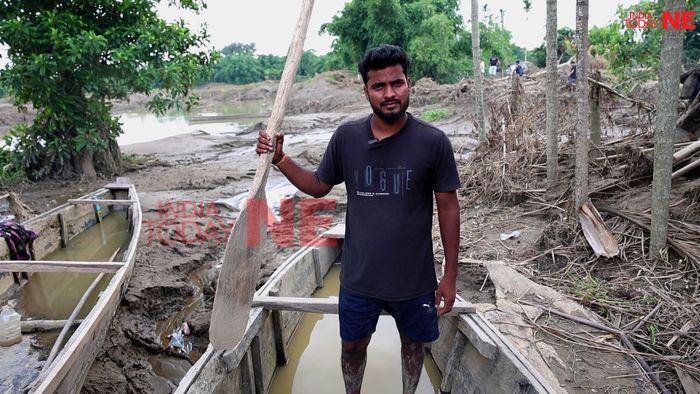
By then, it was clear Shravan Prasad had already become a name people in Sivasagar were repeating to each other. Cameras had been in and out of the village for days. One crew was leaving as another arrived, waiting its turn.
Shravan came out smiling, like none of it had touched him.
The house behind him told a different story — most of what the family owned was gone, swallowed by the Dikhow river that runs behind Nepali Khuti village, in Bihubor's Quarry No. 2. And yet the family insisted on offering bottled water, part of the relief supply they'd just received.
"Arey, I've said this so many times now, I know exactly what to say," Shravan said, laughing, when asked for the interview.
The request was simple: not the version he'd already given everyone else, but the parts he hadn't said yet — not the headline, the person underneath it.
He went quiet for a second. Then he nodded.
"Yeah," he said. "I'm ready."
Twenty-six years old, six feet of him, raised on the same riverbank he would later have to fight against— Shravan Prasad has spent his whole life reading the Dikhow the way other people read weather. He knows its moods. On the early morning of July 19, the river gave no warning it was about to break its own rules.
"It was around 3 am," he said. "I'd gone to the river with some friends, behind my house, to collect the timber that floats down when it rains. We use it for the chulha, for cooking. It had been raining all night, and the current was strong, but the river swells like that every monsoon. We didn't think anything of it. We went home."
There was no flood yet. Not at 3 am. Not even by breakfast.
"By 10:30, maybe 11, the water just rose. Fast. It came into the village before anyone understood what was happening."
He said it plainly, but something in his voice shifted — the practised calm of a man who's told this story to a dozen cameras cracking, just slightly, at this part.
ALSO READ: After father dies saving farm animals in Assam floods, daughters vow to fulfil his IAS dream
"I have lived here my whole life. I had never seen the water reach where it reached that day."
He ran home. His friends scattered toward their own houses. Shravan got his parents and his youngest brother, Prince, out first, moving them to higher ground while the water kept climbing behind him. His other brother, Samir, stayed back at the house.
"I told him — I'll drop Ma and Baba somewhere safe and come straight back. Pack whatever you can. I'll come for you."
He never made it back in time.
ALSO WATCH:
By the time Shravan turned around, the flood had swallowed the paths between houses. Samir was trapped, alone, watching the water climb the walls around him.
"He called me twenty-seven times," Shravan said. "Twenty-seven. Every time, the same thing — 'Bhaiya, paani bhori aahise. Aahi mok bosa.' The water's rising. Come and save me."
Inside that house, everything the family had built over the years — furniture, papers, the small proof of a life lived somewhere — was already floating away. The water reached Samir's neck.
And Shravan, half a kilometre away with a boat and a phone full of missed calls, had two hundred people waiting on rooftops with nowhere left to climb.
"I had to choose," he said, and here his voice dropped, slower now, like he was back in that moment rather than describing it. "My own brother was asking me to come. And I knew — if I go to him now, two hundred people don't make it."
He told Samir to find higher ground. To hold on. To save himself.
"I said, if I come for you, those two hundred people will die. I have to go to them first."
He hung up, and he went.
What followed was hours that don't fit easily into words — boats moving between submerged rooftops, water up to the shoulders of the men paddling them, no rescue teams anywhere in sight because none could get through.
"No one could reach us," Shravan said. "The rain didn't stop. The river didn't stop. We had only ourselves."
It didn't happen all at once. Shravan called one friend first, then went out alone with him while the water was still rising. Word travelled through the village faster than any of them expected — one friend brought two more, those two brought others, and within the hour a small fleet of boats had formed, each one carrying a couple of men who knew the river well enough not to be afraid of it. By evening, nearly a dozen of them were working the flooded lanes together. Boat by boat, house by house, they pulled people out — the old, the sick, anyone who couldn't move on their own — and carried them to ground the water hadn't taken yet.
"We weren't thinking about ourselves. We just kept going."
By the time the water finally settled, Shravan and his friends had pulled more than a thousand people to safety. His brother Samir, somehow, had gotten out on his own.
Ask him if he was afraid, and Shravan shakes his head.
"No. I wasn't scared. I was only thinking about how many more I could save. I grew up in this river. I know it like I know my mother. This land, this village — it's my mother too. Everyone in it is my family. I had to protect them."
ALSO READ: A torn Ramayana survives what the Assam floods could not take
One rescue has stayed with him longer than the rest. An elderly man, four family members beside him, all of them pressed onto a tin roof as the water rose to meet them. The old man kept trying to speak. Shravan, moving fast, focused only on getting them down, didn't stop to listen.
He went back the next day and asked what the old man had been trying to say.
"He told me — 'I was looking at my family. I thought that was our last moment together. Then you came, and you gave us another one.'"
Shravan repeated it quietly, like it still surprised him.
Later, he walked down to the river himself — pointed out the boats, the stretch of water where the worst of it happened. He climbed into one of the boats and sat there a moment, silent, somewhere else entirely. Not fear, exactly. More like the day had reached back and pulled him into it again.
Then the rain started, and there was a scramble for a tarpaulin shelter propped beside a house that no longer had walls to speak of. The wait for it to ease stretched on.
Before the question could even be asked, Shravan answered it.
"Don't worry," he said. "It won't happen again."
He already seemed to know what people wanted to ask him. Whether Nepali Khuti could survive this a second time.
Nobody in that village has an answer yet. The fear of another July hasn't left, and it may not for a while. What's certain is this: on one morning, a twenty-six-year-old had to choose between the brother calling his name and two hundred strangers he'd known his whole life in a different way — as neighbours, as village, as home. He chose the village. His brother lived anyway. But the choice itself — made in seconds, with no one to consult and no time to reconsider — is the story Sivasagar won't stop telling.
MORE NEWS
Read more!