If labour deserves dignity, why are the Banjaras still invisible?
The Banjaras continue to be overlooked despite their vital labour contributions. Inclusion in welfare and recognition of their rights is essential for their upliftment.
- May 01, 2026,
- Updated May 01, 2026, 12:49 PM IST
Every morning, our cities wake up because someone is already working.
The vegetable vendor arranging fresh greens under a fading umbrella.
The fruit seller shouting prices beside a crowded market road.
The delivery rider weaving through traffic with impossible speed.
The roadside utensil seller waiting patiently for customers who may never stop.
We notice the products.
We notice the prices.
But rarely do we notice the people who move endlessly to make survival possible.
Among them are the Banjaras popularly known in many places as Jajabors, the wanderers.
On this World Labour Day, while conversations revolve around factories, offices, and formal employment, there exists another workforce living under open skies, workers without fixed shops, permanent homes, or guaranteed protection.
They are the movers of India.
For generations, the Banjaras have travelled from one place to another in search of livelihood. Their movement is not random. It is a traditional economic system shaped over centuries. They come from Rajasthan, Punjab, Uttar Pradesh, Andhra Pradesh, and several other regions, carrying with them histories that stretch far beyond modern highways and marketplaces.
Long before trucks and transport companies existed, Banjaras were traders who carried goods across regions through Ladenia, the age-old practice of transporting goods on packed oxen. Historians often describe them as one of the communities that helped create “societies in circulation,” connecting distant regions through movement, trade, and exchange.
Movement was never simply migration for them.
It was identity.
It was economy.
It was survival.
But history was not kind to them.
The Criminal Tribes Act of 1871 severely restricted their itinerant way of life, branding entire communities with suspicion and limiting their traditional trade routes. Over time, many Banjaras were pushed into small-scale petty trading simply to survive.
Today, their caravans have changed into roadside tents.
They stay in one location for three or four months depending on seasonal demand or festive markets. During one season they may sell utensils, during another handmade decorative items, household necessities, toys, or daily-use products. Once the market slows, they pack everything again and move elsewhere.
A different road.
A different town.
The same struggle.
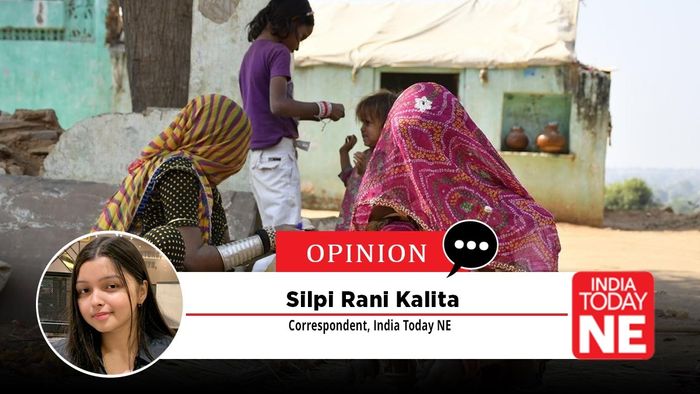
Along highways and urban corners, temporary settlements emerge quietly, tents stitched together with plastic sheets and cloth, smoke rising from makeshift kitchens, children running barefoot near piles of merchandise waiting to be sold. Entire families participate in the work. The men negotiate with customers, women manage sales while caring for children, and even the younger generation grows up learning the rhythms of mobility.
Their lives exist in transit.
Yet despite contributing to local economies, Banjaras are rarely given formal spaces to trade. There are no secure marketplaces waiting for them. No guaranteed shelters. No stable addresses.
Instead, there is constant uncertainty.
The fear of eviction.
The fear of harassment.
The fear of being told to leave overnight.
So they move. Again and again.
And perhaps the deepest cost of this movement is carried by their children.
For many Banjara families, education remains fragile and interrupted. Constant relocation means school admissions become difficult, attendance becomes irregular, and continuity disappears. Childhood often becomes divided between helping with trade and adapting to unfamiliar surroundings.
Yet there are small signs of hope.
Some children are now being enrolled in nearby village schools wherever the families temporarily settle. It may seem like a small step, but for communities historically excluded from stable systems, even temporary access to education becomes an act of transformation.
Healthcare remains another silent crisis especially for women.
Pregnant women often lack proper medical check-ups because healthcare facilities are either inaccessible, unaffordable, or unfamiliar. Awareness itself becomes a challenge when life is constantly on the move. Survival takes priority over treatment.
But beyond all the hardship lies something extraordinary: resilience.
While working on a documentary about the Banjaras in Guwahati, I encountered not just a community, but a reality that most urban lives conveniently overlook.
At first, they were hesitant.
Anxious.
Unsure whether society would judge them again.
But the moment they realised their stories would finally be heard through media, they opened up.
They spoke about their struggles, their trade systems, their journeys across states, and how they continue surviving in cities that often ignore their existence. They explained how markets determine their movement where buyers exist, where profits are possible, where survival allows them to stay a little longer.
What emerged was not a story of helplessness.
It was a story of labour in its purest form.
Because labour is not only what happens inside factories or corporate offices. Labour also lives beside roads, under tents, inside temporary markets, and across endless journeys made in search of dignity.
The Banjaras remind us that work is not always stationary. Sometimes labour walks. Sometimes it travels. Sometimes it carries its entire world on wheels and tarpaulin sheets.
And perhaps that is why they remain invisible.
Modern society celebrates settled success. Permanent homes. Permanent jobs. Permanent addresses.
But what about those whose survival depends on movement itself?
This World Labour Day, maybe the question is not whether Banjaras are workers.
The real question is why workers like them are still unseen.
Because behind every roadside stall is not merely a seller but generations of inherited labour, adaptation, displacement, and endurance.
They are not outsiders.
They are not temporary shadows in our cities.
They are workers.
They are traders.
They are families.
And like every labourer whose sweat keeps society functioning, they deserve dignity, recognition, and the right to exist without fear.