Kaziranga’s rhino habitat shaped by climate shifts and human pressure: Study
Climate shifts and human actions have reshaped the Kaziranga rhino habitat. Conservation efforts must consider both to protect this endangered species
- Feb 04, 2026,
- Updated Feb 04, 2026, 3:01 PM IST
A new scientific study has reconstructed the long-term ecological history of Kaziranga National Park, showing how climate change, vegetation shifts and human activity gradually shaped the habitat of the Indian one-horned rhinoceros.
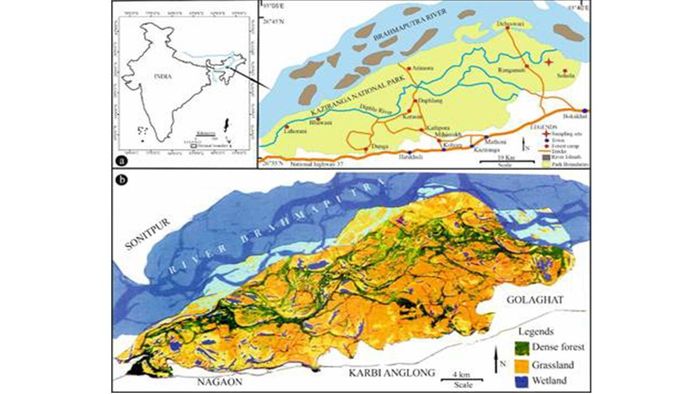
The research is based on sediment layers preserved beneath wetlands inside the park, which act as a natural archive of environmental change. By analysing pollen grains and dung-associated fungal spores trapped in these layers, scientists traced how landscapes and large herbivore populations evolved over thousands of years.
Researchers from the Birbal Sahni Institute of Palaeosciences, an autonomous institute under the Department of Science and Technology, extracted a sediment core measuring just over a metre from the Sohola swamp within Kaziranga. Each layer provided evidence of past vegetation, climate conditions and the presence of megaherbivores.
The study, published in the journal Catena, found that Kaziranga’s present-day grassland and wetland landscape is markedly different from its past. It also documents the regional extinction of megaherbivores, including the Indian rhinoceros, from northwestern India during the late Holocene, a period marked by climatic changes and rising human activity, particularly during the Little Ice Age.
In contrast, northeastern India experienced relatively stable climatic conditions over the past 3,300 years and lower levels of human pressure. This stability enabled rhinoceroses and other large herbivores to migrate eastwards and eventually concentrate in Kaziranga, which is now a UNESCO World Heritage Site and a global stronghold for megaherbivores.
According to the Ministry of Science and Technology, fossil evidence shows that the Indian one-horned rhinoceros was once widely distributed across the subcontinent. Habitat loss, climate deterioration and overhunting in other regions gradually reduced this range, confining the species largely to Kaziranga.
The findings come at a time when nearly 60 per cent of large herbivore species worldwide face the threat of extinction, with Southeast Asia recording the highest number of at-risk species. Scientists say the long-term ecological insights from Kaziranga can help guide more effective conservation and wildlife management strategies as climate change and human pressures continue to intensify.