Meet the Assam engineer behind India's first privately developed orbital launch vehicle
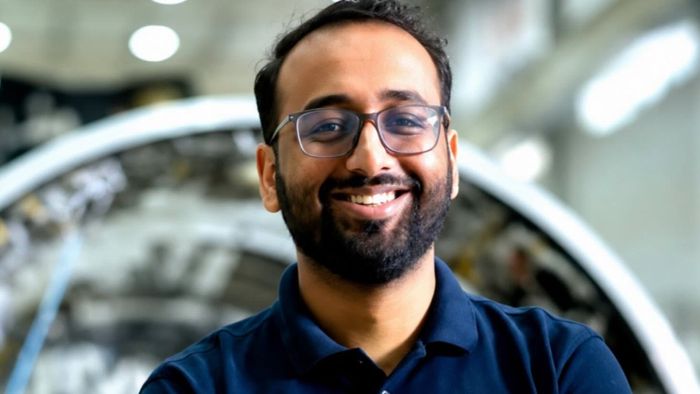
Assam has carved out a place in India's space history with Ved Prakash, a young aerospace engineer from Guwahati, playing a pivotal role in the successful development and launch of Vikram-1, the country's first privately developed orbital-class rocket built by Hyderabad-based space-tech startup Skyroot Aerospace.
- Jul 21, 2026,
- Updated Jul 21, 2026, 9:43 PM IST
Assam has carved out a place in India's space history with Ved Prakash, a young aerospace engineer from Guwahati, playing a pivotal role in the successful development and launch of Vikram-1, the country's first privately developed orbital-class rocket built by Hyderabad-based space-tech startup Skyroot Aerospace.
A Mission and Guidance, Navigation and Control (GNC) Engineer at Skyroot Aerospace, Ved is the only Assamese member of the team behind the historic mission. He has been associated with the ambitious project for the past four years and was among the principal contributors to the launch vehicle's highly sophisticated Guidance, Navigation and Control (GNC) system.
Vikram-1 was successfully launched on July 18, 2026, marking a watershed moment for India's private space sector. The mission made India one of the few nations with a successful privately developed orbital launch capability, significantly boosting the country's growing commercial space ecosystem.
The son of former Oil India Limited Director (Exploration & Development) Dr Manas Sarma and Bintyma Sarma, Ved was born in Guwahati and grew up in Duliajan, where his fascination with space began at a young age.
As one of the key engineers on the mission, Ved worked extensively on the guidance algorithms and onboard flight software that enabled Vikram-1 to accurately navigate its trajectory and achieve its intended orbit around Earth.
The GNC system is among the most critical components of any launch vehicle, integrating advanced physics, mathematical modelling, control theory and indigenous software to continuously monitor the rocket's position, velocity and orientation throughout its flight. The flawless performance of the system during Vikram-1's maiden mission played a crucial role in the rocket's successful orbital insertion.
Ved completed his B.Tech in Mechanical Engineering from KIIT University before pursuing a Master's degree in Aerospace Engineering at Iowa State University in the United States. Although he began a PhD in Aerospace Engineering during the COVID-19 pandemic, he decided to return to India to pursue his dream of contributing directly to the country's space programme.
He joined Skyroot Aerospace in 2022 as a Mission and GNC Engineer, becoming part of a team working to redefine India's role in the global commercial space industry.
According to Skyroot Aerospace, Vikram-1 is a four-stage, expendable orbital small-lift launch vehicle designed to place satellites into Low Earth Orbit (LEO) and carry out dedicated commercial satellite missions. The rocket's first three stages use solid propulsion, while the fourth stage is powered by a liquid engine, enabling precise orbital insertion.
The maiden mission, named Aagaman, also carried a special symbolic payload—a postcard written by Prime Minister Narendra Modi, commemorating the historic flight.
Founded in 2018, Skyroot Aerospace has rapidly emerged as one of India's leading private space companies, focusing on developing cost-effective launch vehicles for the global satellite launch market. The successful Vikram-1 mission is widely regarded as a defining milestone for India's private space sector, demonstrating the country's growing technological capabilities and strengthening its position in the international space industry.
For Assam, Ved Prakash's achievement represents a moment of immense pride. His contribution to India's first successful private orbital launch underscores the growing role of talent from the Northeast in cutting-edge science and technology and adds a new chapter to the state's legacy of producing professionals making a global impact.