‘Mindset that celebrated Bapu’s killing’: Gaurav Gogoi on Bill removing Gandhi’s name from MGNREGA
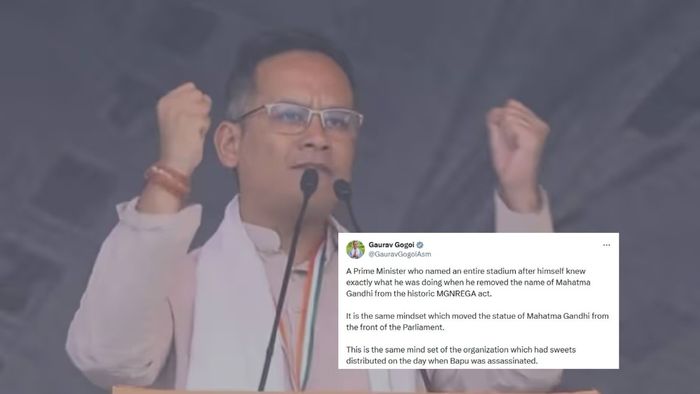
Assam Congress MP Gaurav Gogoi accused the Narendra Modi government of deliberately trying to erase Mahatma Gandhi’s legacy, saying the decision to remove Gandhi’s name from the rural jobs law reflected a deeper ideological mindset.
- Dec 17, 2025,
- Updated Dec 17, 2025, 3:12 PM IST
Assam Congress MP Gaurav Gogoi accused the Narendra Modi government of deliberately trying to erase Mahatma Gandhi’s legacy, saying the decision to remove Gandhi’s name from the rural jobs law reflected a deeper ideological mindset.
“A Prime Minister who named an entire stadium after himself knew exactly what he was doing when he removed the name of Mahatma Gandhi from the historic MGNREGA Act,” Gogoi said in a post on X. He linked the move to earlier decisions, adding that it was “the same mindset which moved the statue of Mahatma Gandhi from the front of the Parliament” and one that had even “had sweets distributed on the day when Bapu was assassinated”.
His remarks came as the Union government on December 16, 2025, introduced a new law in the Lok Sabha to replace the two-decade-old Mahatma Gandhi National Rural Employment Guarantee Act. The proposed legislation, titled the Viksit Bharat Guarantee for Rozgar and Ajeevika Mission (Gramin) or VB-G RAM G Bill, 2025, triggered strong protests from the Opposition.
Soon after the Bill was tabled, Opposition MPs walked out of the Lok Sabha chamber and marched to Mahatma Gandhi’s statue within the Parliament complex. They demanded that the proposed law be sent to a parliamentary committee for detailed scrutiny, arguing that removing Gandhi’s name undermined both the spirit and the history of the rural employment programme.
Defending the government’s move, Union Rural Development Minister Shivraj Singh Chouhan said the Modi government had done more for villages than previous administrations. “We not only believe in Mahatma Gandhi but also follow his principles,” he told the House. He said the new framework aimed to fully develop villages and create a balance between agriculture and labour.
Chouhan maintained that the Bill was consistent with Gandhian values, stating that it was “meant to establish Ram Rajya” and aligned with what he described as Gandhiji’s sentiments. Despite the assurance, the Opposition continued to press its demand for wider consultation, warning that the replacement of MGNREGA marked a significant shift in rural welfare policy.