Nepali Khuti: The Assam village that lost everything in the worst flood in half a century
Assam's July floods devastated Nepali Khuti, sweeping away homes, cattle and livelihoods in a night. The collapse of its dairy economy has left the village facing a long and uncertain recovery.
- Aug 02, 2026,
- Updated Aug 02, 2026, 8:57 PM IST
Floods are an annual reality in Assam, but the deluge that struck the state in July this year has left behind devastation on a scale unseen in decades.
Triggered by incessant rainfall and overflowing rivers, the floods claimed at least 82 lives across the state and affected more than seven lakh people. Hundreds of villages were inundated, forcing lakhs of families into relief camps as homes, roads, bridges, schools and farmlands disappeared under water. Even as floodwaters recede, the struggle for survival continues, with thousands grappling with destroyed livelihoods, damaged infrastructure, shortages of drinking water and the threat of disease.
Among the worst-hit settlements is Nepali Khuti, a small village under Nazira in Sivasagar district, where the flood has all but erased decades of hard-earned prosperity.
Located around 12 kilometres from Nazira town, Nepali Khuti was once known as one of Upper Assam's most prosperous dairy villages. Home to nearly 150 Gorkha families, the village depended almost entirely on dairy farming. Every morning, hundreds of litres of milk produced here were supplied to Nazira and neighbouring towns, making cattle the backbone of the local economy.
For the villagers, cows were far more than livestock. They represented years of hard work, financial security, children's education, healthcare and hopes for a better future.
That future was washed away on the night of July 19.
As relentless rain lashed Upper Assam, floodwaters entered the village with terrifying speed. Within hours, homes were submerged, roads disappeared and families scrambled onto rooftops and trees to save themselves. In the darkness, they watched helplessly as their homes, belongings and cattle were swept away by the raging waters.
For many, the most painful memory is not the destruction of their homes, but the inability to save the animals that sustained their lives.
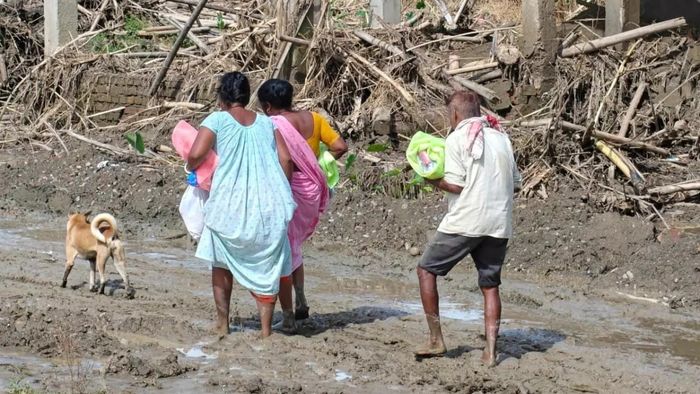
Nearly two weeks later, Nepali Khuti resembles a disaster zone.
Thick layers of mud blanket the village while the air is filled with the unbearable stench of decomposing cattle. Animal carcasses lie scattered across fields and village roads, making movement difficult and raising fears of disease outbreaks.
Many residents could only return to their homes five days after the floodwaters began receding. An elderly woman pointed to the roof of her house, recalling how her family remained stranded there for days before rescue teams reached them. Similar stories echo across the village, with families recounting long hours of fear, uncertainty and helplessness as the waters swallowed everything around them.
According to residents, nearly 70 of the village's 150 houses have either been completely washed away or rendered uninhabitable. The homes still standing bear the scars of the disaster.
Furniture lies buried beneath layers of mud. Vehicles remain trapped inside sludge-filled garages. Jewellery, kitchen utensils, schoolbooks and treasured family photographs are scattered among the debris. Important documents—including land records, educational certificates, ration cards and identity papers—have been destroyed, adding yet another challenge to rebuilding their lives.
The greatest blow, however, has been the collapse of the village's dairy economy.
Residents estimate that nearly 1,500 dairy cattle were lost in the floods, causing losses of approximately Rs 15 crore. For a community almost entirely dependent on milk production, the loss extends far beyond financial calculations. Every animal represented years of investment and a family's only reliable source of income.
Without their cattle, hundreds of families now face an uncertain future with little means to earn a livelihood.
The human toll has been equally devastating.
Seven villagers lost their lives, while residents fear more bodies may still remain buried beneath thick layers of mud. Young men continue digging through the sludge in search of valuables, important documents and anything that can be salvaged. In many cases, however, they recover only painful reminders of lives that have been swept away.
The tragedy unfolding in Nepali Khuti reflects the broader humanitarian crisis across Assam.
Thousands of flood-affected families remain displaced. Crops have been destroyed, schools continue to function as relief camps and damaged roads have left several villages cut off from the outside world.
For the people of Nepali Khuti, however, the challenge extends far beyond rebuilding houses.
Homes can eventually be reconstructed. Roads can be repaired. Compensation may arrive. But rebuilding a thriving dairy economy, restoring financial stability and reclaiming a sense of normalcy will take years—perhaps even generations.
Once celebrated as one of Assam's prosperous dairy villages, Nepali Khuti today stands as a stark reminder that behind every flood statistic lies a community whose dreams, livelihoods and future can disappear in a single night.
As Assam begins its long journey towards recovery, the story of Nepali Khuti is both a testament to the devastating power of nature and the extraordinary resilience of people determined to rebuild their lives from the ruins.