The 10 bureaucrats behind Himanta Biswa Sarma’s high-speed governance machine
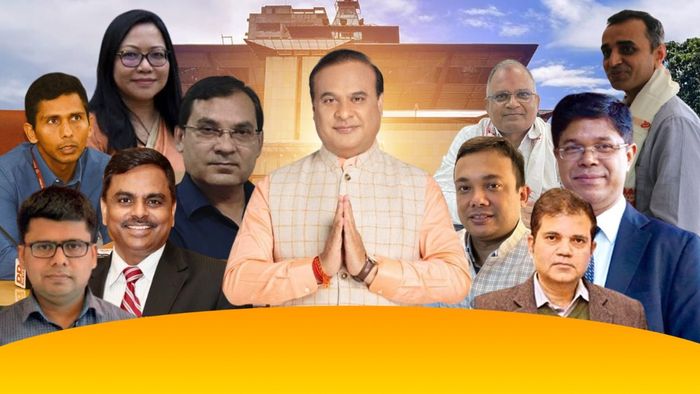
Himanta Biswa Sarma may dominate Assam’s political stage, but who really keeps his government running at breakneck speed? Behind the chief minister’s relentless drive operates a discreet circle of ten powerful bureaucrats. Who are they and how much power do they wield?
- Mar 07, 2026,
- Updated Mar 07, 2026, 10:48 PM IST
Few chief ministers in India today command the kind of visibility, authority and political bandwidth that Himanta Biswa Sarma does. Combative in politics, restless in governance and meticulous in administration, the Assam Chief Minister has emerged as one of the most recognisable political figures from the Northeast on the national stage. Yet behind the image of a hyper-active leader who appears to personally steer almost every policy conversation lies a tightly knit bureaucratic network, a small but powerful group of officers who quietly translate Sarma’s vision of a “New Assam” into administrative reality.
Sarma's style is legendary: hands-on to the point of micro-managing, decisions snapped like whip-cracks, and a restless energy that keeps departments on their toes. From the Assam Micro Finance Incentive and Relief Scheme lifting thousands from debt traps to a medical college boom that's added over a dozen institutions in mere years, his imprint is unmistakable. This blend of street-fighter politics and clockwork efficiency has paid off big.
The approach appears to have resonated with the electorate. In the August 2025 edition of the India Today Mood of the Nation (MOTN) survey, Sarma emerged as the best-performing chief minister among India’s larger states. Around 44.6 per cent of respondents in Assam expressed satisfaction with his governance, placing him ahead of Vishnu Deo Sai, Hemant Soren, Bhupendra Patel and Yogi Adityanath in the rankings of states with more than ten Lok Sabha seats.
But if Sarma’s leadership often appears to be a one-man show, the machinery of governance in Assam is powered by a cluster of senior bureaucrats who form the backbone of the administration.
The administrative axis
The first name that crops up is Ravi Kota, the state’s Chief Secretary, the iron core of governance. A 1993-batch IAS officer, Kota took charge on April 1, 2024, and is widely regarded within bureaucratic circles as the institutional anchor of the government. Known for his strict adherence to procedure and low-profile working style, Kota often plays the role of the rule-keeper in a system driven by fast political decision-making. For Sarma, who is known to operate at speed and often with political instinct, Kota provides the counterbalance, ensuring that administrative processes remain intact and legally sound.
If Kota represents continuity and institutional discipline, Krishna Kumar Dwivedi serves as the operational nerve centre of the Chief Minister’s Office. A 1996-batch IAS officer, Dwivedi functions as Sarma’s closest administrative aide. He is often described as the Chief Minister’s “24-hour interface” with the bureaucracy, coordinating between departments, executing directives and ensuring that decisions move swiftly through the administrative pipeline.
Financial governance, meanwhile, rests significantly with Jayant Narlikar, a 2003-batch IAS officer who heads key financial processes in the state government. As Commissioner and Secretary in the Finance Department, Narlikar oversees fiscal approvals, budgetary frameworks and financial structuring for major schemes. In a government known for ambitious infrastructure projects and welfare expansion, his role in financial calibration has become central to policy execution.
The chief minister remains in near-daily communication with Kota, Dwivedi and Narlikar, the administrative axis that keeps the government’s policy engine running.
The wider governance network
Beyond this core, several senior officers form the “pillars” of Sarma’s governance structure.
Among them is Ajay Tiwari, who oversees the politically sensitive Home and Political Department, crucial in a state that continues to navigate complex security and ethnic issues.
In the healthcare sector, P Ashok Babu plays a central role in implementing the government’s aggressive expansion of medical infrastructure, including new medical colleges and hospital upgrades across the state.
Revenue administration and disaster management, critical in flood-prone Assam, are handled by L Sweety Changsan, a 1994-batch officer with long experience in the state’s administrative machinery.
Industrial policy, another cornerstone of Sarma’s economic agenda, falls under J B Ekka, currently serving as Additional Chief Secretary to the Government of Assam for the Industries and Commerce Department, oversees efforts to expand manufacturing, hydrocarbons and emerging sectors.
In the education sector, Om Prakash has drawn national attention for leading the digital governance platform “Shiksha Setu AXOM”, an initiative that earned the Prime Minister’s Award for Excellence in Public Administration in 2024.
Tourism and government communication, both key to Assam’s rising national profile, are driven by Padmapani Bora. Bora, who also heads the Assam Tourism Development Corporation, has been instrumental in expanding tourism campaigns and managing the state’s public narrative. More importantly, Bora is responsible for the fund management of the Assam government’s various initiatives such as Chief Minister's Atmanirbhar Asom Abhijan, Assam and Mukhyamantri Mahila Udyamita Abhiyan and also of Assam Infrastructure Financing Authority. In a politically driven environment, this role makes Bora, an Indian Revenue Service official, a critical cog in Sarma’s universe.
There are few other officials, who continue to wield influence even after retirement. One such figure is M K Yadav, former Principal Chief Conservator of Forests and Head of Forest Force. Reappointed by the state government as Special Chief Secretary (Forest), Yadav remains a key adviser on wildlife conservation and environmental policy, areas particularly sensitive in a biodiversity-rich state like Assam.
The vision of a “New Assam”
Together, this network of administrators forms the operational backbone of Sarma’s governance project. His long-term vision, often described as the blueprint for a “New Assam”, seeks to transform the state into one of India’s most economically dynamic regions over the next two decades.